
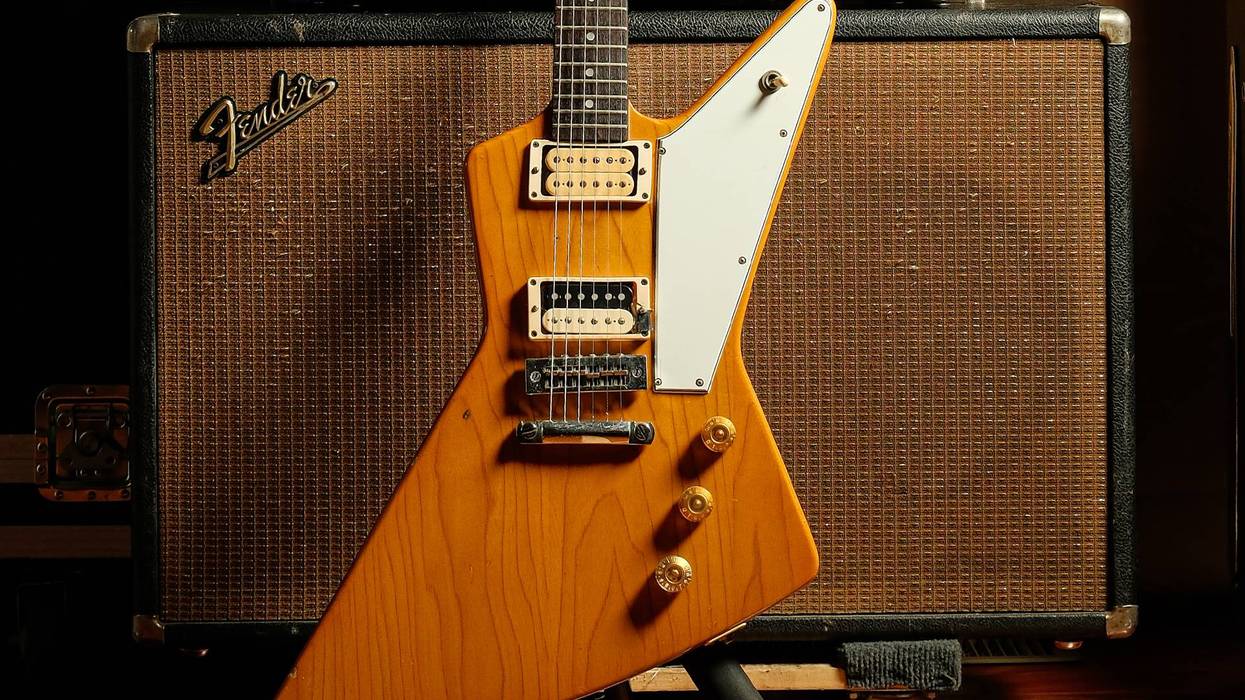

In the not-so-distant past, it wasn’t just Epiphone that was inspired by Gibson. Ibanez’s *1976 catalog, Golden Oldie Electric Guitars, prominently featured two familiar “korina” beauties: No. 2459 (later the Destroyer, but clearly an Explorer copy) and No. 2387CT (a Flying V later called a Rocket Roll/Custom, and now Rocket Roll Sr.). Inside this catalog you’ll find the Ibanez version of just about every now-iconic American-made vintage electric guitar.
This copycat approach wound up sparking a legal battle in the U.S., of course, but Ibanez clearly read consumer demand better than American manufacturers did at the time. Ibanez went even deeper into the classics, down to F-5-style mandolins, and put Bill Monroe on the cover of its folk instrument catalog, no less. Gibson, meanwhile, barely showed any mandolins. Gibson’s 1978 full-line electric catalog does include a range of Les Pauls and SGs, but you’ll also find the RD series, the L-5S and L-6S, and the Grabber bass, set against the slogans “Quality/Prestige/Innovation” and “Yesterday/Today/Tomorrow.” In hindsight, though, Ibanez did a much better job with Gibson’s “yesterday” than Gibson did.
This isn’t to say Ibanez was building classic American models in a top-of-the-line manner at the Fujigen factory. Even with great fit and finish, the cost-cutting 1970s mentality was in play in Japan too, and Ibanez often used birch tops and thinner, multi-piece solid bodies. They also put a nice spin on bolt-on neck construction by calling it a “detachable neck.” Gibson made pancake bodies and the like during this era, but also produced some extra-fancy Les Paul models like the Recording and Artisan, and even “The Les Paul” (not to be confused with the very basic “The Paul”) with maple body and highly figured maple top, hand-carved rosewood parts and as much gold-plated hardware as possible. While Gibson missed the mark a bit, they inched closer to nailing down demand from a higher-end customer base, one that still exists today.
Ibanez launched the Destroyer in 1975. The ash body, finished in a natural stain meant to look like “African korina,” has striking grain and pairs well with the dark rosewood fingerboard. This 1976 example has been modified over the years, but it’s still a strong player. The pickups have been swapped for a vintage DiMarzio PAF in the neck and a vintage Seymour Duncan JB in the bridge. The pickguard has been altered, and there’s a replacement 1970s Gibson “harmonica” bridge (Ace Frehley style!). In the ’70s, Gibson added a volute to its headstocks to address an already common problem: breaks. The Destroyer, Ibanez’s take on the Explorer, went a different route, with a shallower headstock angle and internal reinforcement. After seeing countless broken and repaired Gibson headstocks, I find those changes to a classic design very reassuring.
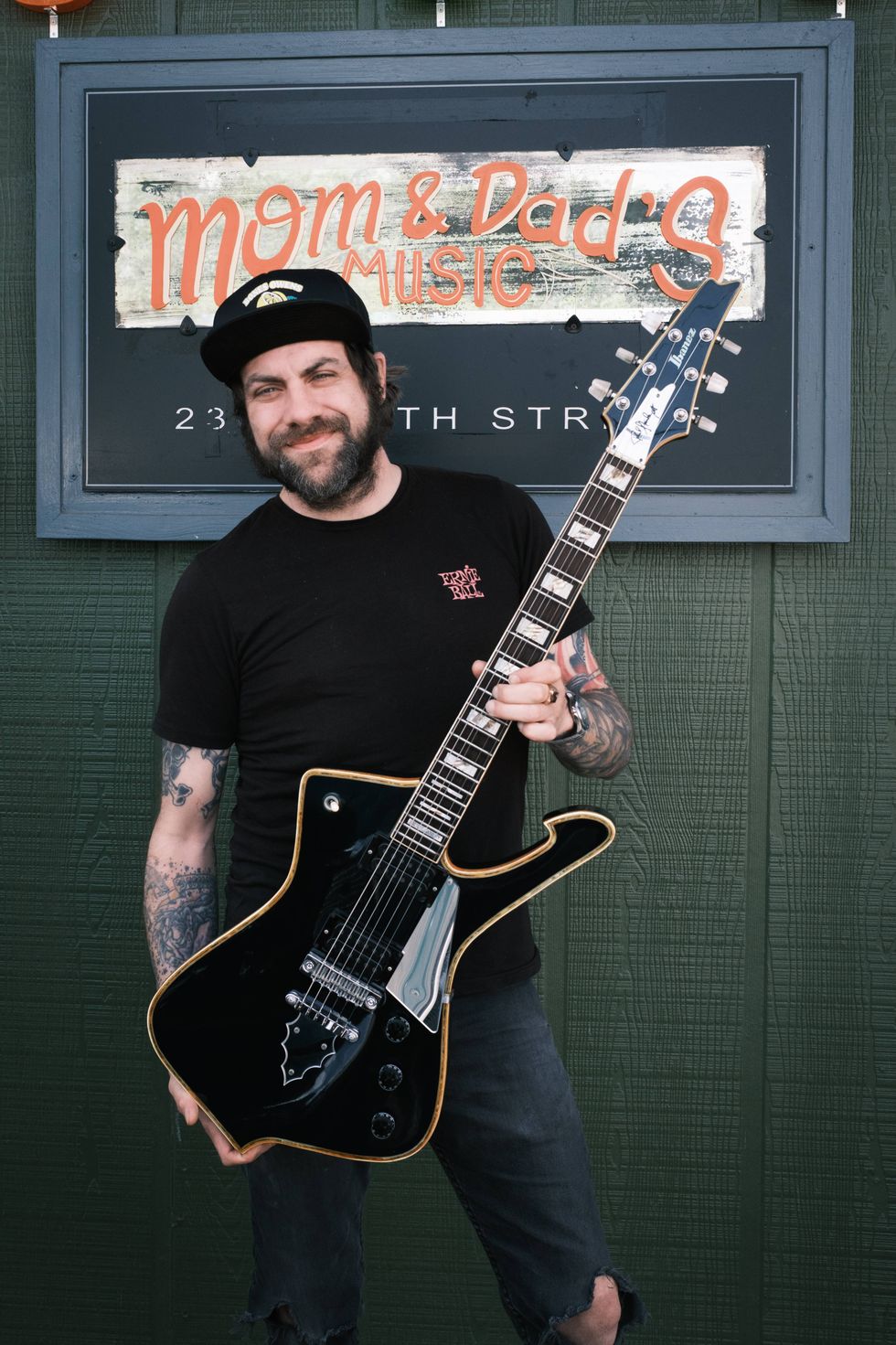
Lloyd Nicely with the 1978 Ibanez PS10
Creativity, litigation, or a healthy dose of both seems to have pushed Ibanez to design and build its own now-iconic ’70s models. The Destroyer was decidedly inspired by Gibson. The Iceman was just plain inspired, and it still is to look at one, vintage or modern. It didn’t start out as a signature model, but Ibanez’s Iceman collaboration with Paul Stanley is the stuff of teenage guitar players’ dreams, and the Kiss Army’s ranks don’t seem to have thinned much in the 21st century. We’ve had several Iceman models come through the shop in recent years. We sold a 1978 PS10 to our friend David: a guitar player, hard-working UPS driver, and inarguably one of the biggest Kiss fans in town. The guitar is older than he is. It’s stealthy and stunning: black with abalone top binding; pearl block inlays with abalone wedges in the ebony fingerboard; a stacked bone-and-brass nut; a mirror pickguard; a curved, pointed decorative mirror below the tailpiece; and a mirror truss rod cover with Stanley’s signature.
The 1995 PS10LTD we had recently wasn’t dramatically different, apart from its gold mirror, because once again Ibanez took its cue from customers about what was, and still is, considered a great guitar. In 1982, Ibanez made just 252 Iceman II guitars, with a bound flamed maple top, gold hardware, and a redesigned headstock with six-in-line tuners. An all-original Iceman II IC400CS also came and went from our shop within days. Even without the Kiss factor, Iceman models from the ’70s, ’80s, and beyond are just plain cool. To a Kiss fan, though, a Paul Stanley signature Iceman, a ’70s Destroyer, or a 1973 Gibson Les Paul Standard in Tobacco Sunburst could each be “the one,” because they shared the stage with Ace and Paul back when they were new.
“Creativity, litigation, or a healthy dose of both seems to have pushed Ibanez to design and build its own now-iconic ’70s models.”
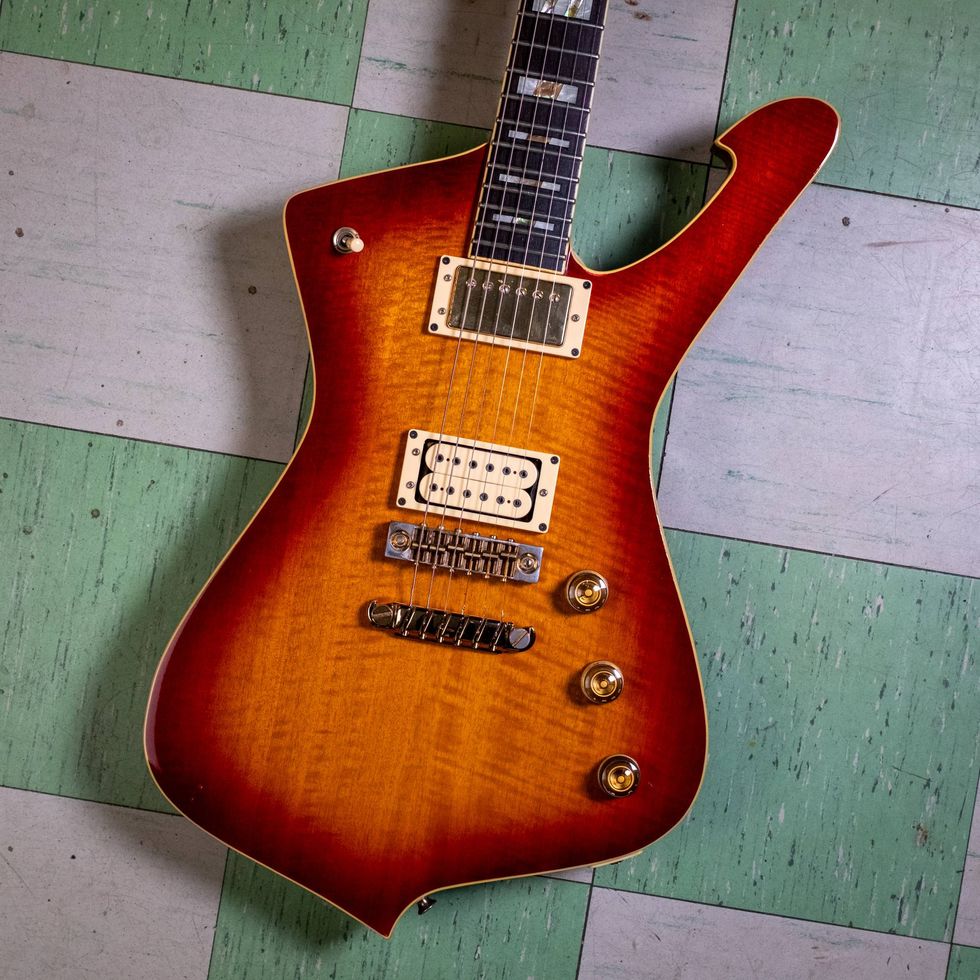
The 1982 Ibanez Iceman II
Cut to today. The 196-page 2026 Ibanez catalog features Karan Katiyar of Indian folk-metal band Bloodywood, shot in high-contrast black and white, looking intense and brutal with a multi-scale Alpha 7-string. We weren’t familiar with the artist, the band, or the genre, so it’s likely we’ve become the golden oldies. Karan and his Alpha are a far cry from Paul Stanley’s Kiss uniform, heavy makeup, and Iceman.
Still, they’re a clear example of why Ibanez sits near the top of the guitar game. They get it. Ibanez put 7-string solidbodies on the map with the Universe in 1990 and leaned into them hard when nu-metal took off at the end of the decade. In the 2000s, the company did the same for eight strings with the RG2228, the first mass-produced 8-string electric. Today they still offer Iceman, Artist, X, Talman, and Gio models, along with RGs, next to classic George Benson and Pat Metheny signature hollowbodies. That’s a long list, and it doesn’t even get into their acoustics or basses. These days, Ibanez is the company with the imitators and the iconic designs. They’ve taken Gibson’s 1970s slogan to heart and still do an exceptional job of representing Yesterday/Today/Tomorrow.
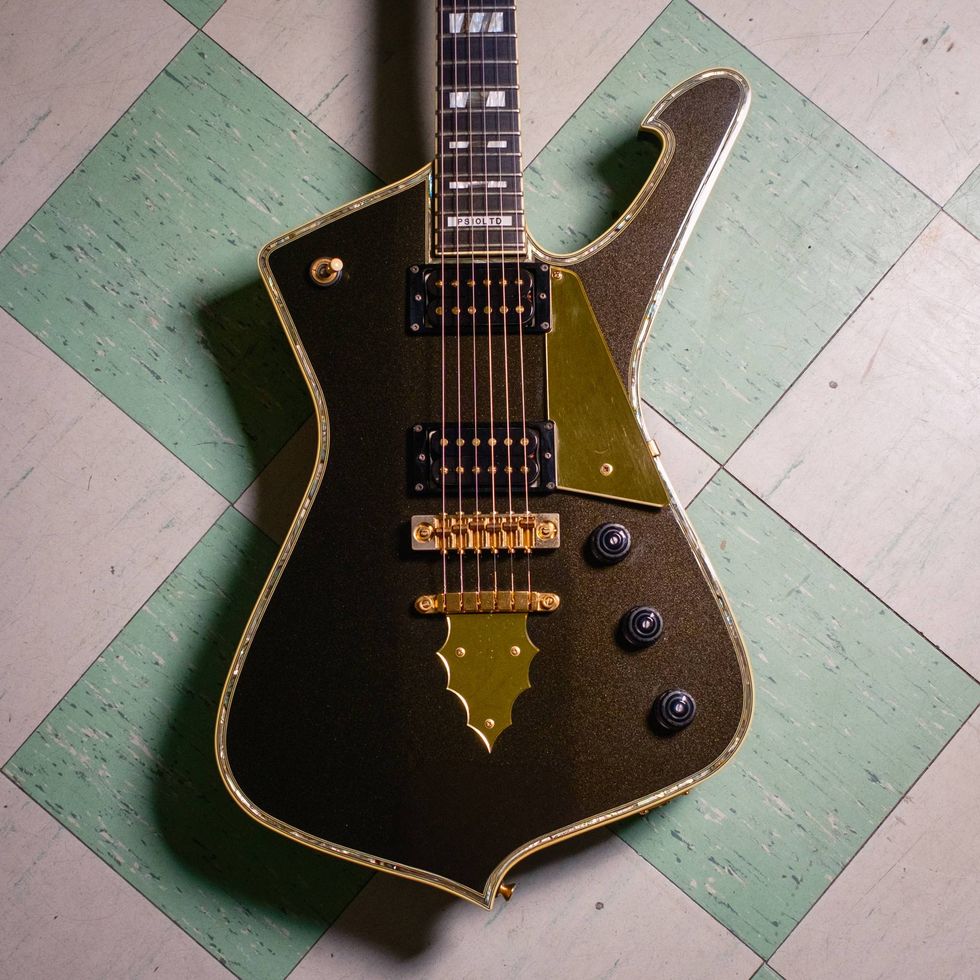
The 1995 Ibanez PS10LTD
*Ibanez offers an archive of decades’ worth of its printed catalogs on its website. It’s wonderful, and we recommend taking a break from your socials to flip through it. PG