
In 1976, the idea behind the Santa Cruz Guitar Company was a fantasy.
At the time, the market was dominated by factory-built juggernauts like Martin and Gibson. Independent luthiers worked on the fringes, Yoda-like in both their wisdom and solitude. Trade secrets were closely guarded. There were no how-to guides for making guitars.
Richard Hoover was part of the movement that changed that. When Hoover started the Santa Cruz Guitar Company—SCGC, for short—he wasn’t just selling acoustic guitars. He was selling the idea of a boutique brand making heirloom-quality instruments that pushed the boundaries of luthiery itself.
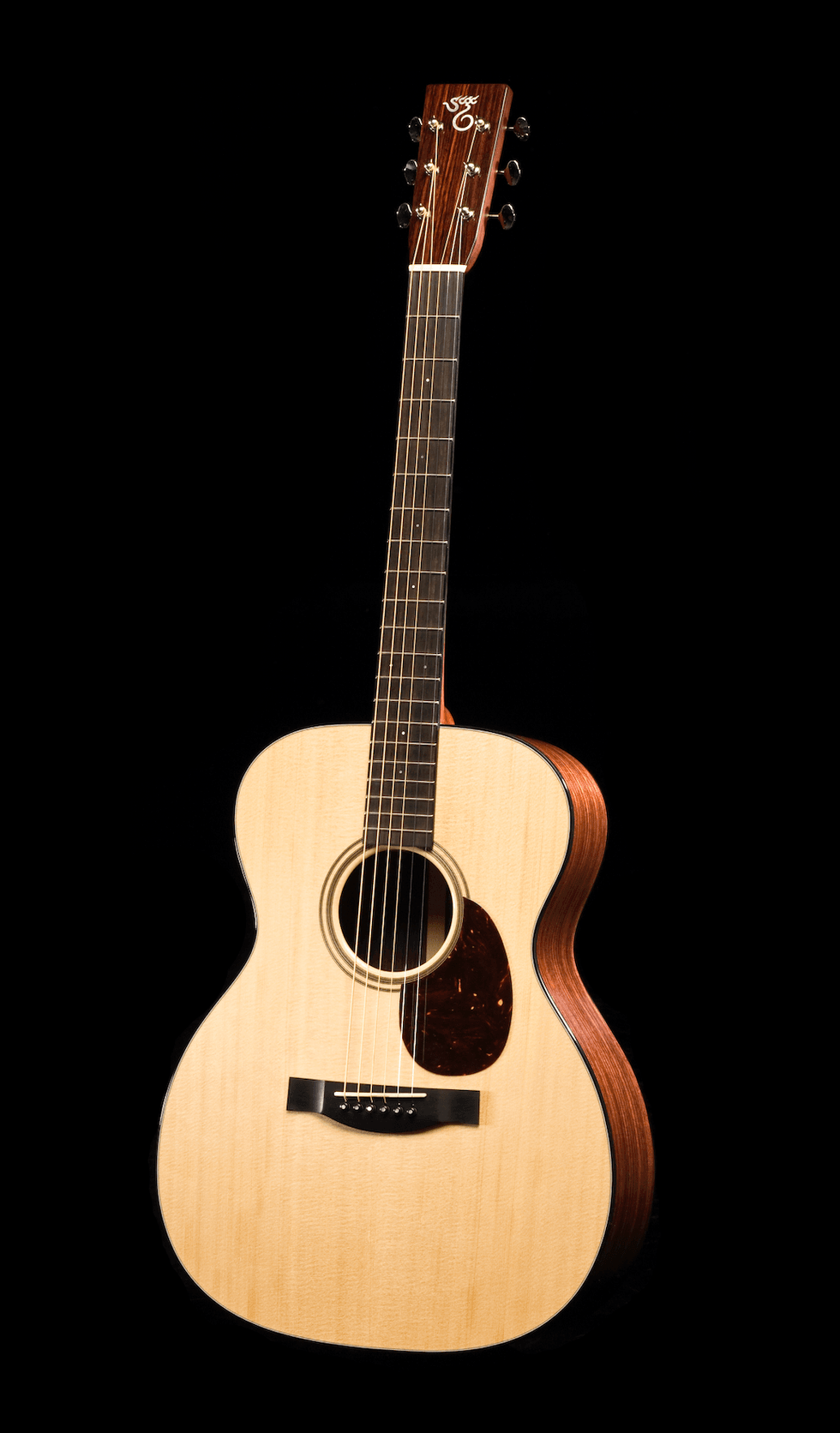
The OM Pre War 50th Anniversary Limited Edition
“There was no such thing as a ‘boutique builder’ back then,” Hoover says. “We were not only trying to sell a new brand, we were trying to get people comfortable with a new concept. Someone played one of our early guitars and thought, ‘This really sounds good. I think this is the best-sounding guitar I’ve ever played. But what will my friends think if I don’t buy a Martin?’”
As the Santa Cruz Guitar Company celebrates its 50th anniversary this year, Hoover, now a sprightly 75-year-old with a wise yet playful personality, can look back fondly on half a century of risky bets that paid off, new ideas that had to find their audience, and a community of forward-thinkers that helped shape the luthiery of today.
As part of that celebration, SCGC has built a limited supply of five special edition guitars that represent the company’s “greatest hits” from its first half-century. What ties them together, aside from industry accolades and player endorsements, is that each represents a time when the company experimented, explored, or broke from tradition in an effort to fill a market opportunity—or even just to survive when the universe might have had other plans.
“Someone played one of my early guitars and thought, ‘This really sounds good. I think this is the best-sounding guitar I’ve ever played. But what will my friends think if I don’t buy a Martin?’”
“We’ve seen it all,” says Hoover. “We’ve been through at least three major economic downturns that would have killed anybody. We’ve had wild successes and miracle blessings that have allowed us to last for 50 years in a business that’s volatile and trendy. Every year we survive gives me another tool in my toolkit to take on the next challenge.”
Small Beginnings in California
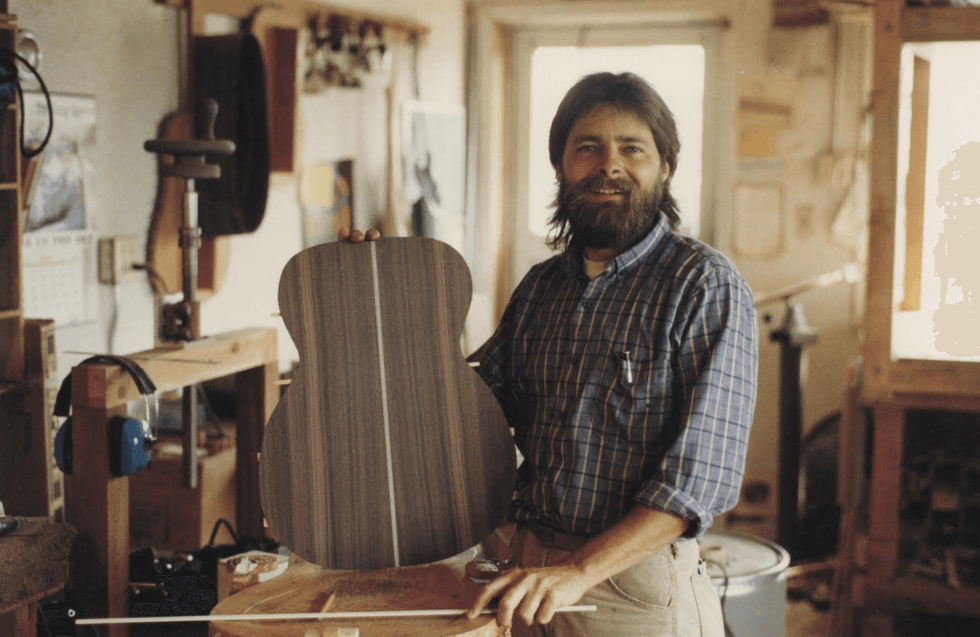
Hoover, photographed on Santa Cruz’s 13th anniversary, in 1989, at their old shop at 328 Ingles Street.
In 1972, a tenacious man in his early twenties moved to Santa Cruz, a college town that sits along the northern shore of the Monterey Bay, about 70 miles south of San Francisco.
Richard Hoover had been tinkering with acoustic guitars since he was a teenager, doing his best with woodworking, design, and fabrication lessons from his father and devouring every piece of literature on violin making that his reference-librarian mother could find. When he arrived in Santa Cruz, Hoover intended to become known as a player, not a builder. But when somebody stole his beloved Martin D-28, it changed everything.
He didn’t have the money to replace it, so he went looking for a loan. As luck would have it, his loan officer was Bruce McGuire, a classical guitar luthier and co-author of Making a Classical Guitar with his own mentor, Art Overholtzer. Hoover invited himself to McGuire’s house and began learning everything he could.
By 1976, Hoover’s own small business had earned him enough of a reputation as a guitar maker to attract investment from two talented repairmen from the local guitar shop, Bruce Ross and William Davis. And with that, the Santa Cruz Guitar Company was born.
That year, the three men brought their first guitar to market: the D Model, a dreadnought that used a unique tapered bracing that enhanced the midrange and treble without compromising the bass volume, giving it a more balanced voice than traditional dreadnoughts.
Knowing they wouldn’t be able to successfully market a premium mahogany guitar, which was Hoover’s preference, they instead turned to koa—a wood that was practically obsolete among ’70s-era guitars. From the very beginning, Santa Cruz was going against the grain.
“Bruce Ross came up with the suggestion of koa, because we both loved the old Martins from the ’20s and ’30s,” Hoover says. “We realized that mahogany and koa share that scale of tonality, so we could get the sound that we wanted from mahogany but with a much more attractive, marketable wood in koa.”
They made only a meager living with the D Model—so meager that Davis cashed in his share of the company after two years—but it helped them gain a foothold in a guitar market that was just starting to warm to the idea of boutique luthiery.
But starting in 1978, they began to develop the guitars that would help to firmly establish the Santa Cruz Guitar Company for the next 50 years.
Breaking from Tradition
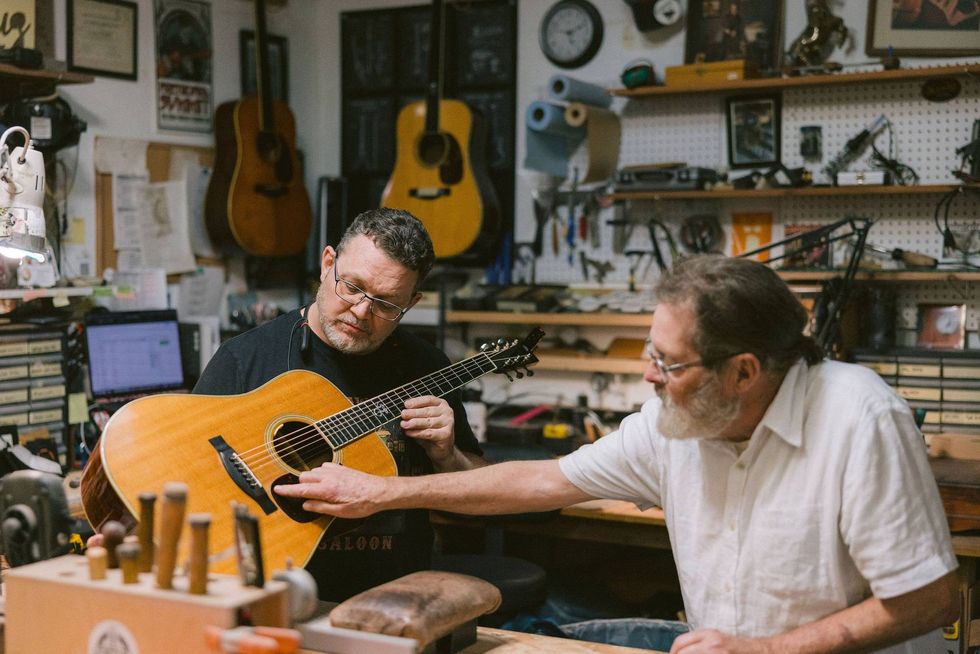
Hoover and Darren Webb, a 30-year SCGC veteran, discuss the perceived differences between saddle slots.
When it was time this year to select five of SCGC’s milestone guitars, Hoover thought they should represent the company’s historic willingness, even eagerness, to change people’s attitudes about acoustic guitars.
“These represent things where I felt we had something unique to offer the market that was sorely needed,” Hoover says. “And even if they didn’t become bestsellers themselves, they would pave the way for future development in guitars.” This year, those five designs—the H Model, the FTC, the Firefly, the OM Pre War, and the 1929-OO—have each received 50th anniversary limited edition builds that honor the original vision with refined, modern interpretations.
“We didn’t have a 100-year tradition of building guitars, so we had to share information with each other to survive. Within 50 years, we’ve made incredible strides because we’re talking to each other.”
In 1978, SCGC introduced the H Model, a small jumbo that challenged the notion that size equals power. Boasting the volume, punch, and responsiveness of a much larger instrument, the H Model initially struggled in the marketplace, but over time, it evolved into one of Santa Cruz’s most popular and iconic offerings, favored by flatpickers, fingerstylists, and rhythm players alike for its comfortable shape, expressive voice, nuanced tone, and versatile playability.
That same year, the company made its first exploration beyond traditional flat-top design. The FTC paired a flat top with an arched back, which gave it an extra level of focus, projection, and tonal complexity. The concept proved difficult to market—it wasn’t until Eric Clapton discovered it in the ’80s that the FTC gained much attention. “It was just pure luck that Eric saw an ad in an old press magazine that was about four postage stamps big, and wrote us a letter,” says Hoover.
With the growing popularity of those instruments, SCGC’s profile rose. Hoover became part of a luthiery revolution, as he and others like Michael Gurian, Linda Manzer, Steve Klein, Jean-Claude Larrivée, Stuart Mossman, Bob Taylor, Dana Bourgeois, and Jimmy D’Aquisto turned a once mysterious and inaccessible profession into a far more visible and collaborative community of respected, high-level handcrafters.
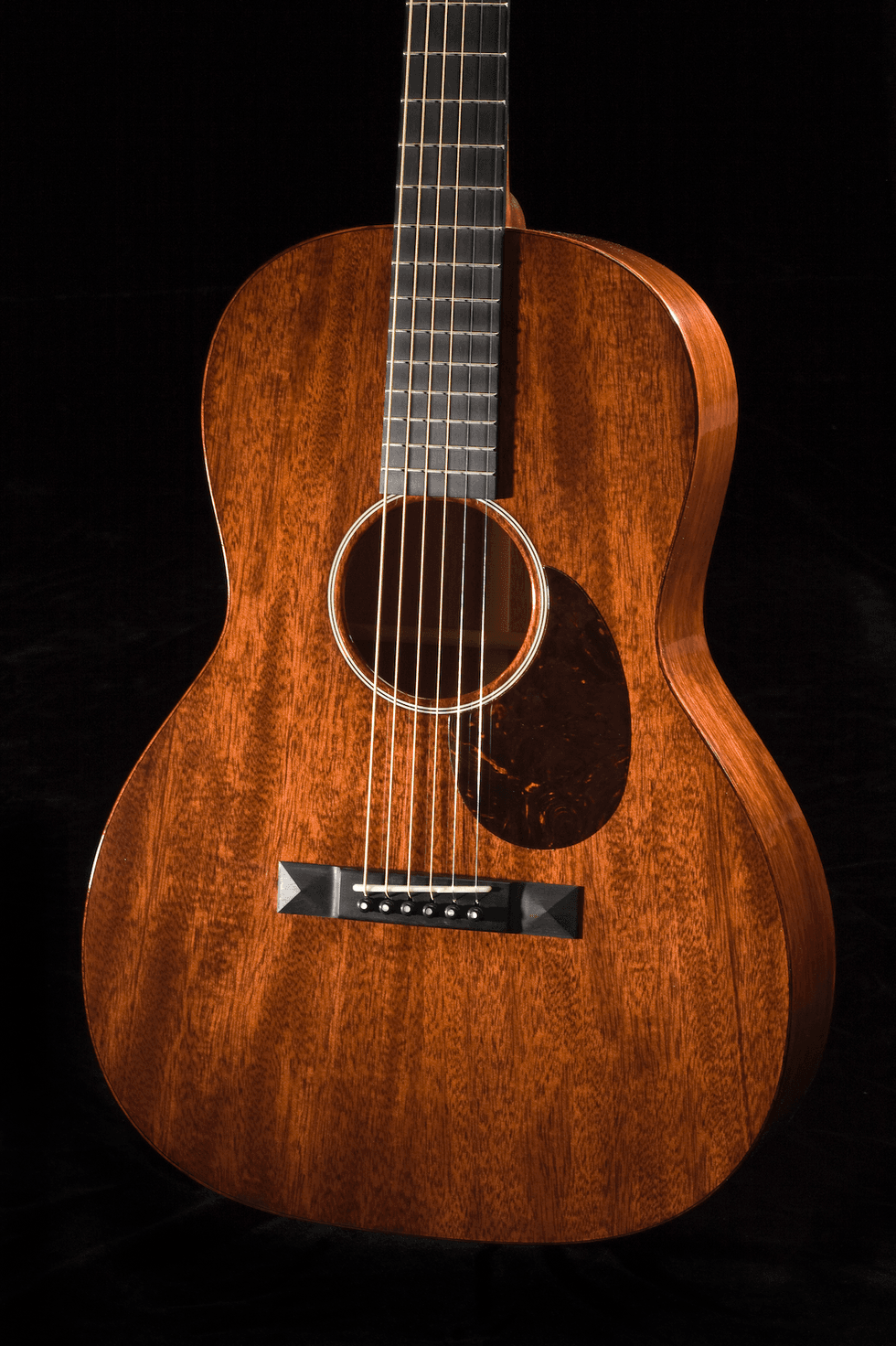
The 1929-00 50th Anniversary Limited Edition
“We didn’t have a 100-year tradition of building guitars, so we had to share information with each other to survive,” Hoover says. “It’s also my personal value. You get more than you give, and the way to happiness is by making other people happy. Sharing information exploded the advancement of the guitar—the knowledge and the consistency and quality of instruments. Within 50 years, we’ve made incredible strides because we’re talking to each other.”
In the late ’90s, with Hoover steering the company on his own following Ross’s departure, Santa Cruz looked to respond to advancements in technology that allowed artists to record themselves from just about anywhere. Wanting to provide a small, light guitar that would travel well but still sound great, they introduced a parlor design they called the Firefly, which became one of the company’s most popular models thanks to its clarity and presence.
At the beginning of the new millennium, Hoover and his team were redesigning their OM model—first re-introduced by SCGC in the mid-’80s—to achieve an antique pre-war sound with extra volume and bass response. But as the American economy tightened in the early 2000s, they wanted to make it more affordable, so they took up a mantra: simple but elegant. They built it with all of their usual attention to quality components and craftsmanship, but with fewer of the fine details. That way they could reduce the labor time, and therefore the price.
The OM Pre War was marketed as a professional boutique guitar at an affordable price, and the response was overwhelmingly positive. The model won industry awards and became one of SCGC’s most popular guitars, even during a time of economic uncertainty. More importantly, though, Hoover says the OM Pre War made the idea of investing in an heirloom-quality instrument like theirs more attainable to the average player.
“We were getting blocked from being introduced to people because they were afraid of the price,” Hoover says. “If we could make a guitar that was just under $2,000, people might not be able to afford it, but at least they’d play it, and they’d realize what they’re missing in a real sophisticated-sounding guitar. So, we were laying the groundwork for selling that guitar 10 or 20 years later to the same people. That worked really, really well.”
During the recession of the late 2000s, the prospect of selling expensive, finely crafted guitars took another turn for the worse. During the economic crisis, Hoover saw an opportunity.
At the time, mahogany was relatively inexpensive. Hoover’s idea was to make a model inspired by the all-mahogany guitars that were popular among players enduring the Great Depression, 80 years earlier. That guitar—the Santa Cruz 1929-OO—became one of the company’s signature models, receiving rave reviews from guitar publications around the world, becoming a major seller during a challenging economic downturn, and helping to spark a mahogany revival in luthiery.
For Hoover, it was a gratifying full-circle moment. “When we started in 1976, I would have liked to make guitars out of mahogany, because I preferred that tone, but people were convinced that rosewood was better,” says Hoover. “It was a chance to get people to suspend their disbelief and give it a fair shot. One of my career goals was to get [mahogany] the respect that it really deserves.”
The Next 50 Years

Hoover ensures that a Moon Spruce top will meet the expectations of a VIP client.
Across five decades, the Santa Cruz Guitar Company has attracted thousands of players willing to pay a premium for their guitars. Along the way, Hoover and Co. have developed signature models for artists like country superstar Brad Paisley, bluegrass pickers Tony Rice and Scott Law, blues icon Otis Taylor, folk singer Janis Ian, and fingerstyle jazz player Eric Skye.
Today, SCGC employs 23 people, and the company has made more than 20,000 guitars—small numbers by factory standards, but an impressive output for a boutique brand. With each one handcrafted and custom-tailored for the player, it’s been a labor of love for Hoover.
Now, as age catches up with him, Hoover is planning for the future. The master luthier has always invested in new talent, training employees in the Santa Cruz school of luthiery and taking a collaborative approach to guiding the business. Over the last 10 years, Hoover has turned that into a more formal succession plan. Recently, he’s been delegating more of the daily operations to others while he remains nearby to consult and advise. “I’m headed into my luthier emeritus days as we speak,” Hoover says.
While he hasn’t cited a retirement plan, that stage of his life seems to be approaching. “I love what I do,” he says. “But it’s not physically possible. My ability to use my hands accurately and efficiently is challenged. To be honest with myself, I’d like to be the one who questions my relevance and adapts accordingly, before someone else suggests it. And it’s only right to care for the people here and not wait till it’s too late. And by that, I mean inform them, empower them, and let them be as engaged as they want to be, so that they can carry it on with their own vision beyond me.”
But that’s the future. Here in the present, Hoover looks fondly on a community that has worked together to make innovative, quality instruments and continually improve upon them. A lot of things have changed in 50 years, but that shared passion for acoustic guitars has not.
“All in all, it’s been really gratifying,” Hoover says. “People come here happy, and they leave even happier. We make a tool for people to go out and change the world. I’ve got it good.”