

In 1957, the world was experiencing profound change. The Civil Rights Act was signed in September. Then, the space race ignited in October, when the Soviet Union launched their Sputnik satellite. The push to put a man on the moon had officially commenced.
Music was also rapidly evolving in 1957. Buddy Holly recorded “That’ll Be the Day” with the Crickets, and it became a defining song of the rock ’n’ roll era. Paul McCartney and John Lennon met in Liverpool, leading to the formation of the Beatles. Teenagers across America were watching American Bandstand on television after school, spreading music across the nation.
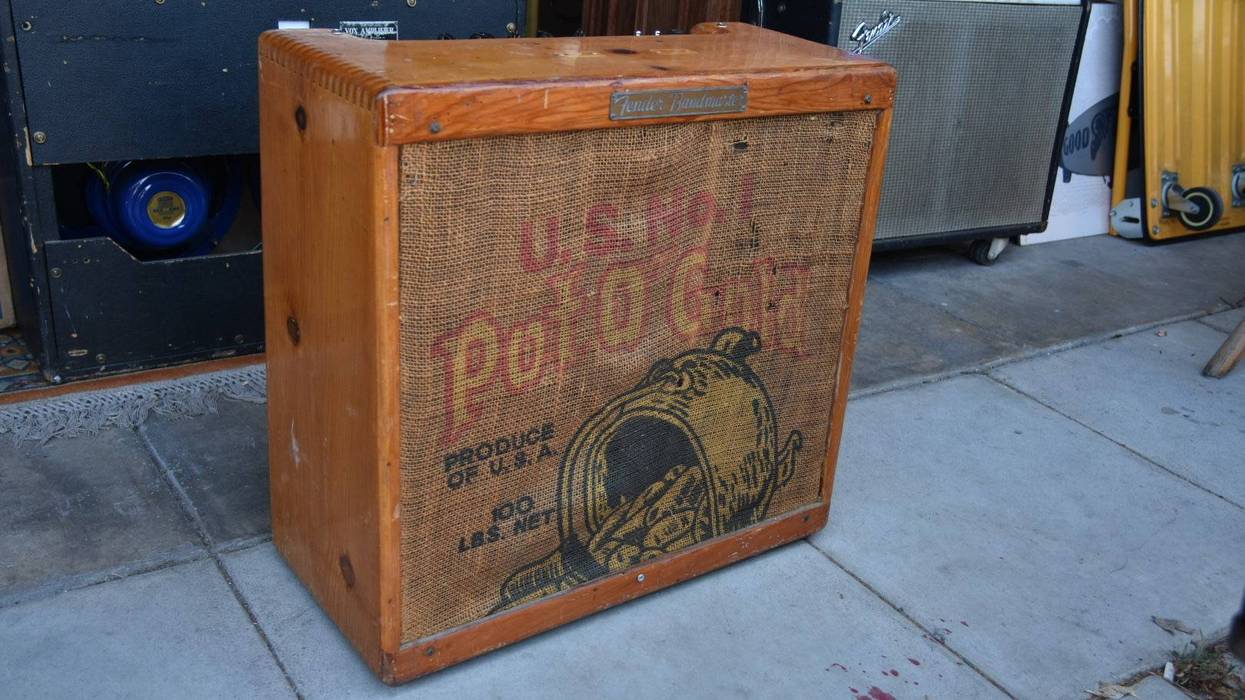
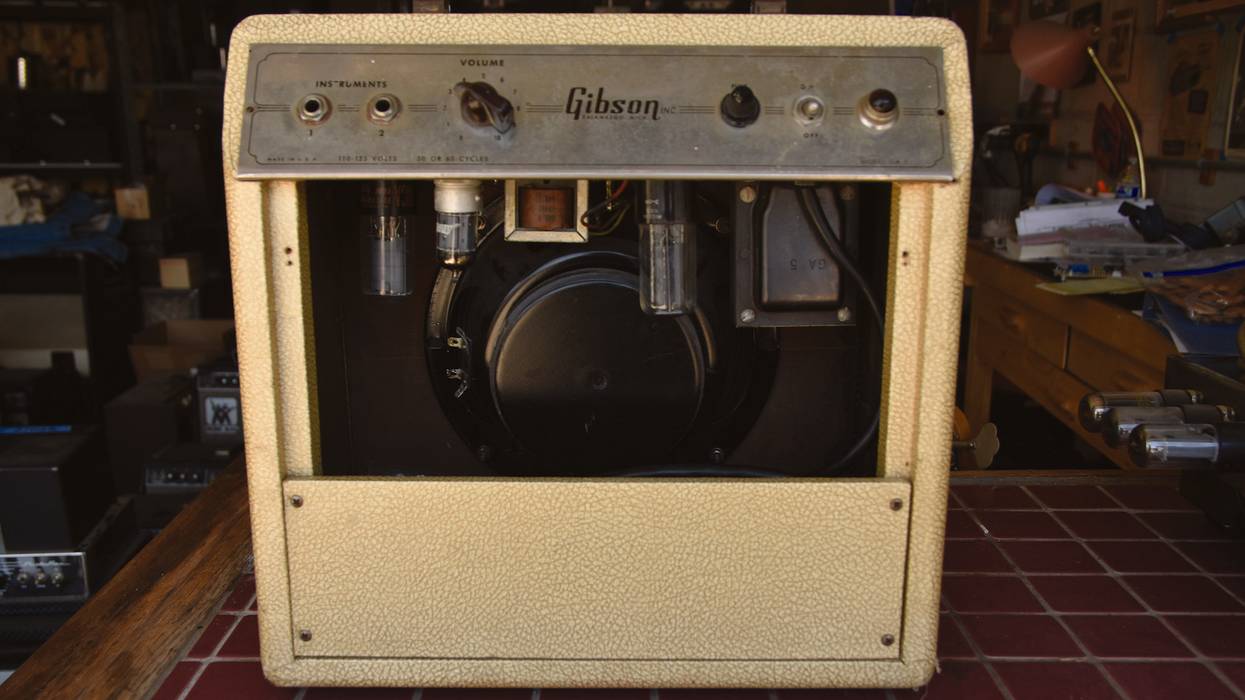
On the bench today, I have a 1957 Gibson Skylark. This model is the GA-5 without tremolo, with the designation GA-5T sporting an added tremolo circuit. It is a 5-watt amp, with a standard set of tubes: a 5Y3 rectifier, 6V6 output, and 12AX7 preamp. If this tube configuration sounds familiar, it is because the Fender Champ uses the same setup! There are many similarities between these two amplifiers. They both put out about 5 watts, have a single-ended output section, and house an 8-inch speaker. While they’re in the same family of amps, there are a few key differences.
“With the volume cranked, the Skylark delivers. The overdrive tone is raw, smooth, and well-balanced.”
Overall, I find the Skylark to have more grit than the Champ, with warm and mid-heavy cleans, whereas the Champ sounds more chime-y and bright. Since these are 5 watt amps, the user can max the volume for that natural tube breakup without rattling the walls. With the volume cranked, the Skylark delivers. The overdrive tone is raw, smooth, and well-balanced. It sounds naturally pleasing to the ear without getting too harsh. This is great for blues, rock, or any guitar player who wants that authentic edge.
The Skylark came in a few different versions over the years, with some using different tubes. This amp has only a volume control, and that’s it! There’s no tone stack either, which is one of the reasons why it has that perfect overdrive sound. The Champ, for example, has the typical TMB tone stack. This stands for “treble, middle, bass”, and is a combination of high-pass and low-pass filters. It is a network of capacitors, resistors, and potentiometers that bleed off specific frequencies. This type of circuit will result in a cleaner, more controlled amplification of the guitar. In the Skylark, the signal goes from the first gain stage through a coupling capacitor, to the volume control. There is not much there in terms of tone shaping, but that also means there is barely any signal loss. The signal then travels into the next gain stage—full frequency response and all.
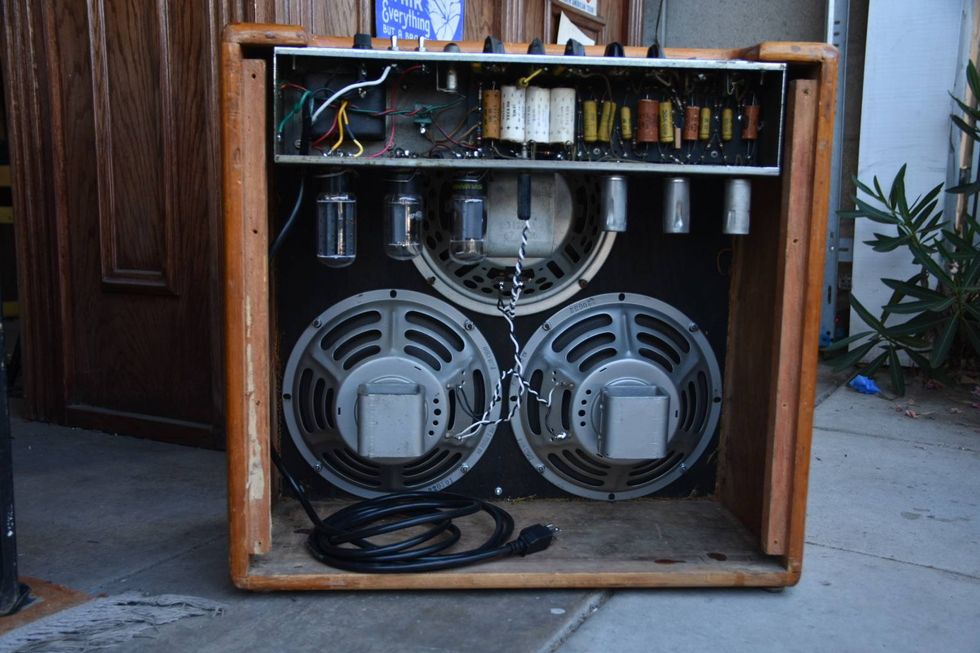
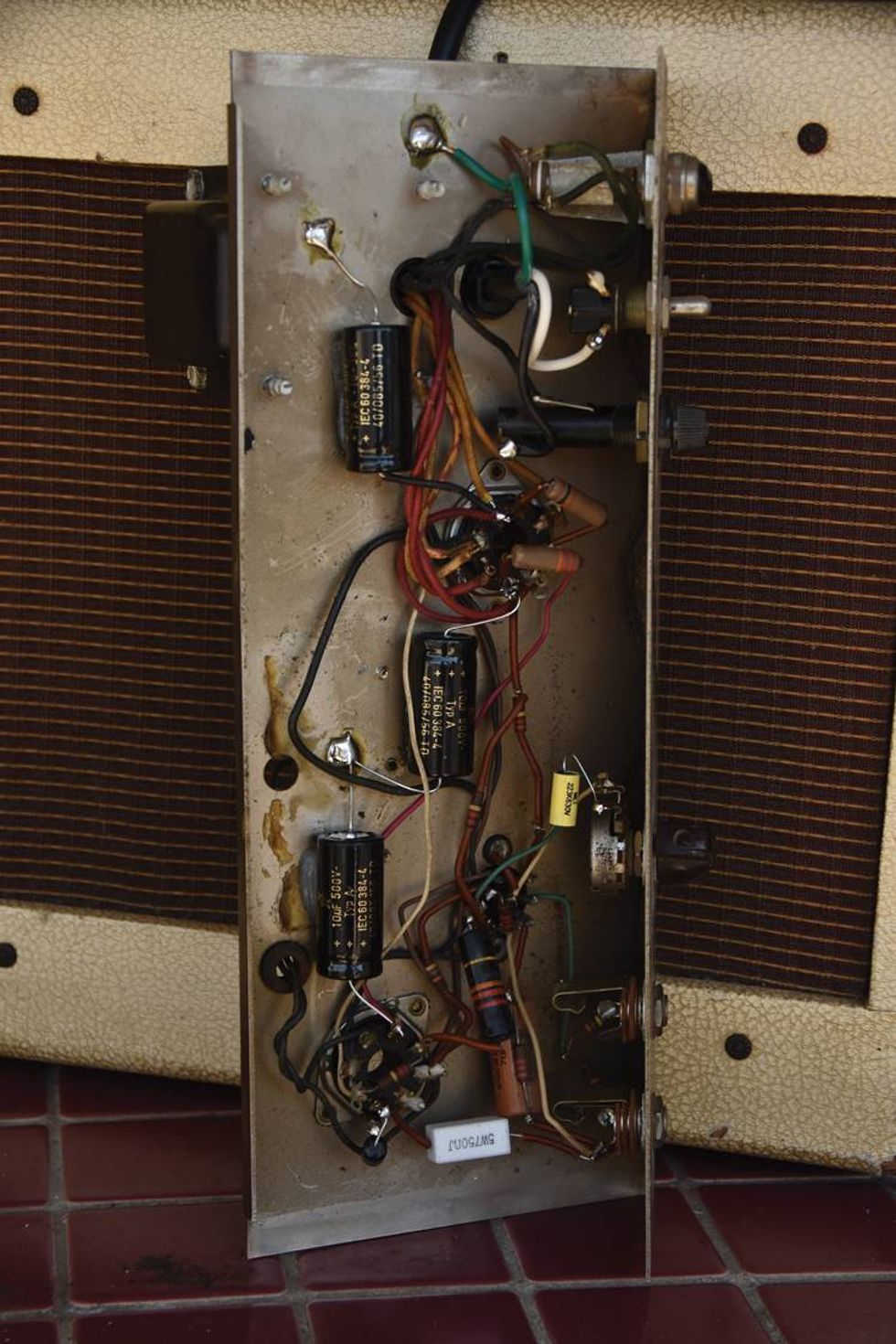
This amp came to me mostly original. The speaker had been replaced, and a 1/4" jack was installed on the back panel. This modification was performed so the user could plug the amplifier into an external speaker cabinet, which provides a lot more versatility. I knew that this amp would need the original filter capacitors replaced, and a grounded power cord installed. The circuit is totally point-to-point, meaning there are no circuit boards or terminal strips. All of the components are soldered directly to the tube sockets, potentiometers, and so on. I like to hard-wire the new capacitors in, and solder their grounds directly to the chassis using my large 1940s soldering iron. This is how I typically ground the power cord as well.
After a quick service, it’s time to fully test the amp. I’m mainly listening for crackling and popping, and testing for coupling capacitor leakage. This amp sports the beloved bumble bee coupling capacitors, which I love to leave installed whenever possible. As a reminder, coupling capacitors pass the audio signal from one gain stage to the other, while blocking the DC voltage from the previous section. As time goes on, these coupling capacitors may begin to leak DC voltage into the audio signal. In this amp, only one of the coupling caps needed to be replaced, as it was leaking about 5 volts.
This amp is cathode biased, so I replaced the cathode bypass capacitor and resistor for the output tube. This is to promote reliability in the output circuit, and keeps the 6V6 running as intended. I left in the first stage coupling capacitor, as it tested totally fine. There’s always a line between originality and reliability, so it’s up to the repair technician to make that judgement call based on their testing and observations.
After testing for a while, I concluded that I did not need to replace any of the other resistors or tubes. The amp came to me with nice old American-made tubes, which can truly stand the test of time. I love being able to leave the old tubes in, especially if the amp has sentimental value like this one. The grit and growl of the Gibson Skylark is an essential component in any collection, and this one will be howling at the moon for another 70 years.