

In Helmet front man Page Hamilton’s 2014 Rig Rundown, he highlighted the 12AX7-driven Fryette Valvulator Tube Buffer, stating, “That is a key piece of gear in my sound, always on my pedalboard.” For a precision-minded musician like Hamilton, a quality buffer can be a foundational part of the rig.
Every foot of instrument cable you run has inherent capacitance. When you daisy-chain a 15-foot cable into a pedalboard packed with true-bypass switches, and then run another 15-foot cable to your amp, you’ve essentially built a massive low-pass (RC) filter. The result? Your signal bleeds high-end frequencies and loses its transient lifeblood before it even hits your preamp tubes. This is where choosing the right buffer transcends being a mere option and becomes an absolute necessity.
A buffer doesn’t just convert Hi-Z (impedance) to Low-Z; its components also add their own “color” and character.
Op-Amp (Operational Amplifier):
This topology is the modern industry standard. It is known to be exceptionally clean, transparent, and linear, and possesses an incredibly low noise floor (dead quiet). An IC Op-Amp-based buffer reproduces your signal exactly as it is, without any meaningful harmonic coloration.
JFET (Junction Field Effect Transistor):
JFET transistors offer the ability to natively accept exceptionally high-impedance loads (up to the megaohm scale). The operational characteristics of a JFET are frequently compared to vacuum tubes because of how they operate in a voltage-controlled manner. This fundamental trait renders JFETs highly musical, incredibly responsive to picking dynamics, and perfectly suited as an instrument-level signal buffer.
BJT (Bipolar Junction Transistor):
Unlike the JFET, BJT transistors are current-controlled and naturally lack the massive high-input-impedance capability required to reach the megaohm scale without employing specialized design tricks (such as bootstrapping). However, BJT-type buffers are often selected due to their highly efficient and economical design, and most importantly, they deliver a uniquely vintage interaction.
Discrete:
In terms of structural architecture, this is fundamentally an Op-Amp; however, instead of utilizing a factory-molded, micro-sized IC chip, this topology is constructed using an array of many full-sized individual (discrete) transistors. This approach allows designers to strictly regulate component tolerances to an extreme degree, yielding gargantuan headroom and a highly specific Total Harmonic Distortion (THD) profile. Frequently deployed in studio-grade buffers or mixing consoles, this topology is exceptionally rare to find in a stompbox format due to its space-consuming footprint.
Tube:
This employs classic vacuum tubes (such as the 12AX7) operating at actual high voltage. A vacuum tube is capable of handling high input impedance natively, just like a JFET, but with a voltage headroom that is far more massive. As a bonus, tubes deliver a pleasing (second-order) harmonic distortion that injects warmth and a 3D dimension into the signal, along with an exceptionally wide dynamic range.
Hybrid:
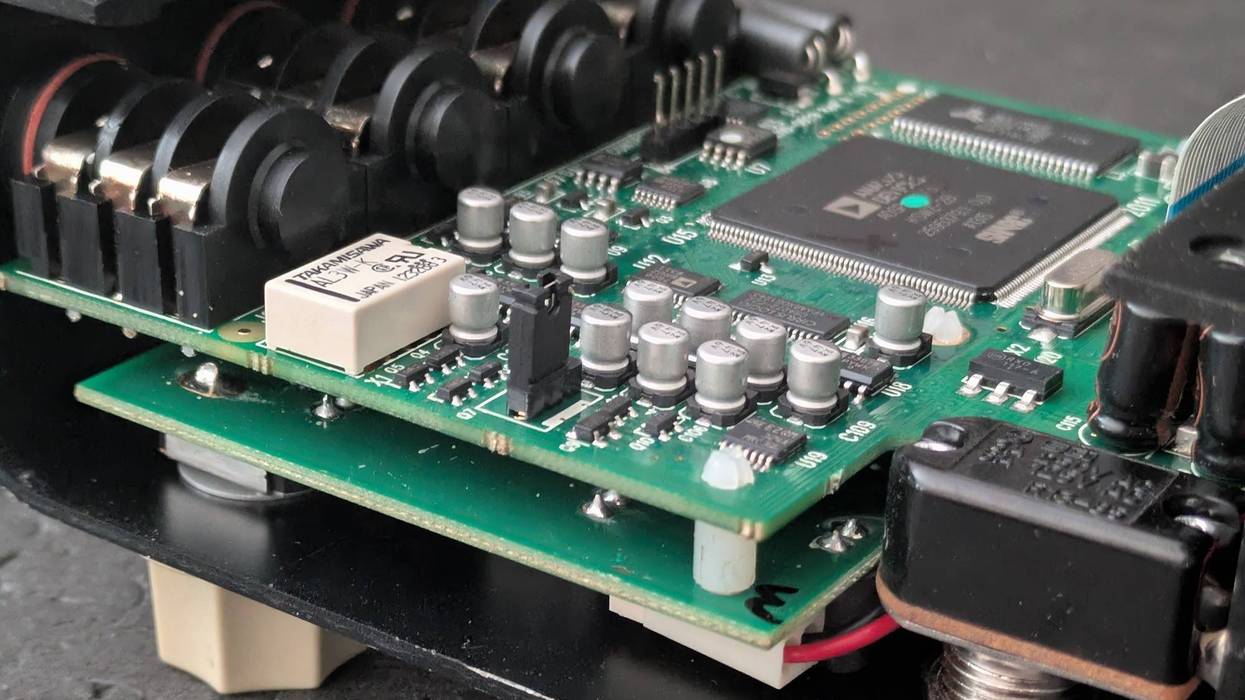
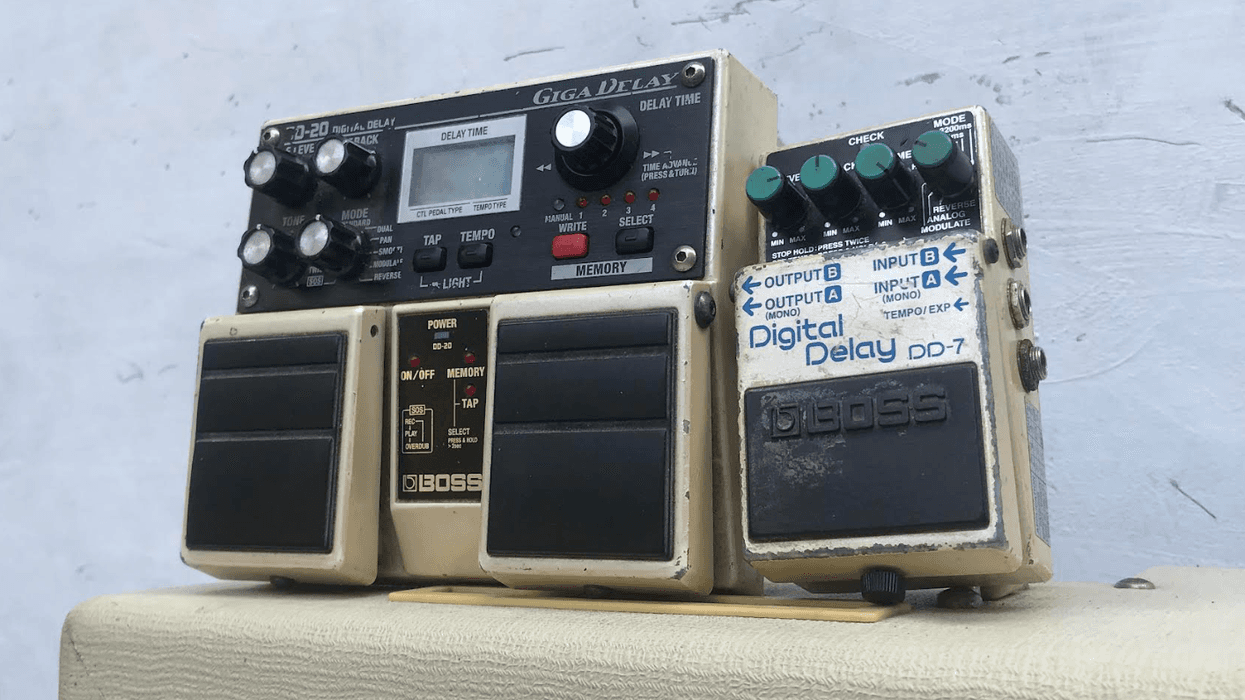
A clever topology that blends two worlds. It typically employs a JFET at the input stage to capture the high impedance from the guitar without degrading the tone, and then utilizes a BJT or Op-Amp at the output stage to forcefully spew a robust low impedance through long cable runs. This is the steadfast default buffer embedded within almost the entire Boss pedal line.
Active Pickups:
A technical fact that is frequently forgotten: if you are using active pickups, you already possess a built-in buffer located at the closest possible distance to the sound source. Hiding stealthily beneath the pickup cover and powered by a 9V battery, this circuit—which predominantly uses micro Op-Amps—instantly converts the signal to low impedance right at the guitar’s output jack. (Examples: EMG 81/85, Fishman Fluence).
Do you actually need two buffers?
Yes. Professional rig builders often quietly employ a “Buffer Sandwich.” One high-quality buffer sits first-in-chain to “catch” the fragile high-impedance signal. A second buffer sits at the absolute end, aggressively pushing your signal through 50 feet of stage cable to your backline or FOH without bleeding top-end sparkle.
The unaffected sound is the feature. It’s exactly this transparency that leads amateur tone-chasers to write off buffers as worthless gear. But when the stages get wider, when you demand wireless freedom, or when your cable lengths cross into the realm of the absurd, the buffer will be right there. It will silently save the life of your tone while you’re too busy praising the sheer magic of your boutique true-bypass overdrive.