


I’ve always been drawn to the aesthetics of vintage guitar amplifiers. From the control panel details to the Tolex and grill cloth, the visual beauty of old electronics never fails to captivate. British amps in particular catch my eye. Historically, they have played an important role in the evolution of rock ’n’ roll music. Visually, they stand out with bold color schemes and funky textures. I’m thinking of amps from manufacturers like Vox, Selmer, and Orange.
There are a few key factors that sonically differentiate British vs. American guitar amplifiers. British amps often use EL34 or EL84 tubes in the output sections, whereas American amps typically use 6L6 or 6V6. In addition to the tube configuration, the supporting circuit design colors the guitar signal. British amps sound warm with emphasis on the mids, while American amps are clean and sparkly. Think of the Beatles’ saturated guitar tones vs. the twangy, sparkly surf guitar we hear on Dick Dale records.
One British amp that stands out comes from a company named Watkins. Charlie Watkins entered the audio manufacturing world in 1954, when he began producing guitar amplifiers, and later went on to design some iconic PA systems under the name WEM (Watkins Electric Music). One of the most fabulous amplifiers I’ve had on my bench for repair lately has been a Watkins Dominator.
The Watkins Dominator is notorious for its shape and color. The amp is V-shaped in the front, with a pair of 10" speakers angled outward. I believe the intention there was to have a broader spread of sound, and it certainly sets the amp apart. It sports bright turquoise Tolex with cream and gold accents. Many customers of mine have locked eyes on the Dominator as they scan the shop for goodies.
This amp is an early version of the Dominator, which was manufactured into the early 1960s. The best way to tell is the control panel design—earlier Dominators have a black panel with gold stripes. Using a pair of EL84 output tubes, the amp pumps out roughly 17 watts. It has 2 channels, with each channel featuring dedicated volume and tone controls. The second channel has depth and speed controls for the tremolo as well.
This particular amp had been refurbished with new electrolytic capacitors. The original Elac speakers had also been swapped out for Celestion G10s, which is considered an upgrade. Celestion speakers boast dynamic richness and enhance the nuances of the amp’s circuitry. The original Elac speakers are known for their clean headroom and hi-fi accuracy.
The amp needed a new power transformer, which I sourced from Mercury Magnetics. It is a universal power transformer, which means it can be wired up to be used for different input voltages in different countries. The original power transformer for this amp was set up for European 220–240V AC wall voltage. The replacement transformer can accommodate either the 100–120V AC for U.S. voltage or the original U.K. voltage.
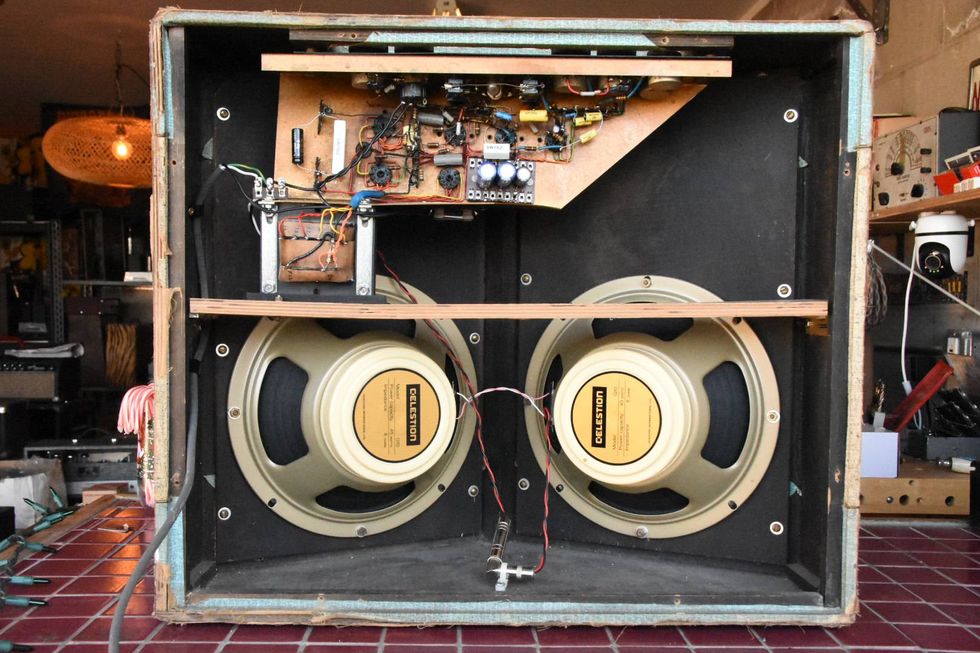
On this amp, the original 10" speakers have been swapped for a pair of Celestions.
The mounting of the power transformer in earlier Dominators is unusual. It’s installed upside-down on the underside of the angled chassis, with a wooden beam attached to the cabinet providing additional support.
Once the new power transformer was installed, I fired up the amp to give it a sound test. Immediately, I noticed how creamy and warm it sounds. The tremolo is surprisingly deep. I heard some intermittent crackling in the tremolo circuit and traced it to a faulty connection on one of the oscillator capacitors. Finally, there were some noticeable microphonics coming from the EL84 output tubes. I have a stockpile of matched NOS tubes, so I picked a lovely pair of Baldwin EL84s to use as a replacement.
The amp’s owner also wanted me to tweak the tone circuit to brighten things up. I don’t always take on modification requests, but in this case adjusting the tone circuit was minimally invasive. This change comes early on in the circuit, after the signal has gone through the first stage of amplification. I installed a 500 pF capacitor between the input and wiper of the volume control to enhance the top end of the guitar signal. This adds some sparkle to the top end and allows the guitar to cut through the mix a bit more.
The Watkins Dominator is not only a visual delight, but also offers some nice versatility for the guitar player. With luscious cleans at moderate volumes and growling distortion at high volumes, it does just about everything that folks look for in British amplifiers. It’s a great example of a well-made amp that can stand the test of time.