

New electric guitars with distressed finishes have been around for decades. In fact, aged reproductions of the iconic 1959 sunburst Les Paul Standard were being crafted before the original examples were even 20 years old. But new acoustic guitars with pick scratches, belt-buckle dents, and artificially produced lacquer checking? Acoustic purists scoffed, “No way!” Now, of course, new acoustic guitars with distressed finishes are far more common, and not all of them are high-end models. Some guitar fans might be asking what happened, but others are wondering why it took so long for the acoustic side of the guitar market to catch such an obvious wave.
We don’t know if it was the scoffing about artificially aged acoustics or a perceived lack of demand, but there was little change until the late 1990s, when some cracks began to appear in the “no phony wear” armor. Inspired by distressed-finish guru Tom Murphy, whose efforts on Les Pauls could be eerily realistic, Gibson began producing a few acoustic flattop reissues with crazing lines in the lacquer, artificially created by carefully scribing them with an X-Acto blade.
While the new century was still a toddler, distressed-finish solidbody electrics had become a firmly established part of the guitar market, with Telecasters and Stratocasters being the most common—partly because Fenders are so easy to disassemble. One company, Nash Guitars, was growing rapidly and only produced aged-finish Fender-style instruments. In all fairness, Bill Nash didn’t limit his modifications to dinged body edges and finger-stained maple fretboards. Both the pickups and the playability were tweaked to be significantly different than what you would find on a new Fender-branded Strat or Tele.
Several things came together in the last decade that seemed to push acoustics closer to the new-but-looks-old zone that was continuing to soak up an increasing percentage of electric guitar sales. There was the return to using animal-protein glue for the assembly of reissue models, and carefully documented searches for “vintage spec” parts were highly publicized, sending online forums into a frenzy. The biggest boost was torrefaction, the process of thermo-curing tonewoods so they have more of the characteristics of wood that hasn’t recently been part of a live tree. Last but not least was the return to thinner, all-nitrocellulose lacquer finishes. This led to a widespread acceptance of new guitars without the deep, glossy, reflective shine that had been the industry standard for as long as anyone could remember. But at this point, manufacturers of acoustics were still striving to achieve the look of a brand-new guitar, but one that had just left the factory 80 years ago.
That “like brand new but old” fixation changed abruptly when two guys in North Carolina, Wes Lambe and Ben Maschal, teamed up as Pre-War Guitars and changed the game plan for vintage-style acoustics. Like Nash Guitars, Pre-War isn’t the custom shop wing of a heritage brand, which means they can offer reissues of a late 1930s Gibson Advanced Jumbo or a Martin D-28 side by side. To avoid copyright issues, Pre-War has done some clever renaming. For example, the “AJ” model refers to their “American Jumbo.” Most importantly—along with torrefied wood, thin lacquer, and original-style parts and details—Pre-War added simulated playing wear—sometimes a lot of it.
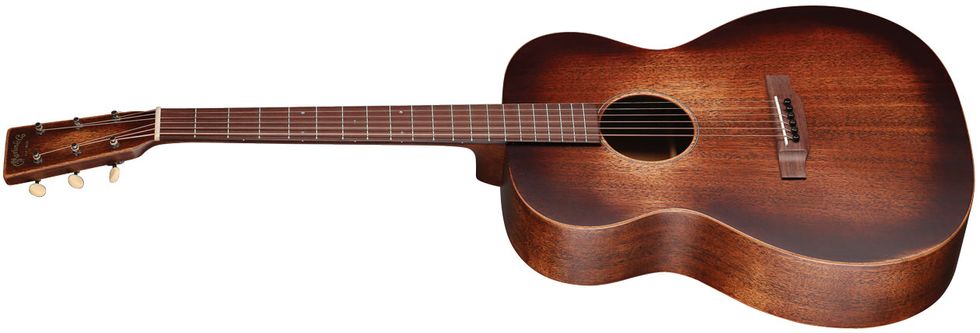
Of course, we can’t claim that Fender’s Road Worn models are the company’s reaction to Bill Nash’s success, and maybe C.F. Martin’s recently released Aged D-18 and D-28 Authentic models were not prompted by the Pre-War Guitars versions of those same Martin dreadnoughts. We’re guessing there’s a connection, and, thankfully, for acoustic players who don’t want to shell out big bucks for a new guitar that doesn’t look new, Martin offers Streetmaster all-mahogany models that have only light distressing. The aging on these guitars is only to the finish and the result is a nice patina, and a selling price under $1,500. (Fender’s Road Worn models sell for under $1,000.) Once big companies like Fender and Martin bring their pricing power to bear, consumers often get more options for less money. Remember when you could only get vintage-style tuners on custom-shop models?
With C.F. Martin offering aged versions of its classic models, it seems unlikely that new acoustics with distressed finishes are a fad that will soon disappear. What does this tell us? One thing is that as new reissues have become more and more exactly like the originals, there is less reason to pay the huge premium to get an old version. And if you like the look and feel of older guitars, a perfect new reissue is kind of a contradiction, if only because many players don’t want a new-looking guitar from decades ago. They want a guitar that has survived all those decades and shows it.
Purists who scoff at distressed finishes on new instruments can look to the violin trade for consolation. New violins that looked like an old, heavily played Stradivarius were widely available over 200 years ago.