Premier Guitar features affiliate links to help support our content. We may earn a commission on any affiliated purchases.
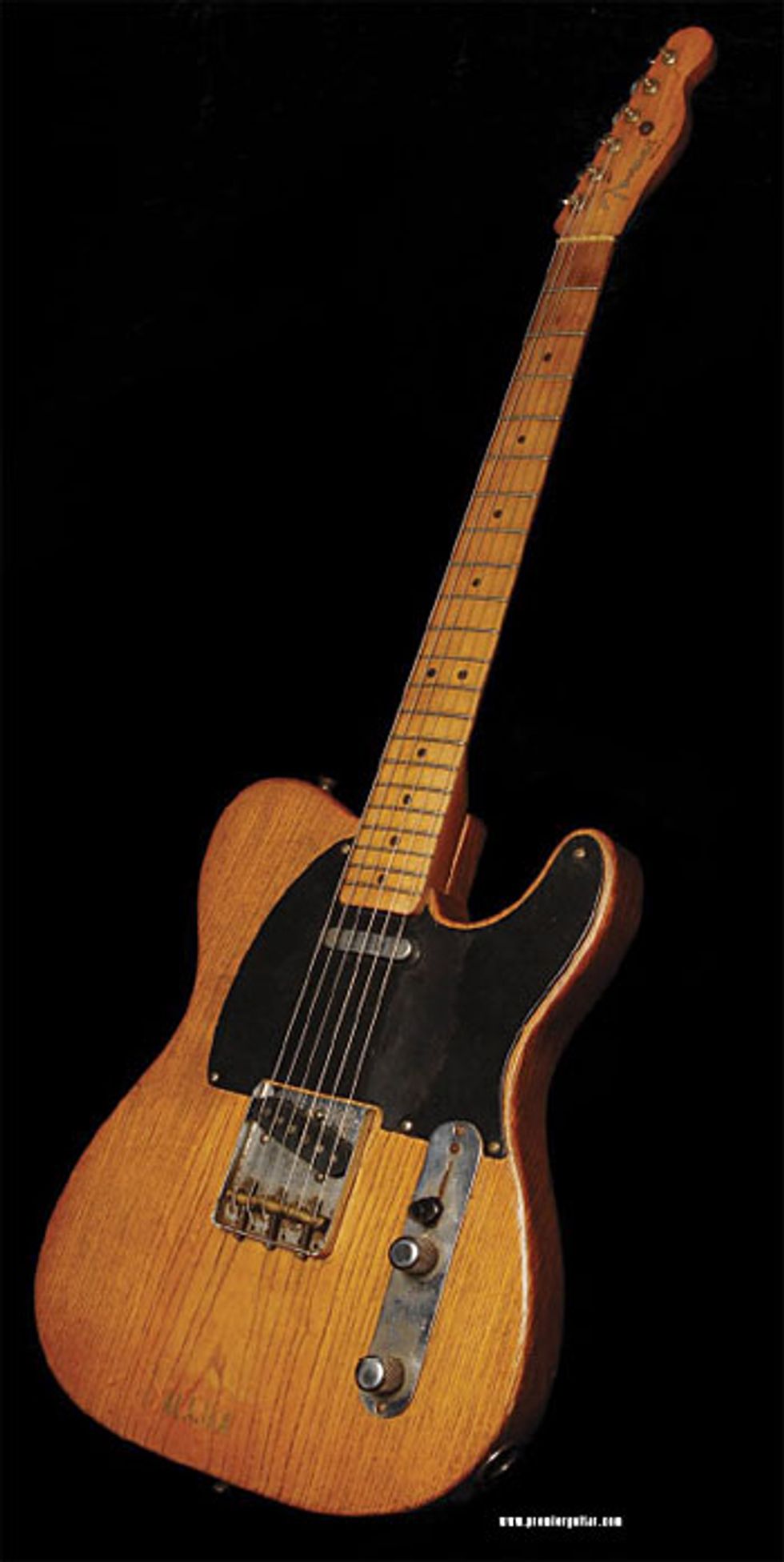
1950 Fender Broadcaster #0099
This gorgeous guitar comes compliments of Johnny Edwards at Coffin Case, and is numbered #0099. This was found in an Alaskan attic, and had one prior owner.
Fender Musical Instruments Corporation (FMIC) today announced the launch of the Vintera III Series, the next evolution of its acclaimed vintage-inspired lineup. Reimagined from the ground up, the highly anticipated range delivers meticulously crafted instruments that capture the defining sounds, aesthetics and feel of the early, mid and late ’50s, ’60s and ’70s.
“Usually when one band is on tour I’m working on writing music for the other one,” said songwriter and record producer, Nate Amos. “Lorelei and Water From Your Eyes both evolved to a point where they each have their own language. With the latter, something about that band seems to call for the Vintera III Jaguar. I think it’s maybe because of the floating tremolo system, but it feels a little bit more chaotic when you really go to town on a guitar like that.”
Designed for players seeking true vintage character, the Vintera III series introduces an all-new philosophy: a targeted focus on iconic moments in Fender history. This “greatest hits” approach highlights some of the most celebrated specifications from the company’s golden eras, giving musicians access to some of the most revered tones ever produced.
This refined direction marks a significant evolution from previous Vintera collections - while earlier generations drew broadly from generations of production, the Vintera III Series narrows its focus to distinct, era-defining designs, allowing Fender to achieve a new level of historical accuracy and authenticity. Every instrument in the range reflects painstaking attention to detail - from period-correct aesthetics and colours, to carefully recreated neck construction and pickups - faithfully capturing the look, feel and sonic character of legendary vintage Fender models.
“With the Vintera III Series, we set out to capture the defining moments that shaped Fender’s legacy,” said Max Gutnik, Chief Product Officer at Fender. “Rather than broadly representing entire decades, we focused on the most iconic specifications that players continue to seek out today. By zeroing in on these historic designs - from era-correct pickups and neck profiles to period-accurate aesthetics - we’re giving today’s musicians an authentic connection to the instruments that helped define modern music.”
To ensure era-accurate tone, Fender’s engineers revisited the company’s original archives, developing vintage-style pickups matched to each period. Players will experience the warm, rounded character of Alnico II and the punch and clarity of Alnico V designs.
The Vintera III Series also faithfully recreates Fender’s historic neck profiles, from the substantial V and D shapes of the mid and late ’50s to the comfortable medium C profiles of the early ’60s and the slimmer C shapes that defined the late ’60s and early ’70s. Each model is completed with era-specific headstocks, decals, fingerboard inlays, stamps and finishes, delivering an instrument that feels as authentic as it sounds.
With Vintera III, Fender brings the spirit of its most influential eras to a new generation of players - offering a lineup that celebrates the instruments, tones and innovations that helped shape modern music.
Models include:
Vintera® III Late ‘50s Stratocaster®
Limited Edition Vintera® III Late ‘50s Stratocaster®
Vintera® III Early ‘60s Stratocaster®
Vintera® III Late ‘60s Stratocaster®
Limited Edition Vintera® III Early ‘60s Custom Telecaster®
Vintera® III Late ‘50s Telecaster®
Vintera® III Mid ‘60s Telecaster®
Vintera® III Mid ‘60s Jazzmaster®
Vintera® III Mid ‘60s Jaguar®
Vintera® III Mid ‘60s Mustang®
Vintera® III Early ‘60s Jazz Bass®
Vintera® III Early ‘70s Jazz Bass®
Vintera® III Late ‘60s Precision Bass®
Vintera® III Early ‘60s Bass VI
VINTERA III COLLECTION
Vintera® III Late ‘50s Stratocaster® (MSRP: $1,249.99 USD, £1,049 GBP, €1,249 EUR, $2,099 AUD, ¥192,500 JPY) The Fender Vintera III series delivers meticulously crafted vintage recreations that capture the authentic look, feel, and tone of iconic Fender guitars from the ‘50s, ‘60s, and ‘70s. The Vintera® III Late ‘50s Stratocaster® features an alder body paired with a 1-piece maple neck and maple fingerboard, delivering that unmistakable Fender sound brimming with punch and crystal-clear articulation. The authentic late ‘50s “D”-shaped neck profile offers an instantly familiar playing experience that feels natural in your hands, while the 7.25” radius fingerboard with vintage-tall frets ensures supreme comfort and outstanding feel. At its heart, three meticulously crafted late ‘50s spec’d pickups capture the bright, singing tones that established Fender’s reputation during this pivotal era. The vintage-style synchronized tremolo system provides effortless pitch manipulation, while period-correct vintage-style tuning machines deliver authentic looks with superior tuning precision. Embrace the authentic vintage spirit and legendary sound of Vintera® III – where every detail tells the story.
Limited Edition Vintera® III Late ‘50s Stratocaster® (MSRP: $1,499.99 USD, £1,199 GBP, €1,399 EUR, $2,599 AUD, ¥225,500 JPY) The Fender Vintera III series delivers meticulously crafted vintage recreations that capture the authentic look, feel, and tone of iconic Fender guitars from the ‘50s, ‘60s, and ‘70s. The Limited Edition Vintera® III Late ‘50s Stratocaster® features an ash body finished in elegant see-thru blonde that beautifully highlights the wood’s natural grain, paired with a 1-piece maple neck and maple fingerboard that delivers unmistakable Fender sound with punch and crystal-clear articulation. The authentic late ‘50s “D”-shaped neck profile offers an instantly familiar playing experience that feels natural in your hands, while the 7.25” radius fingerboard with vintage-tall frets ensures supreme comfort and outstanding feel. Three meticulously crafted vintage-style 1958 spec’d pickups capture the bright, singing tones that established Fender’s reputation during this pivotal era, while the vintage-style synchronized tremolo system provides effortless pitch manipulation. Premium gold hardware appointments create a sophisticated aesthetic that sets this limited edition apart from the crowd. Embrace the authentic vintage spirit and legendary sound of Vintera III – where every detail tells the story.
Vintera® III Early ‘60s Stratocaster®(MSRP: $1,249.99 USD, £1,049 GBP, €1,249 EUR, $2,099 AUD, ¥192,500 JPY) The Fender Vintera III series delivers meticulously crafted vintage recreations that capture the authentic look, feel, and tone of iconic Fender guitars from the ‘50s, ‘60s, and ‘70s. The Vintera® III Early ‘60s Stratocaster® features an alder body paired with a maple neck and rosewood fingerboard, delivering that unmistakable Fender sound brimming with punch and crystal-clear articulation. The authentic early ‘60s “C”-shaped neck profile offers an instantly familiar playing experience that feels natural in your hands, while the 7.25” radius fingerboard with vintage-tall frets ensures supreme comfort and outstanding feel. At its heart, three meticulously crafted vintage-style early ‘60s single-coil pickups capture the bright, chimey tones that established Fender’s reputation during this pivotal era. The vintage-style synchronized tremolo system provides effortless pitch manipulation, while period-correct vintage- style tuning machines deliver authentic looks with superior tuning precision. Embrace the authentic vintage spirit and legendary sound of Vintera III – where every detail tells the story.
Vintera® III Late ‘60s Stratocaster®(MSRP: $1,249.99 USD, £1,049 GBP, €1,249 EUR, $2,099 AUD, ¥192,500 JPY) The Fender Vintera III series delivers meticulously crafted vintage recreations that capture the authentic look, feel, and tone of iconic Fender guitars from the ‘50s, ‘60s, and ‘70s. The Vintera III Late ‘60s Stratocaster® features an alder body and maple neck with Maple or Rosewood fingerboard and period-correct big headstock, delivering that unmistakable Fender look and sound brimming with punch and crystal- clear articulation. The authentic late ‘60s “C”- shaped neck profile offers an instantly familiar playing experience that feels natural in your hands, while the 7.25” radius fingerboard with vintage-tall frets ensures supreme comfort and outstanding feel. At its heart, three meticulously crafted vintage-style late ‘60s single-coil pickups capture the dynamic, versatile tones that established Fender’s reputation during this transformative era. The vintage-style synchronized tremolo system provides effortless pitch manipulation, while period-correct vintage- style tuning machines deliver authentic looks with superior tuning precision. Embrace the authentic vintage spirit and legendary sound of Vintera III – where every detail tells the story
Vintera® III Late ‘50s Telecaster®(MSRP: $1,249.99 USD, £1,049 GBP, €1,249 EUR, $2,099 AUD, ¥192,500 JPY) The Fender Vintera III series delivers meticulously crafted vintage recreations that capture the authentic look, feel, and tone of iconic Fender guitars from the ‘50s, ‘60s, and ‘70s. The Vintera® III Late ‘50s Telecaster® features an ash or alder body paired with a 1-piece maple neck and maple fingerboard, delivering that unmistakable Fender sound brimming with punch and crystal-clear articulation. The authentic late ‘50s “V”-shaped neck profile offers an instantly familiar playing experience, while the 7.25” radius fingerboard with vintage-tall frets ensures supreme comfort and outstanding feel. At its heart, two meticulously crafted vintage-style late ‘50s spec’d pickups capture the bright, cutting tones that established Fender’s reputation during this pivotal era. The vintage-style 3-saddle bridge with steel barrel saddles offers authentic ‘50s twang while vintage-style appointments deliver classic aesthetics and period-correct tuning machines provide superior tuning precision. Embrace the authentic vintage spirit and legendary sound of Vintera III – where every detail tells the story.
Vintera® III Mid ‘60s Telecaster®(MSRP: $1,249.99 USD, £1,049 GBP, €1,249 EUR, $2,299 AUD, ¥192,500 JPY) The Fender Vintera III series delivers meticulously crafted vintage recreations that capture the authentic look, feel, and tone of iconic Fender guitars from the ‘50s, ‘60s, and ‘70s. The Vintera® III Mid ‘60s Telecaster® features your choice of alder or ash body paired with a maple neck and maple or rosewood fingerboard, delivering that unmistakable Fender sound brimming with punch and crystal-clear articulation. Choose between a classic maple cap fingerboard or rich rosewood fingerboard to match your playing style and aesthetic preference. The authentic mid ‘60s “C”-shaped neck profile offers an instantly familiar playing experience, while the 7.25” radius fingerboard with vintage-tall frets ensures supreme comfort and outstanding feel. At its heart, two meticulously crafted vintage-style mid ‘60s spec’d pickups capture the bright, cutting tones that established Fender’s reputation during this pivotal era. The vintage-style 3-saddle bridge with threaded steel saddles offers authentic ‘60s twang, while period-correct vintage-style tuning machines deliver authentic looks with superior tuning precision. Embrace the authentic vintage spirit and legendary sound of Vintera III – where every detail tells the story.
Limited Edition Vintera® III Early ‘60s Custom Telecaster® (MSRP: $1,499.99 USD, £1,199 GBP, €1,399 EUR, $2,599 AUD, ¥264,000 JPY) The Fender Vintera III series delivers meticulously crafted vintage recreations that capture the authentic look, feel, and tone of iconic Fender guitars from the ‘50s, ‘60s, and ‘70s. The Limited Edition Vintera® III Early ‘60s Custom Telecaster® features a double-bound alder body, paired with a maple neck and rosewood fingerboard to deliver that unmistakable Fender sound brimming with punch and crystal-clear articulation. The authentic early ‘60s “C”-shaped neck profile offers an instantly familiar playing experience, while the 7.25” radius fingerboard with vintage-tall frets ensures supreme comfort and outstanding feel. At its heart, two meticulously crafted vintage-style 1963 spec’d pickups capture the bright, cutting tones that established Fender’s reputation during this pivotal era. The vintage- style 3-saddle bridge with threaded steel saddles offers authentic ‘60s twang, while period-correct vintage-style tuning machines deliver authentic looks with superior tuning precision. Embrace the authentic vintage spirit and legendary sound of Vintera III – where every detail tells the story.
Vintera® III Mid ‘60s Jazzmaster®(MSRP: $1,349.99 USD, £819.00 GBP, €969.00 EUR, $2,299 AUD, ¥209,000 JPY) The Fender Vintera III series delivers meticulously crafted vintage recreations that capture the authentic look, feel, and tone of iconic Fender guitars from the ‘50s, ‘60s, and ‘70s. The Vintera® III Mid ‘60s Jazzmaster® features an alder body and a maple neck with rosewood fingerboard that delivers that unmistakable Fender sound brimming with punch and crystal- clear articulation. The authentic mid ‘60s “C”- shaped neck profile offers an instantly familiar playing experience, while the 7.25” radius fingerboard with vintage-tall frets ensures supreme comfort and outstanding feel. At its heart, two meticulously crafted vintage-style mid ‘60s spec’d Jazzmaster pickups capture the bright, jangly tones and warm, woody midrange that established this model’s reputation during this pivotal era. The vintage-style floating tremolo bridge with rhythm circuit switch offers authentic ‘60s versatility and vibrato, while period-correct vintage-style tuning machines deliver authentic looks with superior tuning precision. Embrace the authentic vintage spirit and legendary sound of Vintera III – where every detail tells the story.
Vintera® III Mid ‘60s Jaguar®(MSRP: $1,349.99 USD, £819.00 GBP, €969.00 EUR, $2,299 AUD, ¥209,000 JPY) The Fender Vintera III series delivers meticulously crafted vintage recreations that capture the authentic look, feel, and tone of iconic Fender guitars from the ‘50s, ‘60s, and ‘70s. The Vintera® III Mid ‘60s Jaguar® features an alder body and a maple neck with rosewood fingerboard delivering that unmistakable Fender sound brimming with punch and crystal-clear articulation. The authentic mid ‘60s “C”-shaped neck profile offers an instantly familiar playing experience, while the 7.25” radius fingerboard with vintage-tall frets ensures supreme comfort and outstanding feel. At its heart, you’ll find a pair of vintage-style mid ‘60s single-coil pickups that deliver all the sweet and sparkling tone that made Fender® famous. Other features include a vintage-style floating tremolo with tremolo lock for expressive vibrato, period-correct rhythm circuit for enhanced tonal versatility, vintage-style Jaguar® mute and vintage-style tuning machines for enhanced tuning stability. Embrace the authentic vintage spirit and legendary sound of Vintera III – where every detail tells the story.
Vintera® III Mid ‘60s Mustang®(MSRP: $1,249.99 USD, £669.00 GBP, €789.00 EUR, $2,099 AUD, ¥198,000 JPY) The Fender Vintera III series delivers meticulously crafted vintage recreations that capture the authentic look, feel, and tone of iconic Fender guitars from the ‘50s, ‘60s, and ‘70s. The Vintera® III Mid 60s Mustang® features an alder body and maple neck with rosewood fingerboard for classic Fender tone brimming with punch and crystal-clear articulation. The authentic mid ‘60s “C”-shaped neck profile offers an instantly familiar playing experience that feels natural in your hands, while the 7.25” radius fingerboard with vintage-tall frets ensures supreme comfort and outstanding feel. At its heart, you’ll find a pair of vintage-style mid ‘60s single-coil pickups that deliver all the sweet and sparkling, warm and woody tone that made Fender famous. The vintage-style Mustang® “floating” tremolo provides effortless pitch manipulation, while period-correct vintage-style tuning machines deliver authentic looks with superior tuning precision. Embrace the authentic vintage spirit and legendary sound of Vintera III – where every detail tells the story.
Vintera® III Early ‘60s Jazz Bass®(MSRP: $1,349.99 USD, £1,099 GBP, €1,299 EUR, $2,299 AUD, ¥209,000 JPY) The Fender Vintera III series delivers meticulously crafted vintage recreations that capture the authentic look, feel, and tone of iconic Fender guitars from the ‘50s, ‘60s, and ‘70s. The Vintera® III Early ‘60s Jazz Bass® features an alder body and maple neck with rosewood fingerboard for classic Fender tone that’s full of punch and clarity. The early ‘60s “C”- shaped maple neck with 7.25” radius rosewood fingerboard and vintage-tall frets provides supreme comfort and outstanding feel. At its heart, you’ll find a pair of vintage-style early ‘60s single-coil pickups that deliver all the punchy and articulate, warm and woody tone that made Fender® famous. Other features include a vintage-style 4-saddle bridge for rock-solid intonation and sustain and vintage-style tuning machines for enhanced tuning stability. Embrace the authentic vintage spirit and legendary sound of Vintera III – where every detail tells the story.
Vintera® III Early ‘70s Jazz Bass®(MSRP: $1,499.99 USD, £1,199 GBP, €1,399 EUR, $2,599 AUD, ¥220,000 JPY) The Fender Vintera III series delivers meticulously crafted vintage recreations that capture the authentic look, feel, and tone of iconic Fender guitars from the ‘50s, ‘60s, and ‘70s. The Vintera® III Early ‘70s Jazz Bass® features an alder body and maple neck with maple or rosewood fingerboard for classic Fender tone that’s full of punch and clarity. The early ‘70s “C”- shape maple neck sports binding and block inlays with 7.25” radius maple or rosewood fingerboard and vintage-tall frets. At its heart, you’ll find a pair of vintage-style early ‘70s single-coil pickups that deliver all the punchy and articulate, warm and woody tone that made Fender® famous. Other features include a vintage-style 4-saddle bridge for rock-solid intonation and sustain and vintage- style tuning machines for enhanced tuning stability. Embrace the authentic vintage spirit and legendary sound of Vintera III – where every detail tells the story.
Vintera® III Late ‘60s Precision Bass®(MSRP: $1,249.99 USD, £1,099 GBP, €1,299 EUR, $2,299 AUD, ¥192,500 JPY) The Fender Vintera III series delivers meticulously crafted vintage recreations that capture the authentic look, feel, and tone of iconic Fender guitars from the ‘50s, ‘60s, and ‘70s. The Vintera® III Late ‘60s Precision Bass® features an alder body and maple neck with rosewood fingerboard for classic Fender tone that’s full of punch and clarity. The late ‘60s “C”-shape maple neck with 7.25” radius maple or rosewood fingerboard and vintage-tall frets provides supreme comfort and outstanding feel. At its heart, you’ll find a vintage-style late ‘60s split-coil pickup that delivers all the punchy and powerful, warm and woody tone that made Fender® famous. Other features include a vintage-style 4-saddle bridge for rock-solid intonation and sustain, and vintage-style lollipop tuning machines for enhanced tuning stability. Embrace the authentic vintage spirit and legendary sound of Vintera III – where every detail tells the story.
Vintera® III Early ‘60s Bass VI(MSRP: $1,499.99 USD, £1,249 GBP, €1,449 EUR, $2,599 AUD, ¥236,500 JPY) The Fender Vintera III series delivers meticulously crafted vintage recreations that capture the authentic look, feel, and tone of iconic Fender guitars from the ‘50s, ‘60s, and ‘70s. The Vintera® III Early ‘60s Bass VI features an alder body and a maple neck with rosewood fingerboard for classic Fender tone that’s full of punch and clarity. The early ‘60s “C”-shape, 30” scale maple neck with 7.25” radius rosewood fingerboard and vintage-tall frets provides supreme comfort and outstanding feel. At its heart, you’ll find three vintage-style early ‘60s single-coil pickups that deliver all the deep and growling, rich and articulate tone that made Fender® famous. Other features include a vintage-style floating tremolo for expressive vibrato, individual on/off switches for each pickup, vintage-style Bass VI mute and vintage-style tuning machines for enhanced tuning stability. Embrace the authentic vintage spirit and legendary sound of Vintera III – where every detail tells the story.
If you know Dan Steinhardt from That Pedal Show and The GigRig, you might also know he’s a huge Radiohead (and Oasis) fan! He’s even worked with the band (particularly Ed O’Brien) as a gear maestro. We hit up Dan to talk about all things Radiohead: how they changed the electric guitar, why Ed’s signature Strat is so awesome, and how they’re like Van Halen and The Beatles.
You could be one of THREE winners of the brand new "Swamp Critters" series of slides from RMSC! Three winners will select from The Devil Croc, Golden Gator and Swamp Rattler.
Nine designs but these are the first release of our latest series "The Swamp Critters"!! Made from Firecracker Aluminum and wrapped in the Meanest skins the Swamp can create. Thick walls and high impact resin coating deliver unique and funky sonics in tone and speed that hit you like a Python in Heat!! These are The Devil Croc, Golden Gator and Swamp Rattler. Stay tuned to see all the other releases from this series, all Bigfoot Approved!!! *Note: this series are available in 19mm inner diameter Only
Hello, and welcome back to Mod Garage. This month’s installment in our “Tonewood Teardown” series will be the most important one, dealing with the electrified tone of our guitar. We’ll start work on the wiring, which is the key component of every electric guitar. I really like the analogy that the pickup is the heart, the wiring the brain, and the wires themselves the neural system of an electric guitar. This means we should take care to do everything as carefully as possible here.
While playing our Harley Benton out of the box, I noticed that everything was okay with the stock electronics in this guitar; it sounds unmistakably like a Telecaster. The switch and the controls do what they’re supposed to, but the tone lacks in a few key areas: definition, clarity, twang, and string separation. Adjusting the height of the pickups didn’t change this, so it was time to have a look under the hood and think about a solution.
Both pickups are made by the Roswell company, which is the pickup-making branch of the WSC Music company (aka “Partsland”) with production plants in China and South Korea. Roswell is one of the biggest pickup factories worldwide, and it’s an open industry secret that they supply many guitar builders, including the leading big guys. Our Harley Benton comes with their Vintage Alnico 5 pickup set that is a modern interpretation of the ’50s-’60s Telecaster pickups. You can find a lot of good reviews about these pickups. For the price, they’re solid, but they definitely leave room for improvement, so out they come.
Under the hood of the control plate, I found decent-quality budget components as expected, and the soldering job was tight. I was surprised with the 3-way switch: It’s one of the typical budget switches with a PCB, but the switching haptics feel smooth and precise. Sadly, its lever is made for metric switch tips with a small slit; otherwise, I would have reused it with the new wiring. After detaching all components, the complete electronics system can be taken out in one piece.
There were several reasons behind my idea to turn this Harley Benton into a single-pickup Esquire-style guitar: It’s one of the most underrated electric guitars ever; it saves some weight thanks to having no neck pickup; and I really like single-pickup Esquires!
Because an Esquire typically sports only one bridge pickup, people usually think it’s a tonally inflexible guitar: Many view it as a poor-man’s Telecaster, but this is simply wrong. It is its own model, with its own tone. This is mostly because of the different wiring of the electronics, plus the lack of a neck pickup which causes less magnetic pull on the strings, a feature that further differentiates the sound of an Esquire from a Telecaster. Because of this, the Esquire is more responsive, and has a more percussive attack and more harmonic overtones compared to a Telecaster. With well-designed electronics, this single-pickup configuration is plenty of things, but definitely not inflexible, in my opinion.
Naturally, you can follow a different track for your own project: You could leave the stock pickups untouched, put in two new pickups of your choice, or even create an Esquire look with a neck pickup hidden under the pickguard—amazing your audience, who will wonder where the neck pickup tones are coming from! Maybe you want to follow the Keith Richards route, putting a humbucker in the neck position for some Micawber-style flair. It’s your guitar; you decide what to do with it. Remember, I’m showing just one possible way of doing this type of project.
To get closer to an early-’50s Esquire tone, I had a look at Reverb and eBay for a used Broadcaster/Nocaster-style bridge pickup that fell within our tiny budget. I ended up with a used Seymour Duncan STL-1B Vintage Broadcaster Tele bridge pickup from the mid ’90s for $40. This pickup is very close to the original Fender specs, including the slightly larger magnets, and is a perfect choice for an Esquire-type guitar. I’ve used this pickup on a few guitars before and they always sound fantastic, but many pickup makers will have a similar pickup in their portfolios, if you want to look for an alternative.
When the pickup arrived, I noticed that one of the previous owners used it within a 4-way switch configuration, because there was an additional third ground wire soldered to the baseplate to separate it from the ground of the pickup. You usually need this mod when you want to put two pickups together in series on a Telecaster, but we don’t need this option for our single-pickup wiring, so I removed the third wire and re-connected the baseplate to the pickup’s ground. Both pickup wires were shortened for some reason, but after a quick measurement, it turned out that the remaining wire lengths will suffice for our wiring. Another benefit was that the pickup was naturally aged, so no further work was required to give it an aged look. After a short check with a multimeter measuring DC resistance and inductance, it turned out that the pickup was very close to its factory specs.
After the pickup purchase, our remaining $259 budget went down to $219, but to top it up a little bit, I sold the two stock Roswell pickups for $35 total, so our budget is up to $254 again for the rest of the project.
Now, it’s time to plan the electronics. I wanted to stay close to early-’50s specs, which call for two 250k pots, a 3-way switch, and cloth wire, all of the highest possible quality within our budget. But I didn’t want to copy the original switching matrix with the famous “dark circuit” that Leo Fender thought would be perfect for guitarists playing bass lines. I decided to go with a kind of modified Eldred Esquire wiring with this switching matrix: first position, pickup with volume and tone control; second position, true bypass with pickup connected directly to the output jack; third position, pickup with an additional capacitor and volume control.
I’ll explain more about the individual switching positions and why I chose them in the next part, but for now, these are the parts I selected to set up this wiring:
—two 250k mil-spec pots with a 60/40 taper ratio, U.S. inch, solid shaft
—3-way Duesenberg switch (in my book, this is the best lever switch available)
—custom-made, vintage-style output jack
—Silver Mica treble-bleed network for the volume pot, film caps for the tone pot, and Eldred mod caps
With these parts, our budget is now down to $196, but I’m optimistic that we can finish the guitar without going over.
Next month, we will continue with installing the pickup, our wiring diagram, and an explanation of the individual switching positions. After that, the body of our Harley Benton will be completely finished, and we’ll continue with the neck, so stay tuned.
Somatics, a field within body work, originated as a product of a cultural movement in the 18th century that focused on physical activity and strength-building. The principal element of somatics, which has gained prominence in the past decades in wellness culture and therapeutic contexts, is soma. On a surface level, soma is the perceived experience of the body, as distinct from the intellectual response to stimuli in your brain. The divide is easy to grasp. Maybe your brain thinks you’re at ease, but your body tells you something different: It’s tense, shaky, locked up. Our bodies can send us messages that our cerebrum might not be able to parse in the moment. The thought can be unsettling, but it can also be empowering, even invigorating, to acknowledge that the body can communicate in a way that defies conventional logic and easy explanation.
Somatics can help explain why some bands choose to work at volumes that most people consider dangerous. And they’re especially pertinent when discussing Sunn O))). The American duo of guitarists Greg Anderson and Stephen O’Malley has been making intoxicatingly loud music since 1997, flanked by a fortress of 100-watt Sunn Model T amplifier heads (the band’s name is self-evident) atop towering stacks of speaker cabinets. They’ve been described as drone metal, noise rock, doom, and ambient, and aside from regular collaborations with vocalists like Attila Csihar and select other heavy-music singers, Sunn O)))’s music is largely instrumental.
“That’s our band practice—hiking in the woods.”—Greg Anderson
Their new, self-titled record certainly is, and there is only one type of instrument present: electric guitar. The album’s six tracks, entirely performed by Anderson and O’Malley, unfurl slowly over the course of roughly 80 minutes; in the most complimentary way, these are not thinking songs—this is music that is perceived and experienced more than it is understood.
Even through headphones, the compositions have a palpable, breathtaking sense of mass and space. Guitar may be the only instrument on the record, but it is not the sole source of sound. Throughout the fourth track, “Mindrolling,” we hear running water, recorded in the woods around Bear Creek Studio in Woodinville, Washington. Just northeast of Seattle, a large window in the studio looks out onto the perma-green of the northwest’s forest. You can feel the environment in Sunn O)))’s tracks. The power chords are as towering and knotted as an ancient Douglas fir; the distortion as enveloping and forgiving as the forest floor; the feedback as deep and powerful as the Pacific. This is music to listen to while lying back, spread-eagled, on a cliff face in a hard, thrilling wind.
For Anderson and O’Malley, though, the record is evidence of something else, something just as sacred. “It’s really, to me, a representation of my relationship with Stephen,” says Anderson. “I get a good feeling listening to it.”
O’Malley (l) and Anderson, out in the closest thing they have to a practice space.
Photo by Charles Peterson
Sunn O))), the band’s 10th LP, arrives seven years after Pyroclasts. That seems like a long time to most people, remarks O’Malley, but he considers those years a natural part of “the arc of the creative process.” The new record, he says, is like a flower that emerged over the years. The duo worked with producer Brad Wood, sleeping in a farmhouse on the same property as Bear Creek Studio, which is itself housed in an old barn. Anderson and O’Malley would wake up, have coffee, then hike for a few hours in the forest nearby. After lunch, they’d meet up with Wood in the barn to work.
Anderson lives in Los Angeles, while O’Malley lives in Paris. When pandemic restrictions on concerts began to loosen, they started playing shows as a duo as a way to mitigate risk: Plenty of international tours had been thwarted, at great financial loss, by sudden changes in regional gathering restrictions. But the two-piece shows quickly became more than a logistical necessity. They felt fresh and open, says O’Malley, and he and Anderson were coming up with new ideas based on the limitations of only having two guitars onstage. “The fundamental ideas of the ensemble instrumentation were all there in the distortion,” says O’Malley. “I felt like I could hear it clearer in that abstract distortion and saturation. So we’ve continued on.”
“Whenever we play as a duo, it’s somewhat nostalgic,” says Anderson. “I didn’t know that there was another path forward from that. It turns out there was, and that’s what we were really excited about capturing on the recording—the development of what the duo had become.”
“The fundamental ideas of the ensemble instrumentation were all there in the distortion.”—Stephen O’Malley
Anderson brings up the idea of shoshin, a Zen Buddhist idea that celebrates having a beginner’s mind for all things in life. In the context of the band’s post-pandemic creativity, it suggested embracing the joy he felt in the first days of the project, such that the entire process—playing as a duo onstage and in the studio, focusing only on his friendship with O’Malley—felt like an embodiment of shoshin. The two of them felt joy, but they also felt newness, and explored it. That’s why they decided to create a new album: to document this unexpected expansion.
There was little creative preparation to be done; songs would be captured in the moment as living, breathing things. Both Anderson and O’Malley have Model Ts stashed around the world, from Los Angeles, to Paris, to Amsterdam. The 100-watt heads all have different personalities, insists O’Malley, not least because of the different voltages between American and European power supplies and how the transformers respond. They shipped Anderson’s collection—including Marshalls, Fenders, Hiwatts, Soldanos, Ampegs, Oranges, and, naturally, Sunns—from California to Bear Creek, and rented cabinets in Seattle. Wood placed mics everywhere: on each speaker of the 4x12s, around the room, even outside the room. In another area, smaller combos—including a Fender Champ, Deluxe, and Twin—were used for re-amping and running tape effects on solos. The variety of perspectives allowed Wood to sculpt the mass of distortion and create the record’s cavernous spatial signature.
Anderson relied on an Electro-Harmonix “Civil War” Big Muff, paired with his Pro Co RAT, and the band’s own signature pedal, the EarthQuaker Devices Life, to generate his guitar’s pillowy, bottomless low-end across the record. He likens rediscovering the might of the Big Muff, after all these years, to smoking pot or having sex for the first time. “That’s kind of the shoshin concept, too,” he notes. “Playing with the joy that you had when you first started playing, and trying to get back to that. That can be applied to many different elements, including combining a Big Muff with the RAT circuit.” O’Malley, meanwhile, has used the same ZVEX Super Hard On since 1997. Beginner’s mind, indeed.
During a performance at Le Guess Who on November 6, 2025 in Utrecht, Netherlands, Anderson (l) and O’Malley make an offering to the old gods and goddesses of feedback, surrounded by their bandmates—their Sunn Model T heads.
Photo by Claire Alaxandra
Growing up, Anderson remembers seeing the Melvins in their early days, and the physicality of their gigs’ over-the-top volumes moved him. “That’s why I would follow them around like the Grateful Dead,” says Anderson. The same thing happened when he saw My Bloody Valentine in the early ’90s. “Of course you can hear the music, but to feel it in your bones, that was just something special,” he says. “I had a connection there that I got really addicted to. You can’t really get that on a recording, right?”
Part of the reason the band’s new record is self-titled is because it evokes the feeling of Sunn O))) at its most elemental: Anderson and O’Malley, together in a room, making electrifyingly loud compositions with their electric guitars. When the band first began, they weren’t concerned with playing live. Inspired by that mammoth wall of sound, the idea was to simply get in a room with as many amps as they could manage, get high, and play music together. When they caught on to the physical aspect of the project, they began to think about taking it to the realm of live performance. But that’s not an easy thing to do: The logistics of transporting and operating multiple 100-watt stacks are sticky, and even if you figure out how to do it, there are few venues willing to host such a performance. If a club can’t accommodate Sunn’s backline, or if they require acts to abide by a decibel limit, the band won’t play. (Anderson knows their backline is a lot: “It’s a mountain,” he says.) That can cross out certain cities entirely, but it’s non-negotiable. The volume is part of the band.
“I enjoy the aspect of danger, and I feel like a lot of that has been removed from art and music and film,” says Anderson. “I get it, I understand health and safety, but it also sort of bothers me, because then you’re taking that away from people. There are things that can be done to protect yourself. You’ve taken away that choice and that ability for people to experience it. It’s really loud, but it’s not a painful loud. It’s nearly all low end and low frequencies. There’s not that high, ice-pick, piercing sound in what we do. I equate it more to a warm bath. We’re not trying to damage people’s hearing. It’s not this aggressive moment at all. I understand why it could be interpreted that way, but that’s not the case. To me, the music is very soothing, and I’m grateful that people have gotten that and connected with it.
“It is overwhelming, and to be immersed in that, it does have this kind of comical angle to it sometimes,” Anderson continues. “Oftentimes, Stephen and I will laugh and say, ‘This is insane and amazing that we’re in this right now!’ I think that in itself is a reason to celebrate. It has this kind of celebratory atmosphere to it.”
“I enjoy the aspect of danger, and I feel like a lot of that has been removed from art and music and film. I seek out things that have that edge to it.”—Greg Anderson
Anderson is pictured here lifting aloft his main instrument of worship: a goldtop 2005 Gibson Les Paul Deluxe.
Photo by Claire Alaxandra
Greg Anderson’s Gear
Guitar
2005 GibsonLes Paul Deluxe goldtop with black DiMarzio P90 Super Distortion pickups
Amps
Mid-’70s Sunn Model T
Sunn 2000S
Sunn 1200S
Ampeg SVT “Blueline”
Effects
Pro Co Turbo RAT (with LM308 chip)
Electro-Harmonix/Sovtek “Civil War” Big Muff Pi
EarthQuaker Devices White Light
EarthQuaker Devices Life Pedal
Aguilar Octamizer
Ernie Ball VP JR
4-way splitter box
Anderson notes that he and O’Malley have always delighted in pushing the boundaries of their own expectations, to the point of deleting them entirely. That attitude is one of the keys to their longevity. “It sounds cliche, but I keep saying it over and over again, and it’s true: It’s about being open to different possibilities and ideas,” Anderson explains. “That’s why we’ve sustained, and that’s why it continues to be interesting. Every single band in my life that I’ve been involved with had an ending point. But Sunn O))) has transcended a lot of that.”
“Over time, each person grows in innumerable ways and transforms, and their tastes transform, their perception transforms,” says O’Malley. “It’s like you’re constantly shedding possible versions of yourself.” When you rewatch a film that you haven’t seen in five years, it might mean something entirely different to you. “I think that’s one of the strengths of our music, and the longevity of it, too: the openness to not only changing things, but changing the point of view of what it is.”
Onstage, O’Malley turns sound into a physical force with his Travis Bean “Deo Dei” TB1000A.
Bright Onion Active Splitter Pedal with Phase Switching
ZVEX Effects Super Hard On
So what exactly does “openness” mean? For Anderson and O’Malley, it’s throwing out the “rules” for being a band. They don’t practice; soundchecks before shows are the closest thing they have to rehearsals, and Anderson admits that he despises conventional “band practice.” He casts the idea of practice in a different light. For he and O’Malley, it’s not about strapping on their guitars and going over ideas together. While they were in Illinois to attend a celebration of life for creative collaborator Steve Albini, the two of them went swimming in Lake Michigan. Being present together, at the memorial, going for a swim—that was practice. While they worked on the new record, they took plenty of hikes together in the Washington woods. “That’s our band practice,” says Anderson. “Hiking in the woods.” It doesn’t seem like a coincidence that communing with their surroundings, being present in their bodies, is central to their creative relationship.
“If I remove the word ‘band’ from ‘band practice,’ it makes more sense,” says O’Malley. “It’s the practice of being together. Music is about relationships and interaction.”
O’Malley continues. “I’m not saying going swimming gives me riff ideas, but when you’re in the waves, it’s quite immersive. Being in Illinois, to celebrate the life of a great master who also happened to be a friend, and then taking time to have pleasure by engaging with the ancient lake, it’s pretty powerful.”