

Forever famous for their association with Slash, the original Silver Jubilee amps became coveted in the wake of their single year (1987) of production. But the model’s reputation has as much to do with sound as rarity. For instance, Joe Bonamassa, who can afford just about any amp he wants, uses a Silver Jubilee alongside a Dumble Overdrive Special. As an arena amp, you’d be hard pressed to find a more capable piece of machinery. But what if you don’t need a 4x12 cab or have roadies at the ready? Marshall’s new Mini Jubilee is an excellent possible solution.
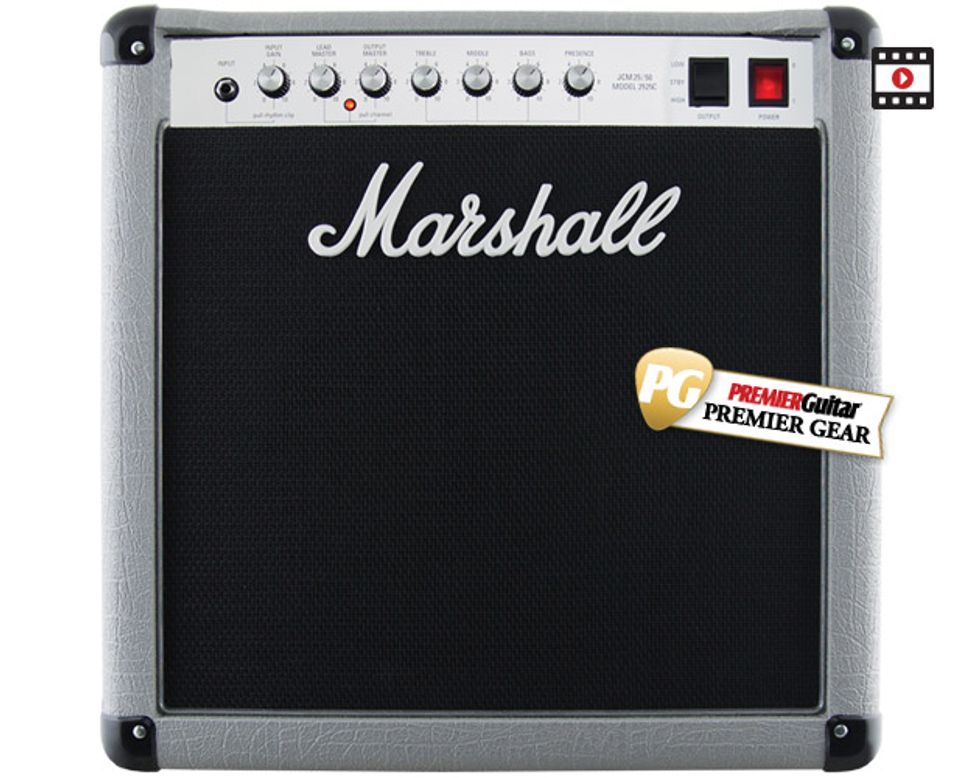
The Marshall 2525C Mini Jubilee is a 20W rendition of the Silver Jubilee and is available as a compact 1x12 combo (reviewed here) or head (the 2525H). It’s powered by three ECC83 preamp tubes and two EL34 power tubes, and—decked out in signature silver and grey vinyl and chrome—it exudes all the coolness of its big brother.
Brit Brute
While the Mini Jubilee is not the cheapest 20-watt combo out there, the price is not out of line within its category—on the high side, perhaps, for a production amp, but on the low-mid side for a boutique offering. Like most things in life though, you get what you pay for, and the Mini Jubilee, crafted at the Marshall factory in England, is very well built indeed. For one thing, it’s dead quiet. I didn’t encounter any humming, tube rattles, or extraneous noises throughout my test period. The pots, meanwhile, have a smooth, gradual taper that allows for balanced and organic transitions across all volume ranges. A 12" Celestion G12M-25 Greenback speaker lurks in the closed-back cab.
The Mini Jubilee’s controls are familiar and straightforward. From left to right, they are input gain (with a pull switch for rhythm gain), lead master, output master, treble, bass, middle, and presence. A footswitch is included for going from clean to dirty. The rear panel has five speaker-out options (1x16 ohm, 1x8 ohm, 1x4 ohm, 2x16 ohm, and 2x8 ohm) as well as a DI out—a nice feature that would be even nicer if there was a mute option for silent recording, as on Marshall’s TSL122.
Diminutive Demon
I tested the Mini Jubilee with an Ernie Ball Music Man Axis Sport, Fender Stratocaster, and Gibson Les Paul, along with a Line 6 M9 patched into the effects loop for some delay and reverb. The Mini Jubilee offers two power modes: high and low, which are 20 watts and 5 watts. I started my test at my apartment using the lead channel and the 5-watt setting. Because the Mini’s preamp section is similar in most respects to the bigger 2555X Jubilee head, it was no surprise that I could tap into the heavy tones that are the bigger amp’s calling card. With the output master between 0 and 2, I was able to get meaty tones at bedroom volumes that could stand in for much louder sounds in a recording situation. And where many low-to-mid-power amps—even at minimum volume—are still too loud for bedroom use, the low-wattage setting in the Mini Jubilee and the gentle taper of its volume controls generate big-but-quiet tones that never sound neutered.
It’s not just power that’s preserved at lower volumes. The Mini Jubilee also stays dynamic. And when I reached for uncommon chord structures, like consecutive stacked fifths on a detuned guitar with a considerable amount of gain lathered on, I heard clarity and felt picking sensitivity that I really didn’t expect.
Ratings
Pros:
Killer sounds across all volume ranges. Portable.
Cons:
Slightly heavy for a 20-watt combo.
Tones:

Ease of Use:
Build/Design:

Value:

Street:
$1,499.99

Marshall 2525C Mini Jubilee
marshallamps.com
The Mini Jubilee loves it loud, too. I used it for rehearsal with a fairly aggressive power trio and, at the 20W setting, had no problems rising above the din. Because a 1x12 combo just can’t move air the same way a 4 x12 cabinet can, the Mini Jubilee didn’t feel as massive as a stack. But I was able to really get the power tubes cooking—generating fat preamp saturation at much lower volume than I could with a 50- or 100-watt amp. Just as important: The amp’s small size meant that, unlike a stack, I could actually lug it to a NYC rehearsal.
House of Gain
You can extract a lot of gain flavors from the Mini Jubilee. Even with the input gain set as low as 1, the Mini Jubilee feels ready for action and itching for a fight—delivering detectible grind and sustain and the capacity for surprisingly screaming solos. With gain above the midpoint, the amp gets into hot-rodded, ’80s L.A. territory—inhabiting a heavy tone zone that can drive blossoming, detailed chords (imagine the rhythm figures in Van Halen’s “Girl Gone Bad”) or the articulate, nasty grinding sounds that propel low-string, boogie-rock riffs like ZZ Top’s “Just Got Paid.”
While many guitarists will inevitably gravitate toward the Mini Jubilee for heavy sounds at lower volumes, the little Marshall offers much on the lower gain side of the spectrum. On the clean channel, even with the input gain up around 8, it’s still surprisingly very clean, although heavy pick attack generates almost a Fender Tweed-like growl.
Pulling out the clean channel’s rhythm clip knob produces mildly overdriven tone variations that make a great foundation for classic rock or dirty blues. Chords take on a meaty crunch, and bluesy, single-note licks have bite that the regular clean channel can’t offer. It would be very cool if Marshall made the rhythm clip footswitchable.
The Verdict
The Mini Jubilee is both a great grab-and-go amp and studio workhorse. At 41.8 pounds, it’s heavier than many 20-watt amps. But if you’re after authentic Marshall tones, it’s a great alternative to breaking your back trying to carry a stack. The size-to-sound ratio of the Mini Jubilee also makes it just plain fun. Whether this version will attain the cult status of its bigger predecessor remains to be seen, but if you consider the flexibility the Mini offers for modern stage and studio applications, it definitely has the goods to become famous on its own terms.
Watch the Review Demo: