
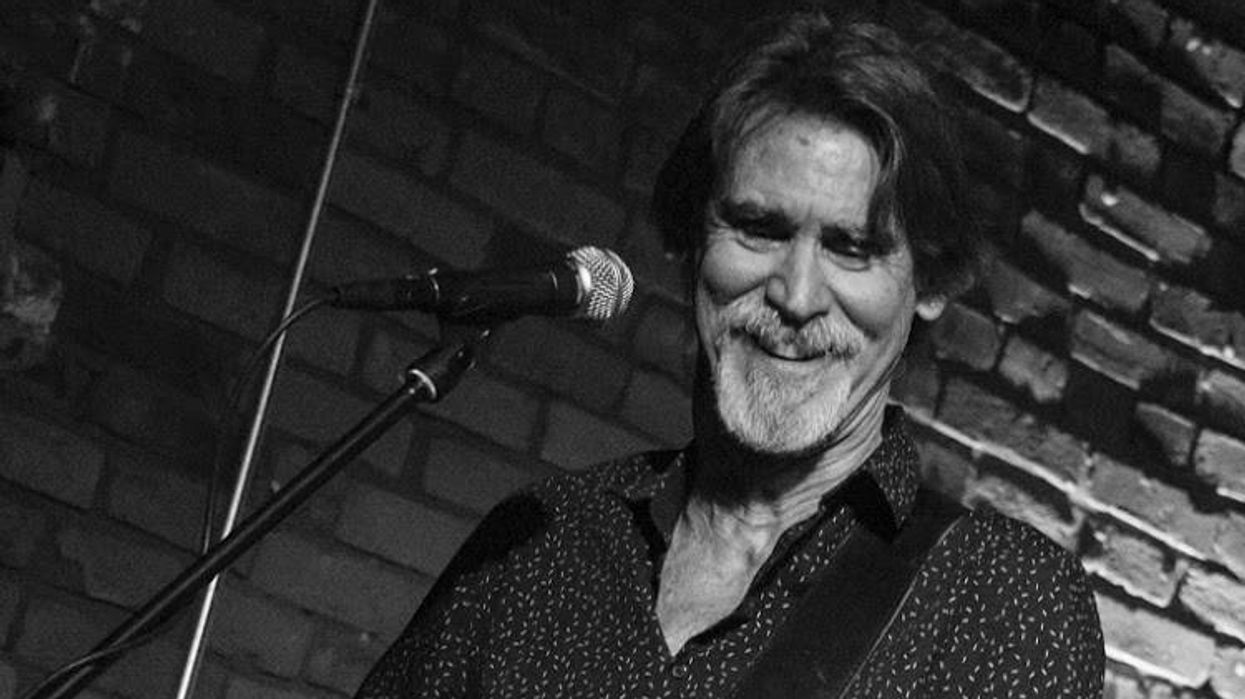
If the Grammys had a Best Supporting Player category, Will McFarlane would have a collection of little gold icons on his mantle. For more than 40 years, the lean, lanky 6-stringer has been an essential part of the Muscle Shoals recording scene, carrying the torch lit by the famed group of session players called the Swampers, who recorded classics with Aretha Franklin, the Rolling Stones, the Staple Singers, Bob Seger, Cher, Wilson Pickett, and Paul Simon, and set the die for the sound of many of the greatest American-flavored roots-based hits and albums of the ’60s and ’70s.
McFarlane has been a primary author of the chapters that followed. “After arriving and becoming embedded in the scene, Will became the central lead guitarist for the Muscle Shoals sound,” attests music historian and journalist Rob Bowman, whose Land of a Thousand Sessions: The Complete Muscle Shoals Story 1951–1985 has just been published. And so, McFarlane has recorded and played live with such legends as Bob Dylan, Bobby “Blue” Bland, Pops Staples, Little Milton, Candi Staton, Etta James, Johnny Taylor, and even Toby Keith. His work at the area’s tracking houses for the Jackson, Mississippi-based Malaco label helped define the sound of Southern-tradition-based blues, soul, r&b, and gospel from the ’80s to the early 2000s. And today, among the 6-string cognoscenti, McFarlane is a legend himself.
McFarlane’s days in the Shoals began after he met famed Swampers guitarist Jimmy Johnson at the Troubadour in West Hollywood. He recalls, “A friend, Duncan Cameron, who’d just done an album that Jimmy produced in Muscle Shoals with the Amazing Rhythm Aces, introduced us, and we were in Jimmy’s hotel room. Jimmy said, ‘Well, play me something.’ I had brought a guitar and I played a song I’d written called ‘A Secret Side of You,’ and then he said, ‘Play me something I don’t like.’ We hit it right off, and he asked me if he could fly me to Muscle Shoals to demo that song in a couple weeks.”
The band Johnson assembled for the session was essentially a subset of the Swampers that included bassist David Hood, drummer Roger Hawkins, and keyboardist Clayton Ivey. McFarlane continues, “I played the song for Clayton, and he did a quick numbers chart, which I had never seen, but I totally got it. We played it down quick, Jimmy hit the red light, and we played it through. Afterwards, Jimmy asked, ‘Any confessions?’ I turned to David and said, ‘Do y’all keep first takes around here?’ And he said, ‘All the time.’”
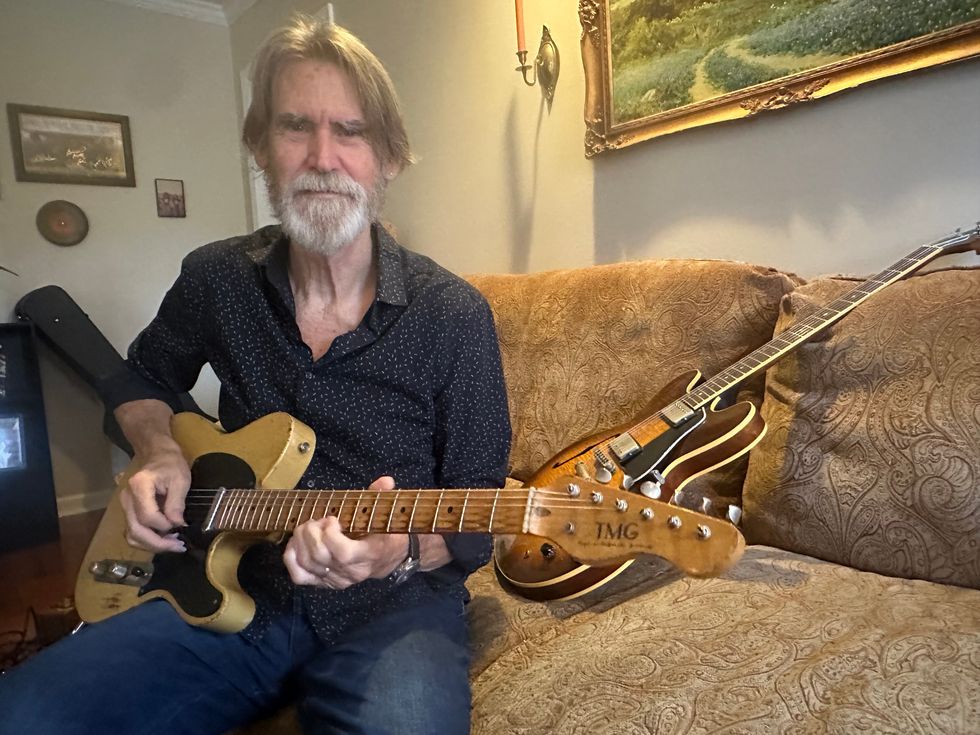 Will McFarlane keeps a Deluxe Memory Man in line with a Princeton—his rig for noodling on the couch at home. Ted Drozdowski
 Will McFarlane’s Gear
GUITARS
- 1954 Fender Stratocaster (white refin)
- 1963 Fender Stratocaster (sunburst)
- Gibson ES-335
- Gibson Les Paul Classic
- Reverend Rick Vito Soulshaker
- Strat-style Danocaster
- TMG Custom Relic Tele-style
AMPS
- 1958 Fender Champ
- 1964 Fender Princeton
- 1969 Fender Princeton
- Carr Sportsman
- Carr Rambler
- Tyler 20-20
EFFECTS
- Strymon Flint
- JHS Panther Cub
- JHS Pulp ’N’ Peel
- JHS Moonshine
- JHS Morning Glory
- JHS The Milkman
- JHS Flight Delay
- JHS Phaser
- Harby Centauri
- Keeley C-2 Compressor
- FX Engineering RAF Mirage
- Boss RC-20
- Bad Cat Siamese Drive
- EHX Deluxe Memory Man
- Dunlop Cry Baby
- Ernie Ball Volume Pedal
STRINGS, PICKS, & SLIDES
- D’Addario NYXL (.010s–.046)
- Dunlop Ultex 1.0s
- Jimmy Johnson’s Custom “Swampers” Picks
- Coricidin bottles
- Dunlop Moonshine Ceramic
- Furious Slides Titanium
As luck had it, Roger McGuinn and Chris Hillman were making an album in the next studio at Cypress Moon, one of Muscle Shoals’ three historic studios along with Muscle Shoal Sound and FAME (and yes, you can tour all three). They heard the tune and cut it for the LP they were working on, 1980’s McGuinn-Hillman.
“I thought, ‘Wow, this is easy,’” McFarlane says. “I’d worked with [producer] Paul Rothschild on Bonnie Raitt records. Paul was into splicing tape. So we’d take 20 takes of a song sometimes. And I’d come back the next morning and there’d be a pile of two-inch tape on the floor. I went back to LA and I gave everybody notice.”
“I turned to David Hood and said, ‘Do y’all keep first takes around here?’ And he said, ’All the time.’”
Relocating to Muscle Shoals ended McFarlane’s 1974-to-1980 stint in Raitt’s band, but the route he traveled began earlier—perhaps even at birth, in 1952, on a Naval base in Coronado, California. “My mom, who died when I was 5, had perfect pitch and studied music at the University of Texas,” he says. “Apparently, she could turn her back on a piano and if you hit a chord she could tell you all the notes in the chord. So, she left the DNA with me.”
McFarlane comes from a family of military men, but like many musicians of his age, his destiny was changed by the Beatles’ first appearance on The Ed Sullivan Show. His first guitar was a plywood Regal acoustic, which was soon replaced by a Teisco-style electric, with light-switch pickup selectors, gold-foils, and a baseball-bat neck. The need to upgrade was compelling when he began playing in a band.
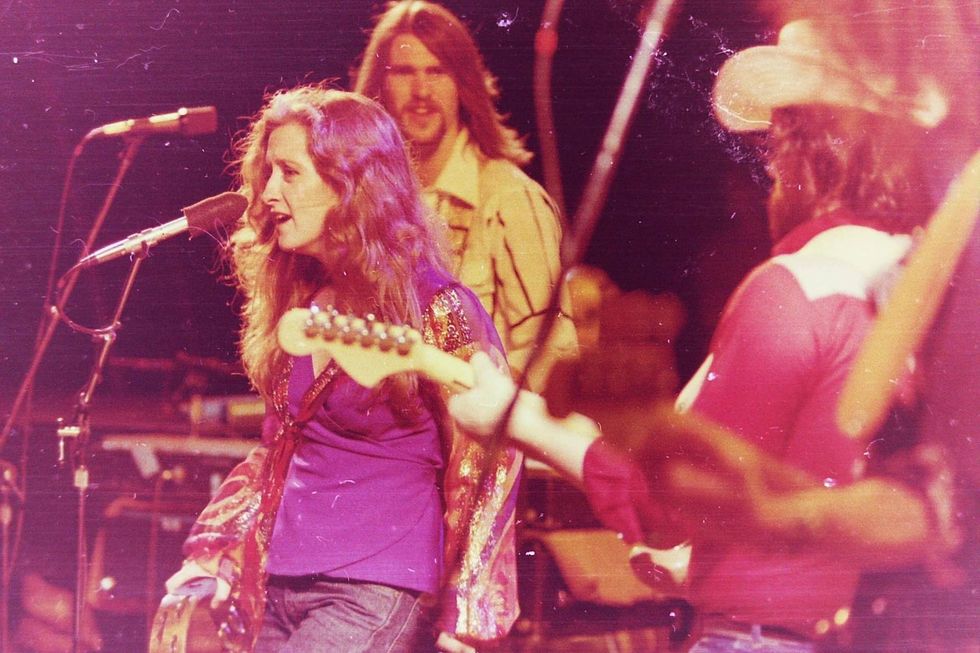
McFarlane is onstage with Bonnie Raitt and Lowell George in this vintage photo. “When I was with Bonnie, Lowell would invite me out every now and then to sit in on the encore,” he says. “It was frightening. He’d get a Y-cord and plug me into his rig, and that was the first time I played with compression and delay and a Dumble.”
courtesy of Will McFarlane
“There was an ad in the paper that just said, ‘Gibson guitar and amp, $150.’ I begged my dad to please, please get me this guitar. So we went out to a poacher's cabin in the woods, in the swamp. There were beer cans all over, and alligator jaws. He had a white SG with three gold humbuckers, a teak bridge, and mother-of-pearl inlays, and it said Les Paul Anniversary on the truss rod cover. The amp was a Gibson Falcon.” Unfortunately the Falcon could not compete with drums, so after his father was reassigned to New York, McFarlane eventually replaced it with a black-panel piggyback Bassman.
His chops developed around his love for r&b and Motown, and then blues and soul. And he joined an ambitious band that chased their collective dreams to the West Coast, Colorado, D.C., and Cambridge, Massachusetts. That where’s Dick Waterman, who managed Raitt as well as Son House, John Hurt, Buddy Guy and Junior Wells, Fred McDowell, Skip James, and other blues legends, discovered McFarlane playing a small club called Jack’s on Massachusetts Avenue.
“It’s amazing! You’re making 10 bucks a night and all the beer you can drink, and the next thing you know you’re on a sound stage in L.A. with Jackson Brown and David Lindley, and Linda Ronstadt is stopping by to say ‘hi.’”
McFarlane knew who Waterman was and had spotted him sitting at the back of the room over a string of his band’s weekly gigs. One night, Waterman brought Bonnie Raitt along and sat at a front table. By closing time, McFarlane was hired. “It’s amazing,” he recalls. “You’re making 10 bucks a night and all the beer you can drink, and the next thing you know you’re on a sound stage in L.A. with Jackson Brown and David Lindley, and Linda Ronstadt is stopping by to say ‘hi.’”
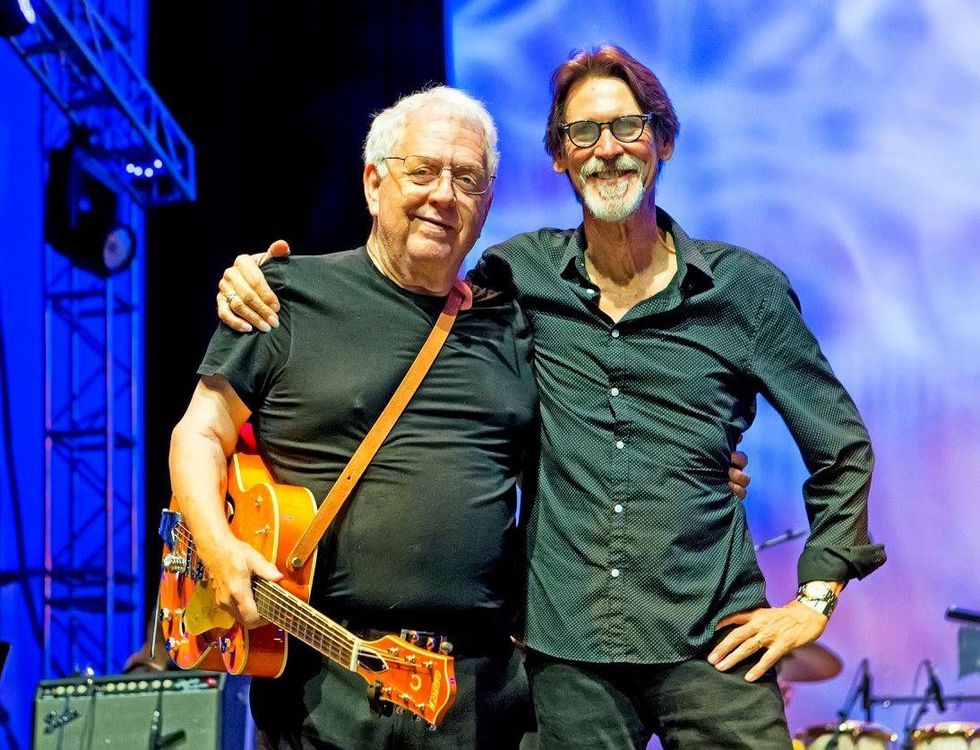
McFarlane poses with his mentor, Jimmy Johnson, who introduced him to Muscle Shoals and ushered him into the region’s studio session community.
courtesy of Will McFarlane
With the experience of recording and touring with Raitt, and the influence of his heroes Cornell Dupree, Reggie Young, Jessie Ed Davis, and Steve Cropper deep in his trick bag, McFarlane was a snug fit for the Muscle Shoals scene, where that intangible yet palpable quality called “soul” is as central to the region’s music and culture as the Tennessee River.
Just sitting on a couch in his home as we talk, the buttery midrange of the’54 Strat he’s fiddling with sings with a blend of clarity and light hair, emitting a poem of elegant notes that comes effortlessly. It’s this seemingly innate, almost telekinetic ability paired with intention, expertise, and warm positivity that’s made him an MVP.
“After I got here, Jimmy Johnson started to include me in everything,” says McFarlane, who describes himself as a stream-of-consciousness player. “Normally, you can’t just move in and get a lot of work, but Jimmy really was just great. Even when the Swampers were inducted into the Musicians Hall of Fame, Jimmy said, ‘We couldn’t have done it without our friends.’” So McFarlane was included in the induction, along with keyboardists Spooner Oldham and Clayton Ivey, and guitarist Pete Carr.
“Once, I was asked to do a guide vocal for Little Milton. That was intimidating.”
In particular, McFarlane became a favorite of the old-school blues, soul, and gospel performers signed to Malaco Records, an indie-label powerhouse that sold millions of albums—mostly to a middle-aged-and-up Black audience—in the ’80s and ’90s. Bobby Bland, Little Milton, Denise LaSalle, Shirley Brown, Johnnie Taylor, and many others “greeted me with their arms wide open,” says McFarlane. “I have so many great memories, from making music to shooting pool with Milton and Bobby. Bobby would turn to me before a take and say, ‘Give me those love licks!’ I’m always up for anything in the studio. Once, I was asked to do a guide vocal for Little Milton. That was intimidating.”
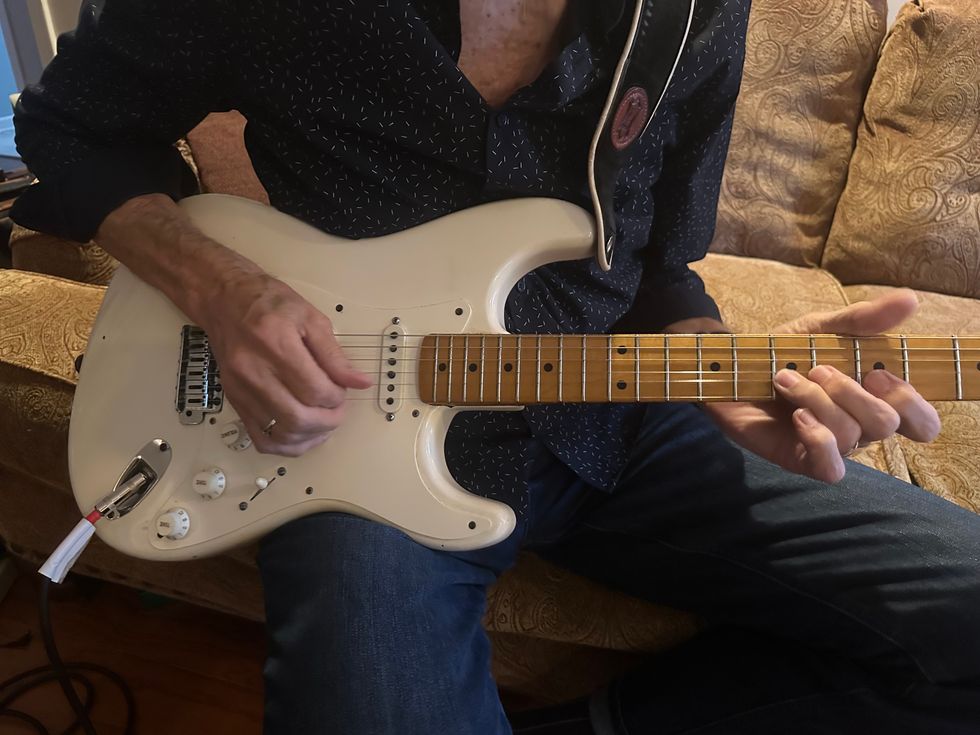
McFarlane acquired this refinished 1954 Stratocaster when he was with Bonnie Raitt.
Ted Drozdowski
The caliber of those artists and their recordings should never be underestimated. “Cutting ‘Last Two Dollars’ with Johnnie Taylor, I thought I was just going to play a rhythm track, but I was the only guitar player when they went, ‘kick us off,’” McFarlane recounts. “I only had my Telecaster plugged straight into the amp, so I flipped it to the front pickup. When you listen to the track, where there’s a rhythm part going, there’s no fills, and no fills where there’s rhythm. It was just one pass, because you could tell when Johnnie was singing that ‘this is the take.’”
He continues, “Listening to Johnnie Taylor in headphones was like listening to Sam Cooke. I don’t think he ever punched in a vocal. Matter of fact, at one point, he got to a session late. We’d already cut three tracks for him. And the producer went, ‘Hey, Johnny, would you go out there and give me a scratch vocal?’” McFarlane laughs. “He just turned around and goes, ‘I don't do scratch vocals.’”
While the pace of recording in Muscle Shoals has slowed today, the legacy of the music made there and of the people who made it remains undimmed. Nashville’s Country Music Hall of Fame and Museum has just inaugurated the comprehensive exhibit Muscle Shoals: Low Rhythm Rising, devoted to the art that emerged from what might otherwise be considered an Alabama backwater, compared to other recording capitals. In addition to the sonic results that came from the Shoals, it’s also important to remember that the studios’ foundational work was done in the face of segregation, and, like Stax and Motown recordings and artists, this played an important role in breaking down racial barriers. (You can visit the Country Music Hall of Fame website to eyeball some of Low Rhythm Rising’s artifacts, including Duane Allman’s 1964 Strat and Pop Staples’ 1970 Tele, which he played in the Band’s historic concert film, The Last Waltz.)
McFarlane was the music director for a Nashville concert celebrating the three-year-long exhibit’s debut in November. The show found him onstage with the great soul songwriter Dan Penn (“Do Right Woman, Do Right Man,” “I’m Your Puppet’), Spooner Oldham, Bettye LaVette, Candi Staton, Jimmy Hall, John Paul White, and his old friend Clayton Ivey, among others.
McFarlane regularly performs with Hall, the frontman of ’70s soul-rock hitmakers Wet Willie and a touring vocalist with Jeff Beck. The guitarist also co-leads Big Shoes, a Little Feat-inspired band. And he’s recorded about a dozen faith-based albums and singles under his own name. Of course, more sessions are always on the table.
“At this point, I don’t have any delusions of stardom,” McFarlane observes. “But I do have a life full of camaraderie and making great music that I love with my friends and heroes, and being in a rhythm section. I’m grateful for all that.”
Take a Deep Dive into the Shoals
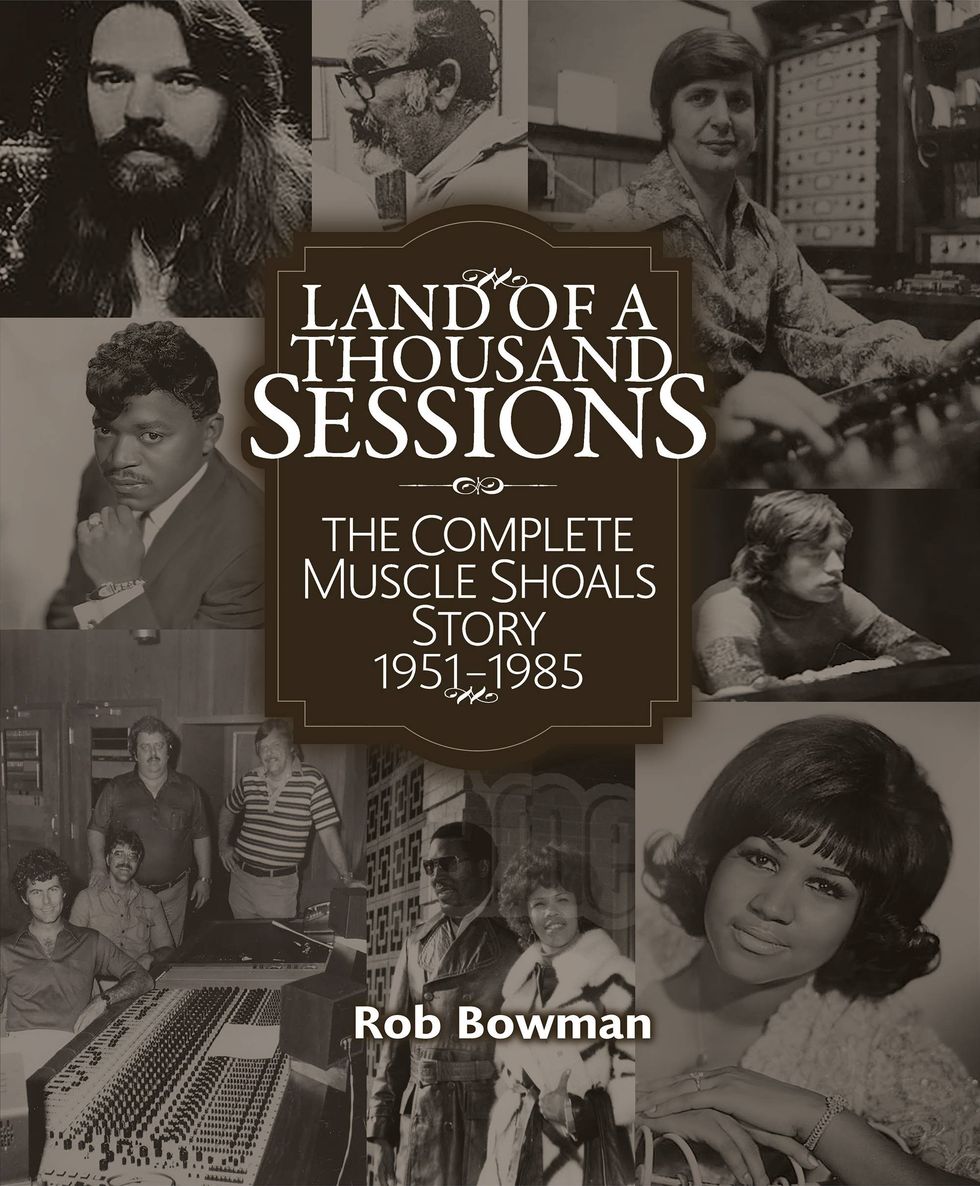
For a definitive look at the formative history of the Muscle Shoals Studio scene and its defining music, look to Rob Bowman’s new book, Land of a Thousand Sessions: The Complete Muscle Shoals Story 1951-1985. At 750 pages, the six-time-Grammy-nominated music journalist and historian spares no details.
The book was a six-year passion project for Bowman, and is buoyed by interviews with nearly 100 key figures, including Jimmy Johnson and Mick Jagger. He also dives into what most would consider the off-brand sessions that happened in the 10 studios covered in the volume’s 34-year span, from prog rock to psychedelic blues. And, of course, the racial climate in which Black and white musicians united in harmony to make some of the finest recordings of all time.