

Low-to-medium gain clip.
Rhythm track: Gain at 8, EQ noon, Clip at zero, volume bass and treble at noon.
Lead Track: Gain at 11 o’clock, volume at 10 o’clock, clip at zero until 0:37 when clip goes up to 3 o’clock, gain to 2 o’clock, and volume to 9 o’clock. (note extra saturation and volume drop—this would be much hotter, high-gain signal with a little extra volume).
RatingsPros:Impressive smooth-to-savage and low-to-high-gain versatility. Thoughtfully executed design and build. Fair price. Cons: Vintage RAT tones can be elusive and difficult to pinpoint with the more complex control set. Street: $165 Magnetic Effects Lonely Robot magneticeffects.net | Tones:  Ease of Use:  Build/Design:  Value:
|

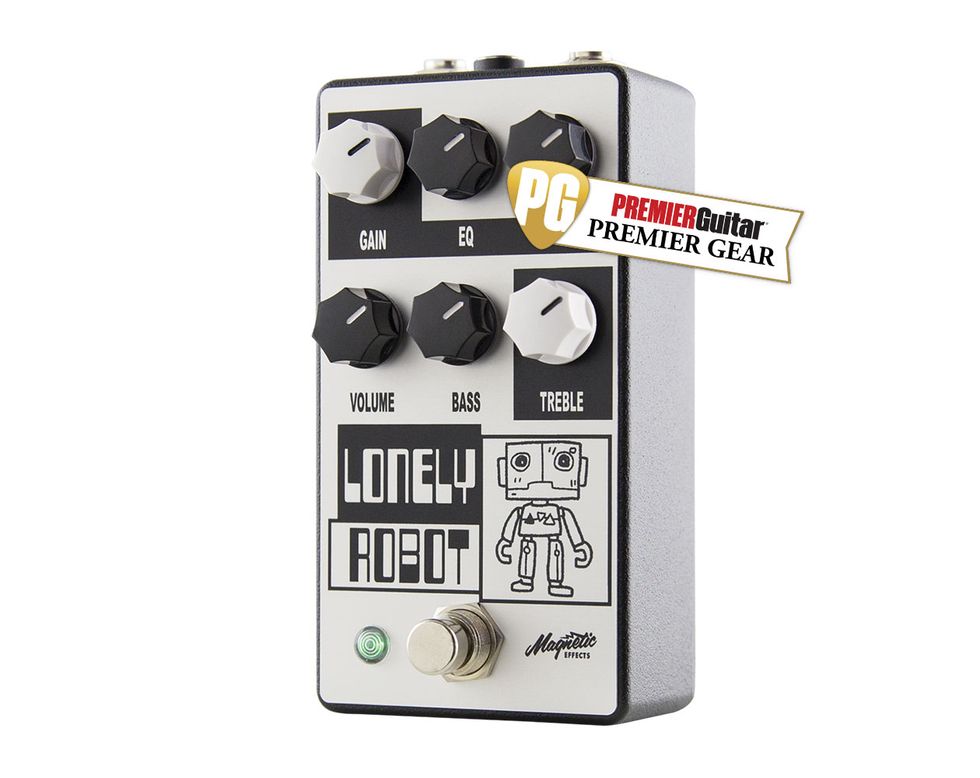
A many-headed rat is a nightmarish notion. In the stompbox universe though, it’s a very appealing proposition—at least if you’re talking about the mutation of a certain classic distortion circuit. And Magnetic Effects’ Lonely Robot is indeed a multi-faceted—one might say hydra-headed—evolution of Pro Co’s standard-bearing RAT.
Pro Co’s original RAT and RAT 2 could generate smooth-to-punky distortion, searing lead tones, and wooly stoner rock haze—all from a master volume, a distortion control, and a clever filter ranging from bright to blunted. But as anyone who has spent time with an old RAT can tell you, there are days when you long for a touch of treble on top of those smoky filtered sounds, or a bit of ballast for its toppy, grinding high-gain tones. The Lonely Robot delivers many such tones—all on top of a thoughtfully voiced RAT-influenced foundation that’s enhanced with an expanded control set. The many extra colors the circuit creates make the Lonely Robot a monstrous, malleable variation on the RAT motif.
OpAmp Identity Crisis
The Lonely Robot circuit features several essential ingredients from the classic RAT formula. A National Semiconductor LM308N OpAmp is at the heart of the circuit. And though the importance of this particular component remains up for debate in some circles, it’s almost always a feature of the best vintage RAT specimens.
The big difference in the Lonely Robot is the impressively flexible control array that expands on the original RAT’s volume/distortion/filter equation. Practically and functionally speaking, the Lonely Robot’s bass, treble, EQ, and clip (clipping threshold) controls take the place of the RAT’s filter control. Players happy to dive headlong into intuitive exploration of a pedal’s performance envelope will love the interactivity and sensitivity of these controls. But old-school RAT users looking for a seamless transition between pedals may have to do more homework and experimentation. The more complex control set means precisely equivalent tones between a RAT and the Lonely Robot can be tricky to pinpoint. The consolation is that the many in-between tone colors you’ll find instead are numerous and fantastic.
Rodent Wisdom
While finding approximations of favorite RAT tones probably isn’t the most satisfying way to experience the Lonely Robot, using it to tailor distortion sounds that dovetail with your guitar, pickups, and amp is a joy. The Lonely Robot’s tones are often richer and more complex than a typical RAT’s. And you can sculpt sounds for specific instruments and musical expressions in very precise ways.
One effective technique for finding sweet spots in the Lonely Robot’s voice is to dial in a gain level, set bass and treble EQ controls around noon, and place the clipping threshold at its most open and uncompressed full counter-clockwise position. From here it’s relatively easy to explore and hear subtle variations from the bass, treble, and EQ controls and the way they interact with your instrument and amp.
Magnetic Effects says the EQ control is designed to control the amount of gain applied at specific frequencies. But I didn’t hear any evidence that the EQ control boosts a specific frequency range at a given position. Instead, the EQ knob seems to work much like a presence control on an amplifier—exciting upper-mid content and accenting the pedal’s husky distortion peaks at one end of its range and mellowing the output, reducing sizzle, and emphasizing warm, round bass overtones at the other.
The clipping threshold control is more mysterious. But its utility becomes more apparent as you home in on a tone you like. It’s useful to think of the clip control in terms of compression. Moving clockwise through its range toward extreme settings dulls picking attack and saturates the signal. Typically, I kept this control at its lowest extremes, which results in an airier, more open signal. But I enjoyed the effect in small doses, and it can be very useful for taming treble spikes in high-gain settings.
In general, the Lonely Robot’s distortion voice is as rich and growly as a good RAT’s, and then some. High-gain tones range from singing contoured lead sounds to fuzzy textures with rich high-mid presence. Mid-gain tones can move from smoother almost Marshall-like distortion to ragged and punky, depending on how you situate the treble, bass, EQ, and clip controls. Low-gain tones, meanwhile, are exceptional and the real surprise. I doubt many players have considered a RAT-style pedal for near-clean boost duties, but the Lonely Robot excels in this setting—adding heat and body to single notes and sparkle and attitude to chord arpeggios.
The Verdict
The Lonely Robot is wonderfully versatile. It’s not as easy to use or as intuitive as an original RAT and chasing specific vintage RAT tones via the interactive control set can lead you down the occasional rabbit hole. The flipside is that the Lonely Robot’s fine-tuning capabilities lead to unexpected surprises and make it a joy to match to specific rigs, making it a potentially valuable studio tool. It also possesses a capacity for airiness and articulation that a vintage RAT cannot easily match. And even if this greater civility sometimes seems to come at the expense of an original’s feral appeal, the Lonely Robot generates unique variations of the RAT voice that are equally intriguing and exciting.