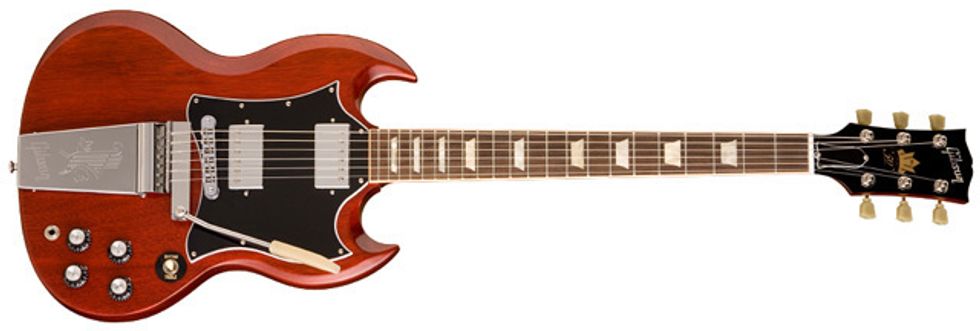
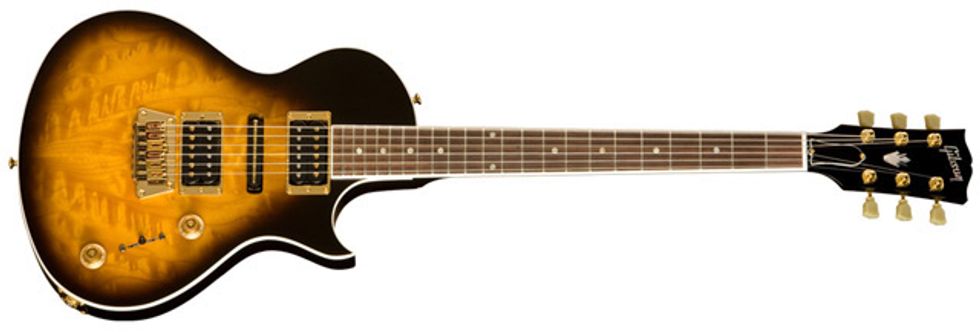
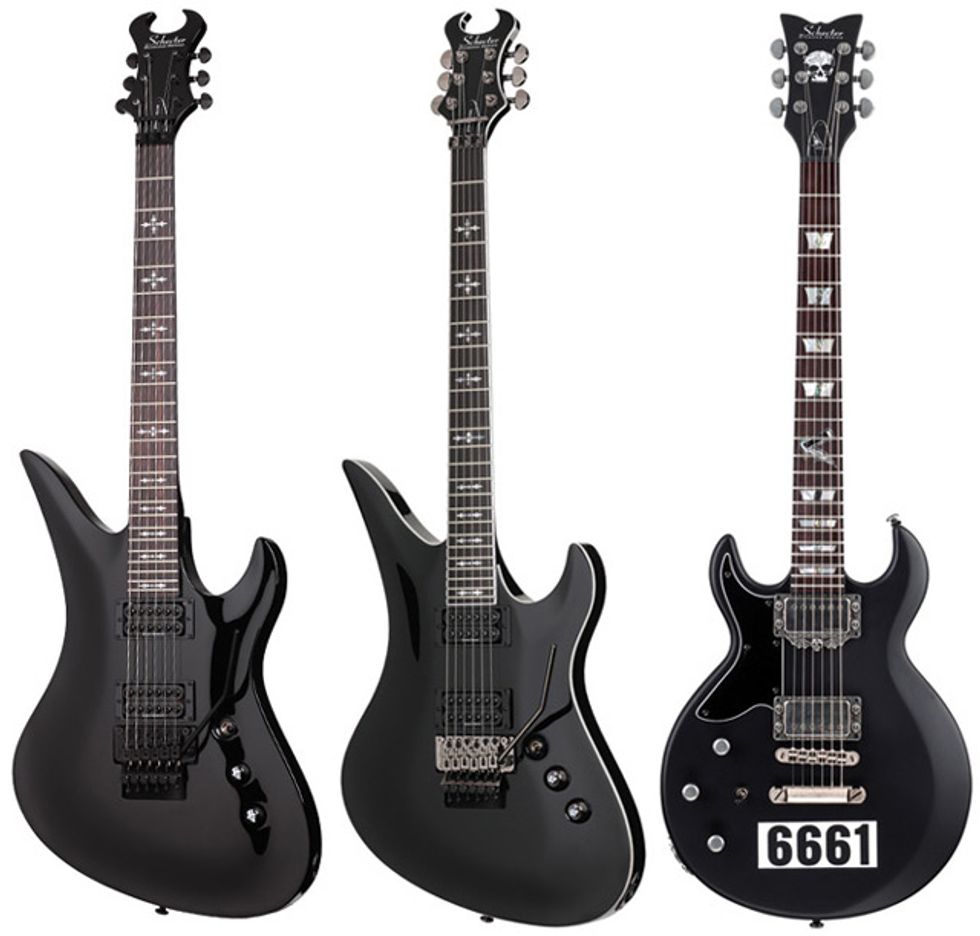
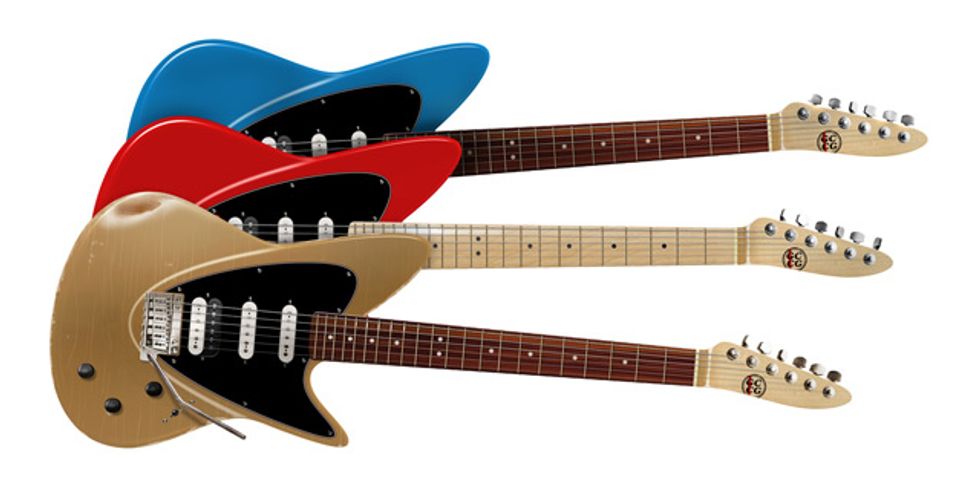
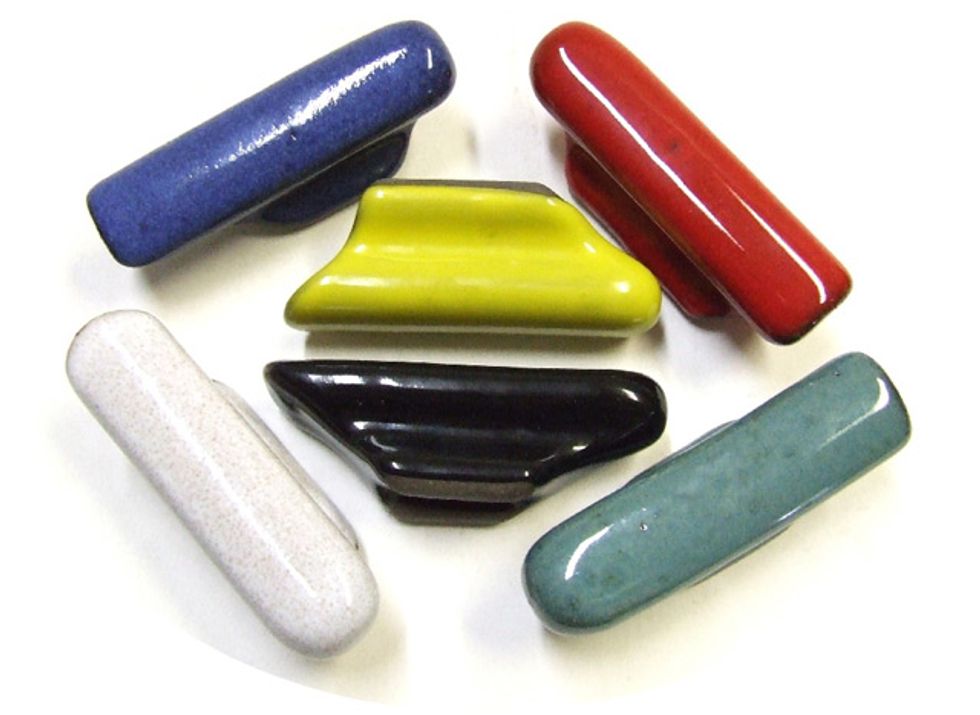
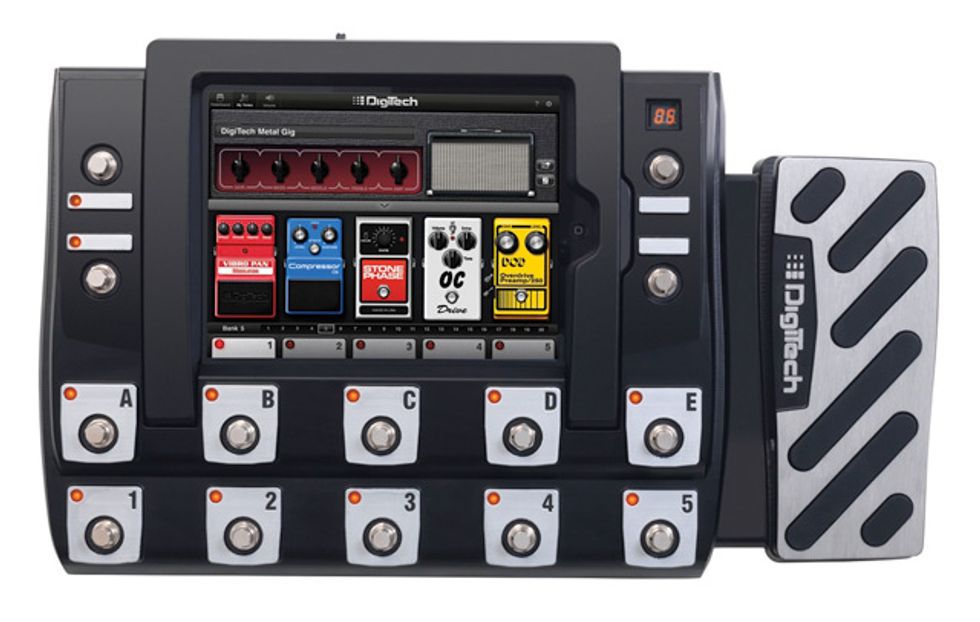
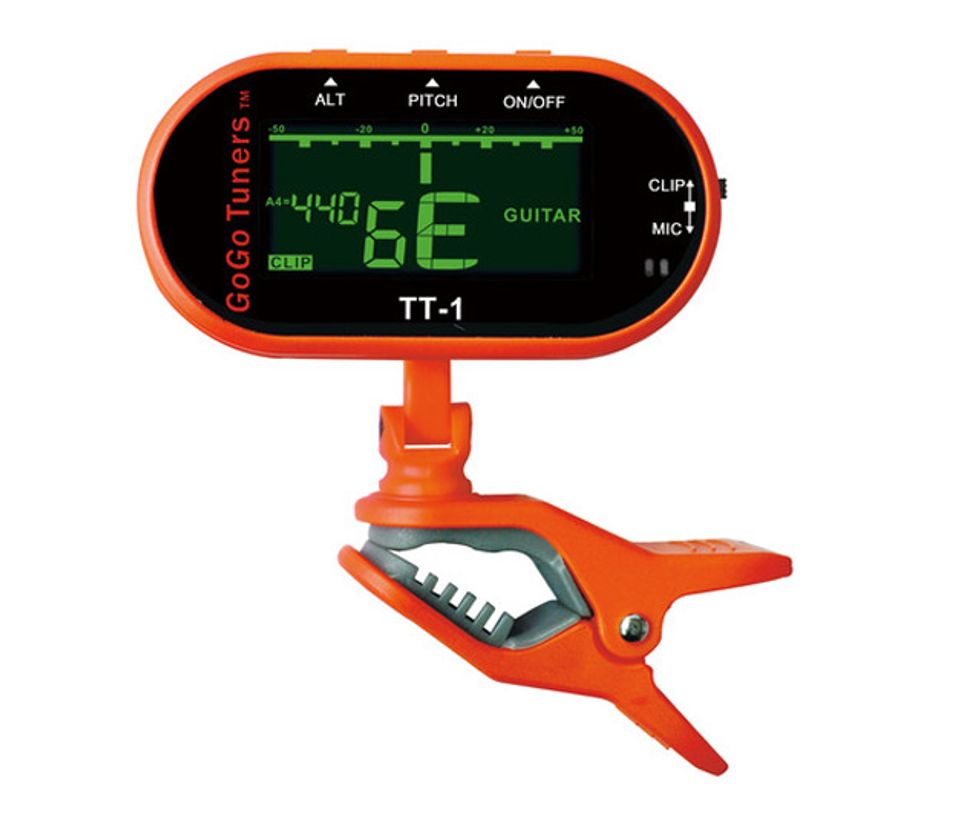
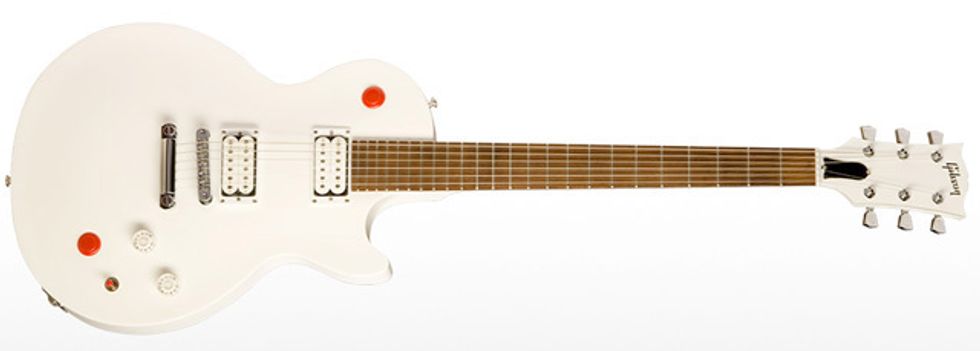
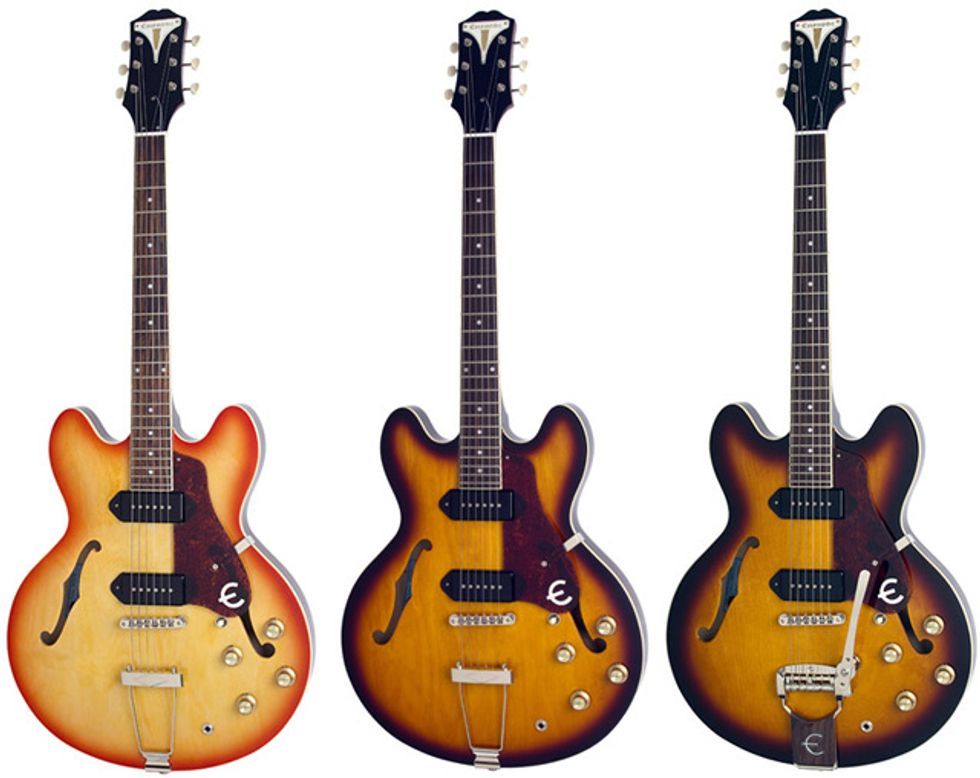
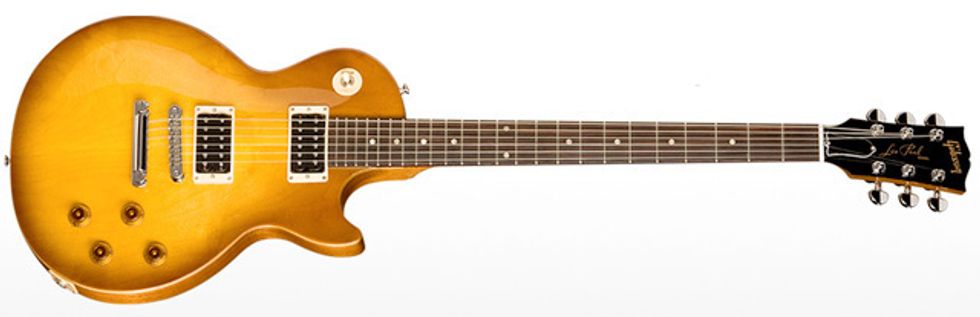
The anniversary guitar features a pair of '57 Alnico pickups with phase switching and a Maestro Vibrola with vintage-style рLyreс tailpiece. It has 22 medium-jumbo frets on a rosewood fingerboard with a mahogany neck and body. MSRP: $2839 gibson.com
Pedalboards tell stories, and this year's submissions prove it! From the minimalist who ditched the road case and went back to a One Spot on the floor, to the collector building a “Starboard” entirely from famous guitarists’ gear, to the neurosurgery videographer crafting soundscapes for the nervous system—these rigs reflect real lives and real gigs. Bass players with bamboo builds, experimentalists with dual boards, and portable warriors powering entire rigs from USB banks all made the cut. Here are seven boards with stories to tell.
New Wave Happy Place
Reader: Stephen Jackson
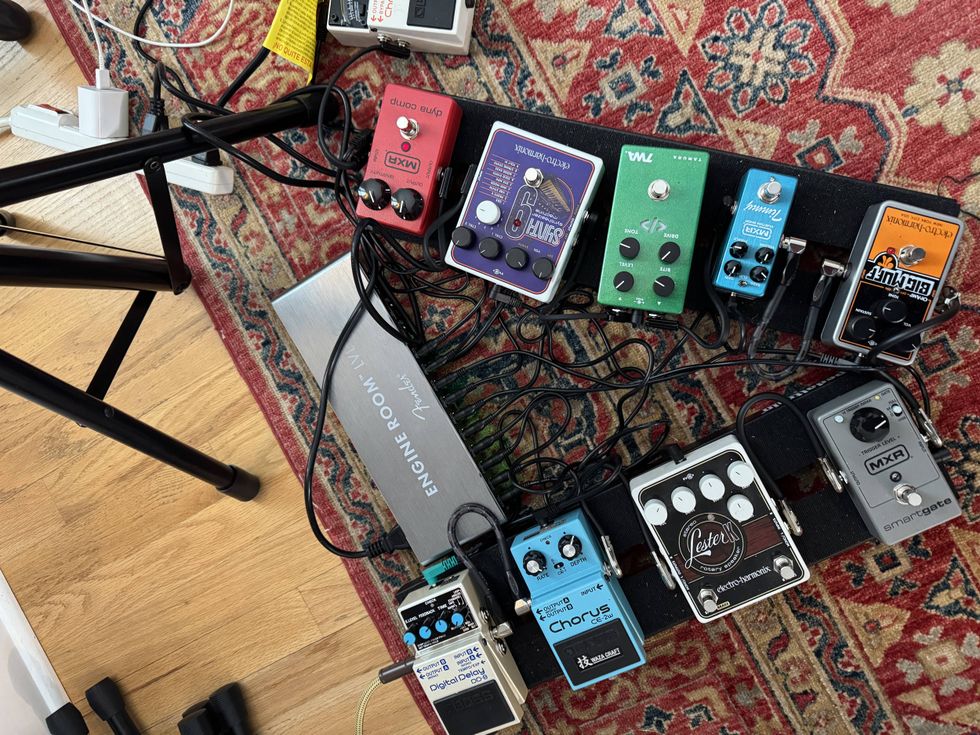
I’m a pretty ordinary guitar player, but I’ve loaded up on ten pedals that make me sound halfway decent. For me, my happy-place sonics are from the diffuse new wave genre of the late 1970s to mid-1980s. I just can’t get enough.
I prefer keyboard-dominated new wave that’s generally kind to enthusiastic but ordinary guitarists. I like it nice and dark—the Cure, Siouxsie and the Banshees, or the Cocteau Twins—or more pop-ish with some grit, like the Psychedelic Furs. I also love what I call “skinny guitar rock new wave”—earlier Talking Heads or Elvis Costello.
My pedals are powered by a Fender Engine Room LVL12, which is great for cutting down amp hum. Yes, there are battery packs that power pedals and may even help reduce cord hum, but they make me nervous—I forget to charge my phone or my vacuum stick, let alone a battery pack.
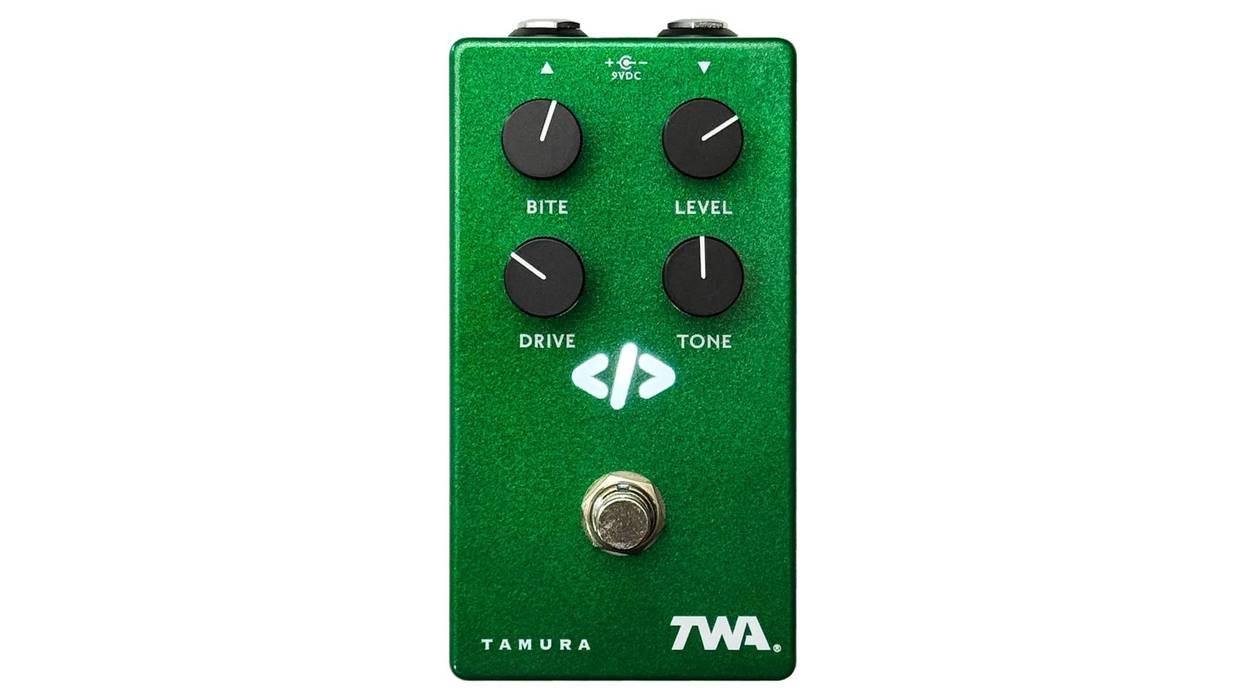
The first port-of-call from guitar to amp on my rig is a Boss TU-3 Chromatic Tuner. Next is an always-on MXR Dyna Comp compressor. Following that is a new wave synth staple, an Electro-Harmonix Synth9. Then the overdrive pedals: a newly-released entry in the Tube Screamer lineage, the TWA SC-01 Source Code, which is commonly on and dialed up relatively mellow; a kicked-up MXR Timmy; and a seething and spitting Electro-Harmonix Op Amp Big Muff Pi. My skinny rock songs get the SC-01 treatment or a Timmy on occasion. Oddly enough, the Big Muff is at home when turned down to backing some electronica—Berlin, for instance—as well as noisy new wave.
Next up is an MXR Smart Gate. Before I added that—and the Fender Engine Room—my Fender Jazz Bass had an annoying hum. Not anymore.
Finally, there are three stomps that, along with the Synth9, get my sound to the electronica and pop new wave happy place: an Electro-Harmonix Lester K stereo rotary speaker pedal, a Boss CE-2W Waza Craft Chorus, and a Boss DD-8 Digital Delay. My advice: never fear a chorus pedal.
Portable Power
Reader: Adam Thomas
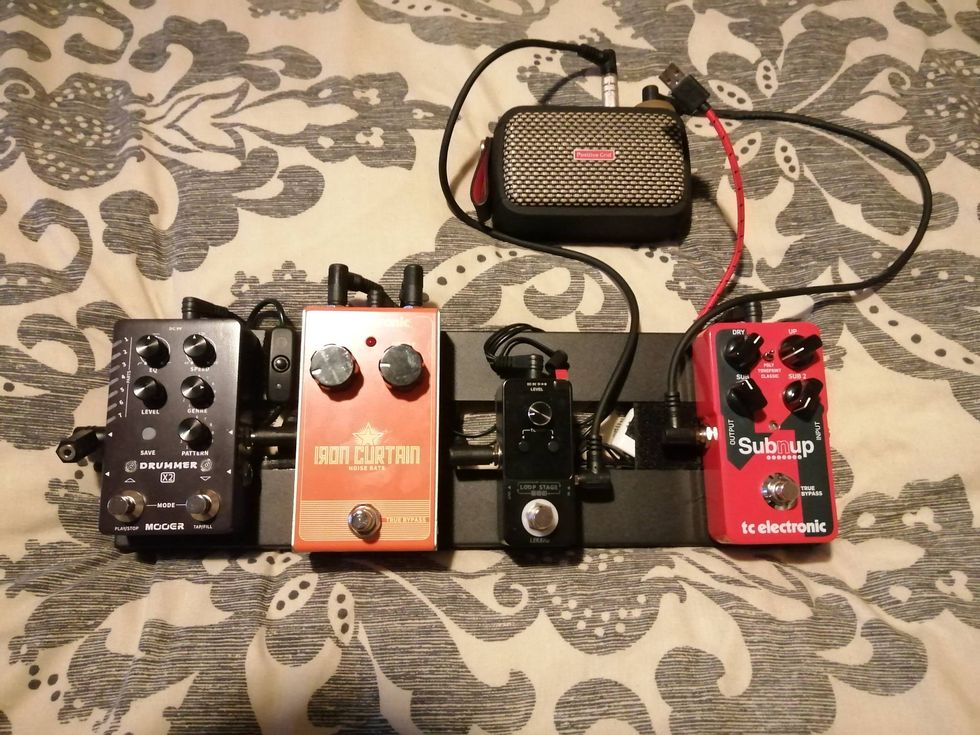
The board itself has a Li’l-moXie power supply hiding underneath. The red USB cable plugs into any USB power bank and powers the whole rig. The guitar output plugs straight into the [TC Electronic] Sub ’N’ Up [Octaver] pedal for the creation of bass lines and general low-frequency ambience. From there the signal travels to the Spark GO to be given a thorough going-over before it heads into the Lekato Looper. The second layer of the loop probably needs a true bypass from the Sub ’N’ Up and a different preset on the GO—no problem if you have the Spark Control X.
Next I send the signal into the [TC Electronic] Iron Curtain noise gate to get rid of any little imperfections created by the looper, and off we go to the Mooer Drummer X2 to provide some rhythmic accompaniment. I send the final output to a SubZero 15" portable PA (battery powered) via a stereo splitter line, giving me more options than you can shake a stick at for the entertainment of your fellow man, no matter where you may find them.
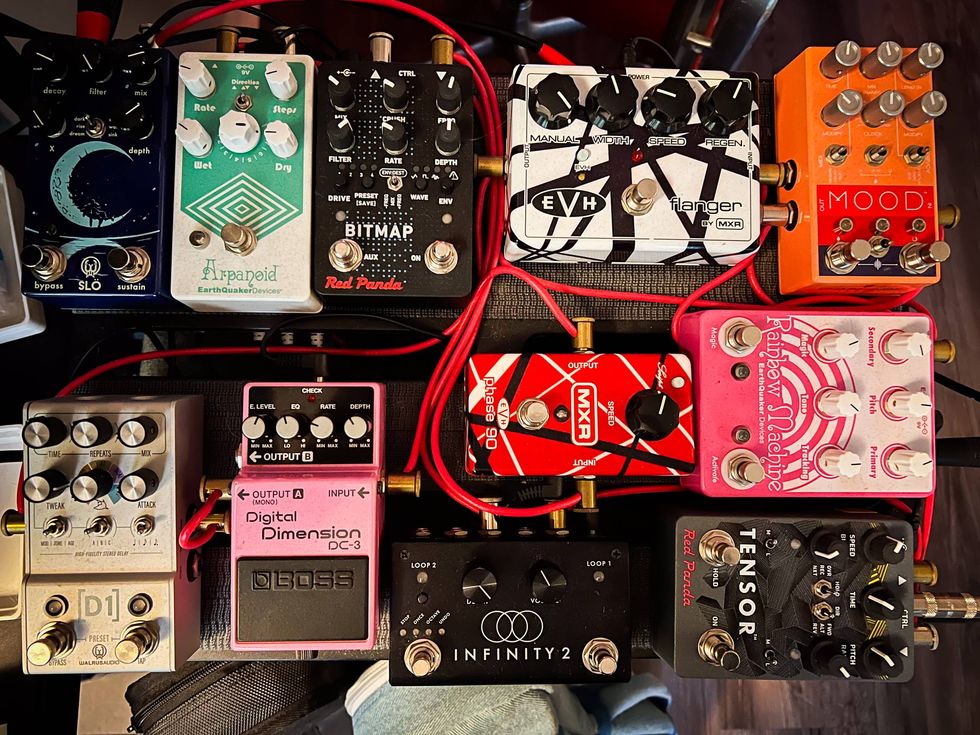
Experimental Lab
Reader: Kurt Nolen
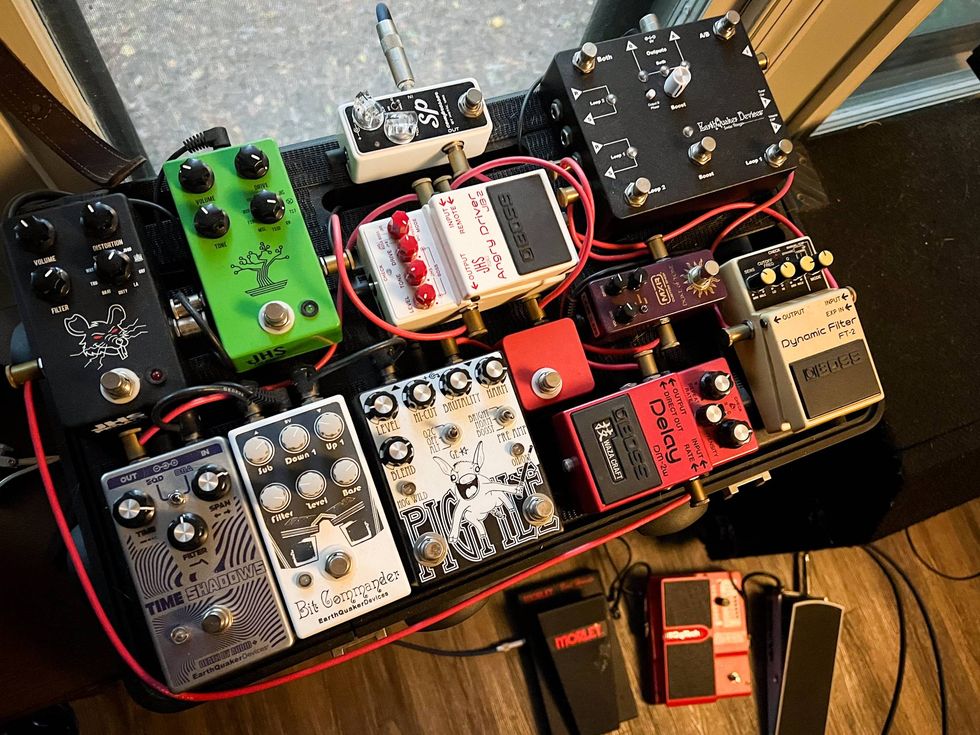
I’m the Medical Photographer/Videographer for the University of North Carolina School of Medicine Department of Neurosurgery, and frequently need to produce educational/academic or communications-related videos. Sometimes this material can use more narrative styles of music, but frequently it needs textural soundscapes that reference the subject matter in the video and drive viewer interest without being distracting. Want to evoke the sound of your globus pallidus? What does your nervous system sound like? What would high-intensity, focused ultrasound treatment sound like if you could hear it? This rig does it. I’m also an experimental composer and noise artist in my free time and needed something that could serve that purpose—or for sitting in with my friend’s Oingo Boingo cover band.
Board #1 (front of amp): guitar into Ernie Ball VPJR, DigiTech Whammy 4, Morley Bad Horsie, Xotic SP Compressor, Boss FT-2 Dynamic Filter, EarthQuaker Devices Swiss Things—loop 1 out to MXR Duke of Tone, Electrofoods Ultd Pigpile fuzz, EarthQuaker Devices Bit Commander, EarthQuaker Devices Time Shadows V1, Boss JB-2 (with JHS Red Remote), JHS Bonsai, JHS PackRat, Boss DM-2W to loop 1 return.
Board #2 (amp FX loop or loop 2 on EQD Swiss Things if running direct): FX out to EarthQuaker Devices Rainbow Machine, MXR EVH117 Flanger, MXR EVH Phase 90, Boss DC-3, Walrus Mako D1 Delay V2, Red Panda Bitmap, EarthQuaker Devices Arpanoid, Chase Bliss Audio MOOD, Red Panda Tensor, Pigtronix Infinity 2, Walrus Audio Slö Multi Texture Reverb to FX return (or Swiss Things loop 2 return if direct).
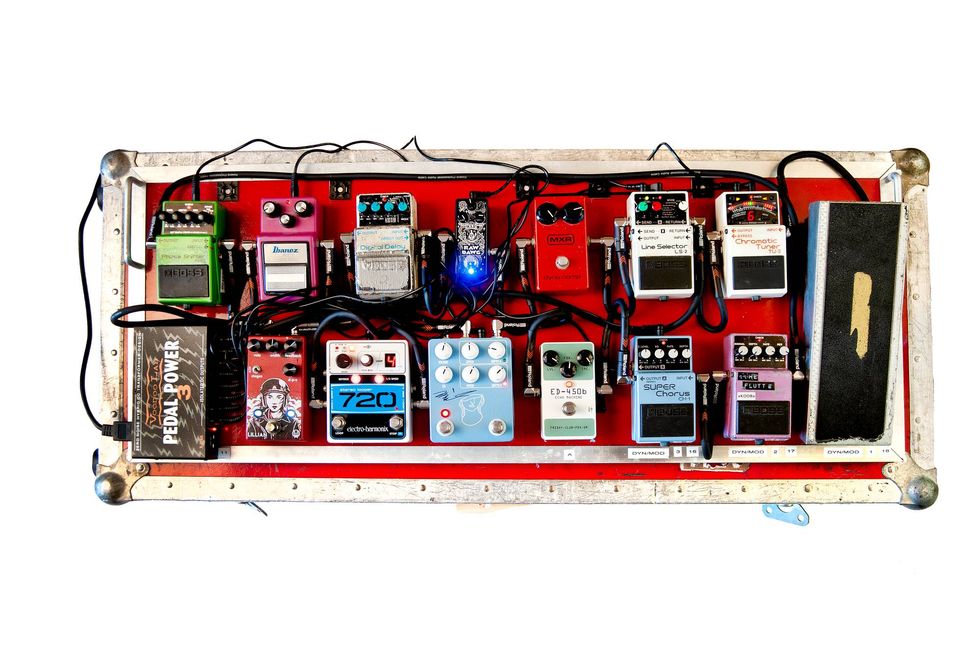
Legendary Pedals
Reader: Paul Martin
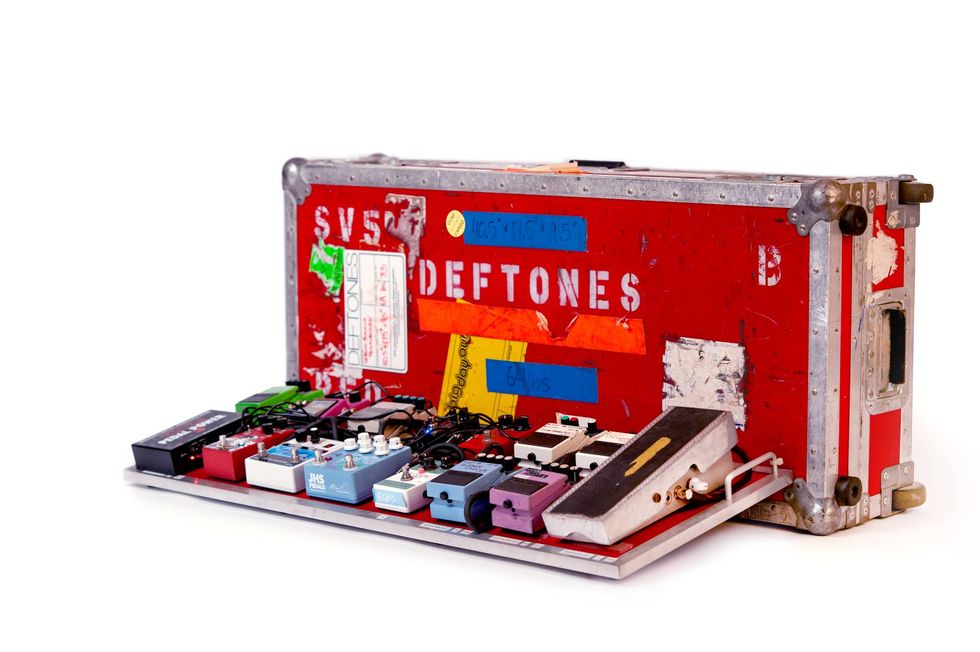
This is my “Starboard.” I call it that because it’s made up of pedals previously owned by famous guitarists. I mostly bought them from artist sales on Reverb, with a couple from Techno Empire and Pedal Pawn in the U.K. I was randomly collecting artist-owned pedals for a while, but when I bought [Deftones bassist] Sergio Vega’s pedalboard I decided to put a board together. The line selector switches between the top row for soloing and bottom row for clean. The board itself was owned by Sergio.
Top row: Boss PH-3 Phase Shifter, owned by Andy Taylor (Duran Duran and the Power Station); 1980s Ibanez AD9 Analog Delay, owned by Mitch Holder, a go-to session guitarist for Frank Sinatra, Barbara Streisand, and Lionel Richie; Boss DD-2, owned by Kiko Loureiro (Megadeth); signed MXR EG74 Eric Gales Raw Dawg Overdrive (limited to 250); vintage MXR MX-102 Dyna Comp, owned by producer and musician Dennis Herring; Boss LS-2 Line Selector, owned by Evanescence; Boss TU-3 Chromatic Tuner, owned and signed by Tommy Emmanuel.
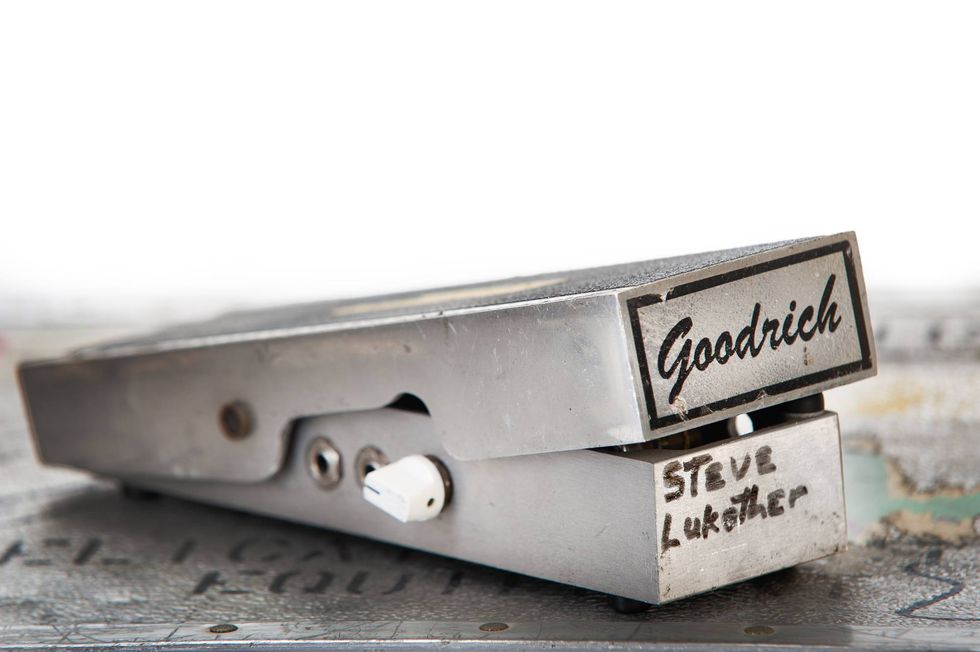
Bottom row: Walrus Audio Lillian Analog Phaser; Electro-Harmonix 720 Stereo Looper, owned by Malcolm Cecil, who invented the TONTO analog synthesizer and was responsible for the sounds on Stevie Wonder’s first three albums; JHS Artificial Blonde Madison Cunningham Signature Vibrato, signed by Madison when she was in Dublin supporting John Mayer; Friday Club ED-450b Echo Machine, owned by Isaac Brock (Modest Mouse); Boss CH-1 SUPER Chorus, owned by Daryl Stuermer (Genesis and Phil Collins); Boss HF-2 Hi Band Flanger, owned by Tad Kubler (the Hold Steady); and Goodrich Model 122 Volume Pedal, owned by Steve Lukather (Toto). From soloing on Stevie Nicks’ “Stand Back” to virtually all of Michael Jackson’s Thriller, it doesn’t get much cooler than that.
Bamboo Bass Rig
Reader: Dino von Wintersdorff
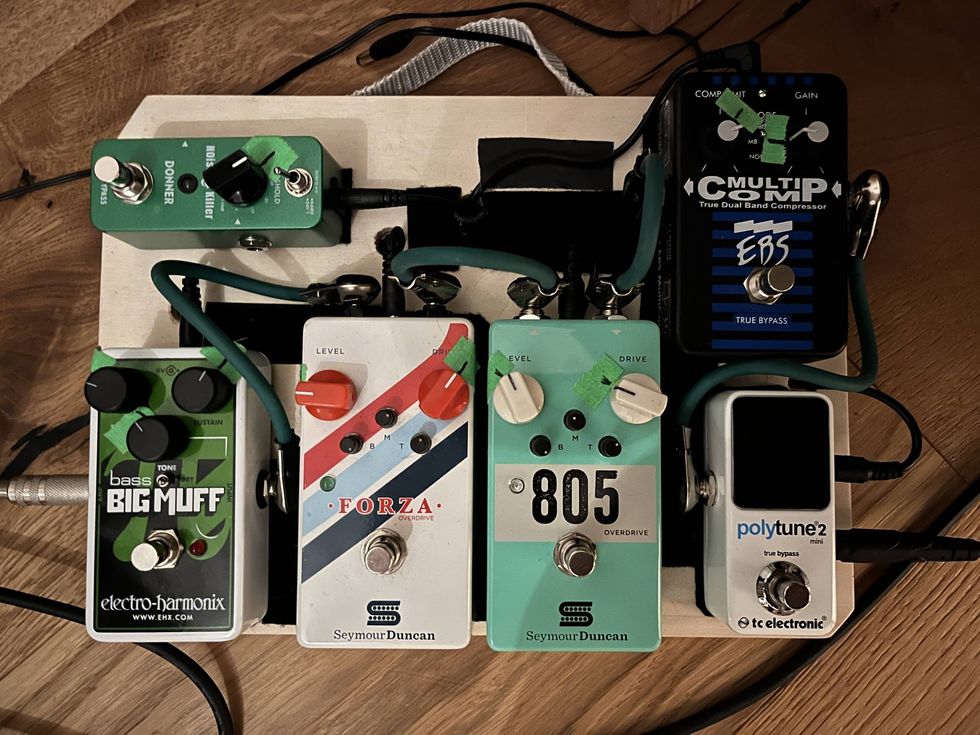
My bass pedalboard: Starting with a TC Electronic PolyTune 2 tuner, the signal goes into a Seymour Duncan 805 Overdrive, then a Seymour Duncan Forza Overdrive, an Electro-Harmonix Bass Big Muff, and finally a Donner Noise Killer. [An EBS MultiComp sits top right as well.] All on a board made out of bamboo and plywood, giving a fresh vibe on the stage!
First I got the Seymour Duncan Forza to have some nice controllable overdrive for the bass—the 3-band EQ helps get a nice tone. Then I found the clean signal was too boring and I added the SD 805 to have an always-on slight crunch and tone shape, and I love it! Sometimes the Muff and Forza are on at the same time, but the 805 isn't. So switching back to only 805 mode can be wild—there are times onstage that I would hit not only those three pedals, but also the tuner, instantly killing my signal!
No Board Required
Reader: Sam Paige
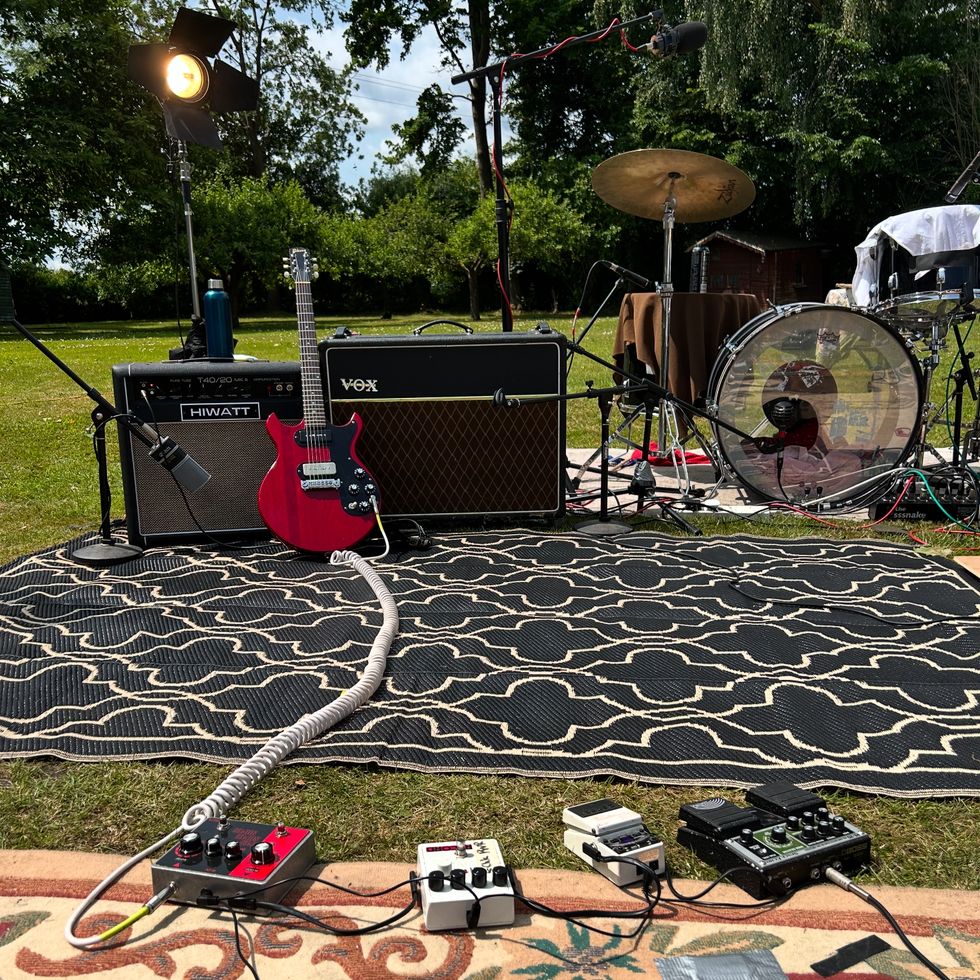
So obviously, yeah, there’s no board. It’s on the floor. In the 20-plus years I’ve been playing—starting with a few daisy-chained pedals to a fully-loaded [Pedaltrain] Novo 24 and nearly doing my back in taking the case offstage—I’ve got back to the pick-and-mix life of a [Truetone] 1 Spot and whatever I fancy.
Recently a band I fronted for six years or so fell apart, and as one door closed another opened. Starting in a new project, this was the first few weeks of bringing some old pedals and the 1 Spot to a new adventure and finding a new footing again.
Chain: Defects Super Super Super, something of a clone of the rare Death By Audio Super Fuzz War. Fuzz on one side, then boost. Inside there are dip switches for each side to shape EQ, add gain, add mids—usual setup is “full Fuzz War” with added mids, and currently a full-range boost on the other side. Second, the Electro-Harmonix Mel9, a sort of impulse buy based on seeing one of my favorite guitarists, Mr. John Dwyer, use it. It’s janky, has trouble with certain power supplies, and seems to have no built-in compression. So your effect out is either too quiet, just right, or blows your head off. I love it. It hasn’t left a setup since I bought it. Next, the Boss TU-2—god knows how old it was when it got to me (I rarely buy new), but I’ve had it for at least a good 15 years. A bit hard to see in the direct sunlight, but at least it won’t break. And a Boss RE-20 [Space Echo]—the more I use it, the more I’ve grown to love it—the perfect amount of bounce for echo effects. It’s forever inspiring and reliable. I keep thinking of trading in for one of the newer models, either to downsize or expand, but I can’t relegate this pedal to the shelf, or the draft listings on Reverb or eBay.
Double Trouble
Reader: Randall Brown
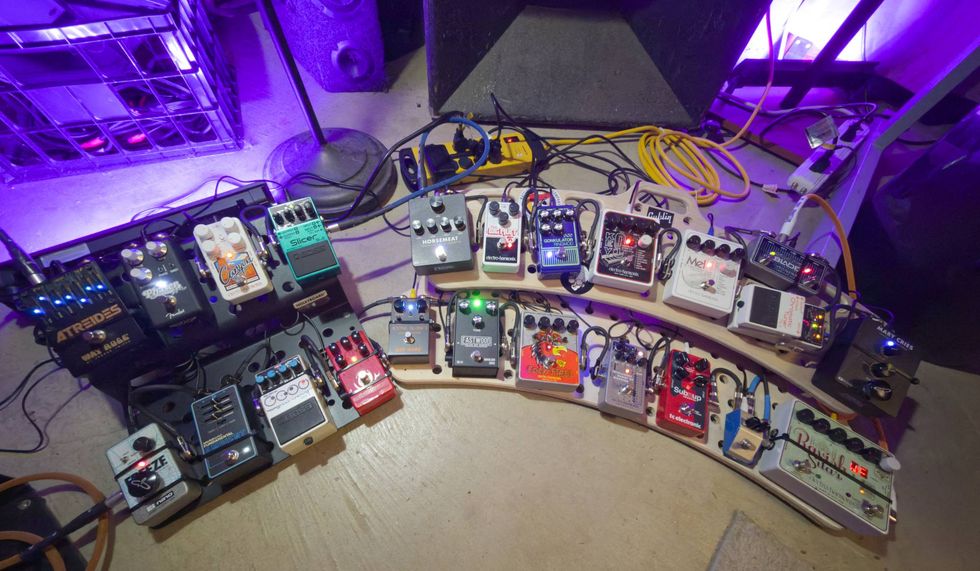
I spent years as an “only use the amp’s drive channel” guy, then started looking at EHX pedals out of nostalgia for a long-lost Muff Fuzz. Over the last 15 years or so, I’ve collected this batch of circuit friends with the idea of building wide tonal flexibility. I’m influenced equally by classic riff lords like Black Sabbath, contemporary psychedelic outfits like Osees and King Gizzard, and the ultra-modern trips of St. Vincent.
One of my favorite recent discoveries is a parallel mix of the EHX Cock Fight and the Fender Waylon Jennings Phaser—a slow-modulated buzz that really straddles the synth/buzz-guitar fence. I still pay the most attention to the magic that Electro-Harmonix puts out. In my drive to build the mega-board I have now, I started with the Freeze first. I also keep an eye out for additions to what I call the “fake bored keyboardist” section. The Freeze, Canyon, Key9, and Mel9 are the cornerstones of that. There are some days when I think I should go back to a single overdrive or go straight into the amp. But all the sounds are just too much fun!
My guitar goes into a PRS Mary Cries compressor, then a Boss TU-2, then into an Electro-Harmonix Switchblade Plus. From the Switchblade, two signal chains go to two different amplifiers.
Roland JC-120 signal chain: Electro-Harmonix Ravish Sitar, Tonebutcher WeeWah auto wah, TC Electronic Sub ’N’ Up, Electro-Harmonix Intelligent Harmony Machine, Electro-Harmonix Cock Fight, Eastwood BB-01 Manalishi Drive, Way Huge Stone Burner, Catalinbread Bicycle Delay, Boss DD-2 Digital Delay, Walrus Audio Fundamental Series Ambient, Electro-Harmonix Freeze.
Fender Hot Rod Deluxe signal chain: Electro-Harmonix Mel9, Electro-Harmonix Key9, DOD Gonkulator, Electro-Harmonix Nano Big Muff Pi, PRS Horsemeat Transparent Overdrive, Boss SL-2 Slicer, Electro-Harmonix Canyon, Fender Waylon Jennings Phaser, Way Huge Atreides Analog Weirding Module.
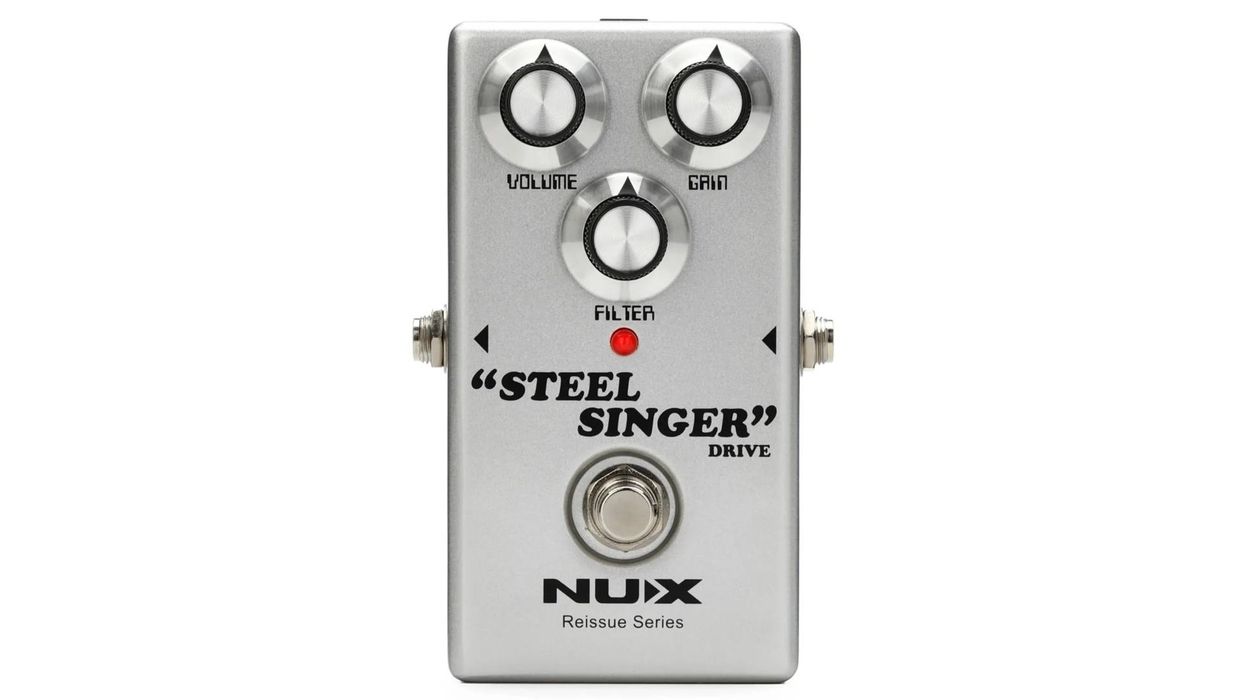
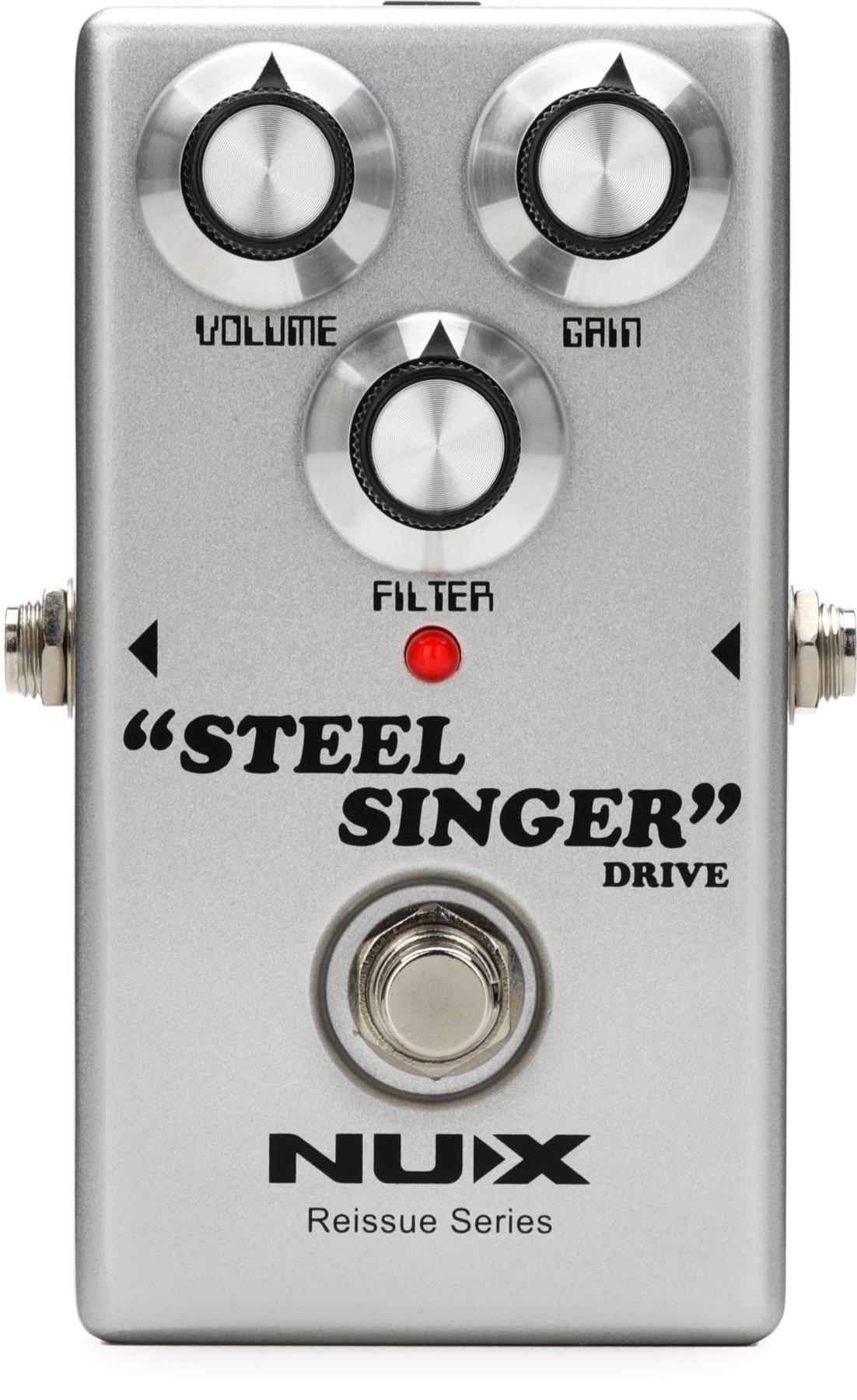
Like most of you, I would guess, I’ve never had the pleasure of playing aDumble amp. I have a fair idea of what they are supposed to sound like thanks toStevie Ray Vaughan and, presumably, David Lindley and Henry Kaiser (I’m never sure what amp I’m hearing on records from those two mad geniuses). But I definitely don’t know how a Dumble feels, or how it sounds up close in a room. So, I have to take NUX’s word for it that they deliver on the Steel Singer—an overdrive inspired by the Dumble Steel String Singer.
Fat and Snappy
While I can’t comment on the Steel Singer’s ability to perfectly ape a Dumble, there is a lot of reason to recommend the NUX Steel Singer as an overdrive. As a light drive or near-clean boost it can be a great thickening agent (at bassier filter settings), or a better-than-serviceable treble booster at toppier filter settings. At its trebliest extremes it can be a bit crispy, so you should take care. Additionally, the NUX tends to move beyond light drive pretty quickly—requiring only a slight bump in pedal to filthy up a Deluxe Reverb and Stratocaster.
To many ears, single coils and clean Fender-style amps might be the most natural and well-suited companions to the Steel Singer. In these setups, the pedal adds discernible edge in the midrange, while retaining the scooped essence of those formulas. Humbucker users can get in on the fun, too, and a PAF can coax many Plexi-like drive tones from a Deluxe Reverb. British-style amps, however, are less accommodating to the NUX’s charms. AC15-style and 18-watt Marshall-style settings on a Carr Bel-Ray, for instance, clashed with the NUX at times, a setup where klones and TRS-style pedals got along reasonably well.
The Verdict
To many ears, single coils and clean Fender-style amps might be the most natural and well-suited companions to the Steel Singer.
There are two keys to success using the NUX Steel Singer. One is to keep the gain and tone at relatively modest settings and out of the range where merely excited tones become fried. The second is to expect the best results with single coil pickups and clean Fender-style amps. This makes sense. Dumble’s Steel String Singer is, in many respects, an evolution of black-panel Fender designs. And if the goal is to create smooth overdrive and boost tones, a pedal that dovetails more precisely with that Fender-style profile is a smart move. That isn’t to say there aren’t joys to be found in a Steel Singer/humbucker combo, or even with an AC30. But such tones will be better suited for more adventurous players less aligned with classic amp-drive results.
Chops: Intermediate Theory: Intermediate Lesson Overview: • Learn how to construct Dorian scales. • Understand the minor-key harmony of “Last Dance with Mary Jane.” • Develop an ability to hear the raised 6 in a minor scale. Click here to download a printable PDF of this lesson's notation.
I love modes. I love playing them. I love teaching them. But they are tricky to teach because it’s difficult to wrap your head around them without having to dive deep into theory, which isn’t an easy step for some players. As a teacher, I look for ways to make modes fun and relatable, and this always lives and dies by the quality of your examples and source materials. Over this past holiday break, I started researching the mighty 5-watt Fender Champ tube amp. What does this have to do with modes? Read on.
Tom Petty’s guitarist Mike Campbell is a well-known fan of low-wattage Fender amps. I was watching a segment on the history of the Champ and when the main riff to “Last Dance with Mary Jane” came up, it piqued my interest. It was a song I knew well, hadn’t really heard in a long time, and never had a reason to study—until now.
There was something about the song that was unique and I wanted to dig into. And because I needed inspiration for a new lesson, the timing was perfect. The first thing I like to do when figuring out how a tune works is to lay out the main chords as an inventory. For this tune, the chords are pretty simple:
Am–G–D–Am
Yet again, Tom Petty takes a simple harmony and crafts an enduring rock anthem around it. We all joke about three-chord rock, but this is not only three-chord rock, it’s modal as well. So, why is this a Dorian chord progression? Just looking at the chords might be enough if you’d studied harmony a ton, but if you haven’t, the next step we should take is to spell out the chords into their individual notes:
Am = A C E
G = G B D
D = D F# A
Now that we’ve deconstructed the chords, the next task is to decide which note you think is home, or in theory-speak, the I. In this case, it’s pretty clear that A is home. We keep coming back to it, and it really does feel and sound right. With that done, we can take the chord tones and alphabetize them, starting with A. This yields a string of seven notes: A–B–C–D–E–F#–G.
Okay, we’ve taken inventory of all the notes contained in those three chords, starting from our root (A). The next step is to ponder the harmonic consequences of this discovery. What makes this a Dorian progression is the D major chord with an Am tonic. This D triad brings us an F#, which is not the normal F you’d see in an A Aeolian, aka A natural minor, scale (A–B–C–D–E–F–G). With Dorian, you end up with a scale that sounds minor, but with a raised 6, compared to natural minor. This yields an intriguing sound that’s not quite as dark as the minor scale you’re accustomed to. Many people describe and teach Dorian as a minor scale with a raised 6, and that’s exactly what we have here.
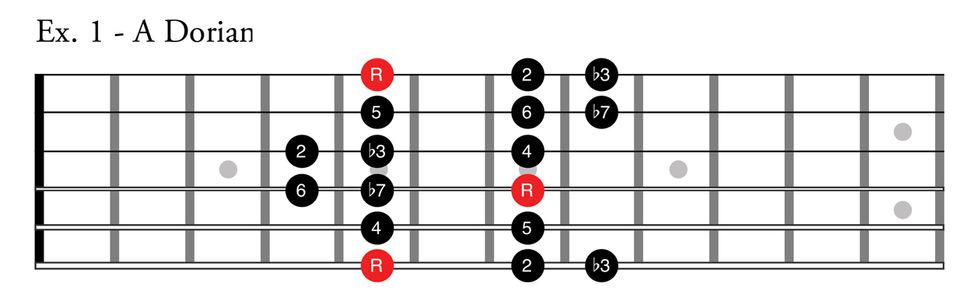
To get familiar with this sound, grab “Last Dance with Mary Jane” on your favorite music service and play along in A Dorian. Ex. 1 shows a handy scale diagram based on the 5th fret root of A on the 6th and 1st strings.
Now that we’ve connected the chords to the Dorian mode and we have a scale fingering, let’s hear some riffs in context.
For Ex. 2, I’m keying off the fact that this Dorian scale position is in the same spot as the familiar minor pentatonic scale, so we’re getting to use both the mode and the pentatonic in the same phrase. I’m featuring the F# (or the 6) as the signature note that makes Dorian unique, and also because it’s the 3 of the D major chord. You can play that F# whenever you want in this progression, but it’s extra awesome over the D chord.
With its bluesy beginning, Ex. 3 is another line that relies on the pentatonic scale lurking inside of the Dorian scale. Again, when the D major chord occurs in the second measure, I’m calling attention to it with the F#. It’s a simple way to connect with the Dorian scale and still keep that rock/blues feel we all love.
For our final example (Ex. 4), I stayed away from the pentatonic sound and tried to create a simpler melody with just the Dorian scale. It starts in the middle of the guitar’s range and follows a see-saw pattern of “go up a few, go down a few.” At the start of each chord change—every two beats—I align to the chord in the progression: A for the Am chord, G for the G chord, and F# for the D chord. This is a little bit of voice-leading that reminds me of “While My Guitar Gently Weeps.” It not only helps you anchor the chord progression, but it connects with the mode at the same time. We’re only using a portion of Ex. 1’s two-octave scale pattern—sometimes simple is best.
But wait there’s more! While the opening chords clearly spell out an A Dorian progression, the chorus shifts to yet another modal key. This song keeps on giving us things to learn and practice—how cool. When the chorus starts, we hear the following chords:
Em–A–Em–A–G
As before, let’s pull the chords apart to see what’s inside:
Em = E G B
A = A C# E
G = G B D
And just like last time, we need to determine the root. In this case, it’s clearly E minor, so we’ll call this an E something mode. Starting with E, let’s ascend through the pitches to see what we get:
E–G–A–B–C#–D
This gives us six notes. While we’re missing the second note after E (which, in a seven-note scale, would be some type of F), we can still conclude it’s another Dorian scale, this time in the key of E. Relative to E, C# is a raised 6 and this matches our general idea of Dorian construction: minor scales with a raised 6. It’s really cool that this song allows you to practice in two keys, A Dorian for the verse and E Dorian (E–F#–G–A–B–C#–D) for the chorus.
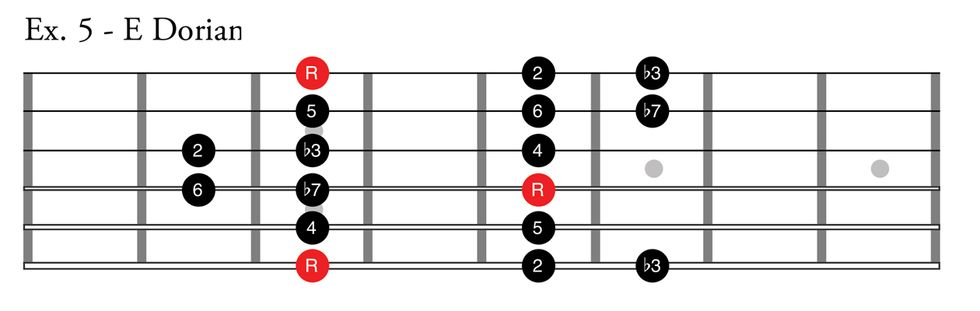
Ex. 5 is a scale diagram for E Dorian. Note that it’s the same pattern as our previous A Dorian scale, just shifted up to the 12 fret to place the E root on the 6th and 1st strings.
The chorus is my favorite part of the song because it’s a moment where everything comes together—the chords and Petty’s vocal melody combine for a beautifully haunting Dorian sound. Pay attention to the “ry” in the melody of “Mary” to hear that C# over an Em chord—that’s the distinctive Dorian color at work. It’s one of the reasons I’ll keep this song in my arsenal of material for teaching Dorian to students, along with Pink Floyd’s epic “Breathe” from Dark Side of the Moon. (Go work out the Dorian key for that one.) For now, use the above examples for inspiration and find your own riffs and ideas for “Mary Jane.” Let your creativity and ears be your guide.
I hope you enjoyed exploring how to reverse-engineer a simple song. Over time, this process will become faster and you’ll be able to hear the modes more easily. The next time a tune really tickles your ear, take it apart as we’ve done here. Who knows? It may spawn a soloing concept or a song idea you wouldn’t have otherwise considered.
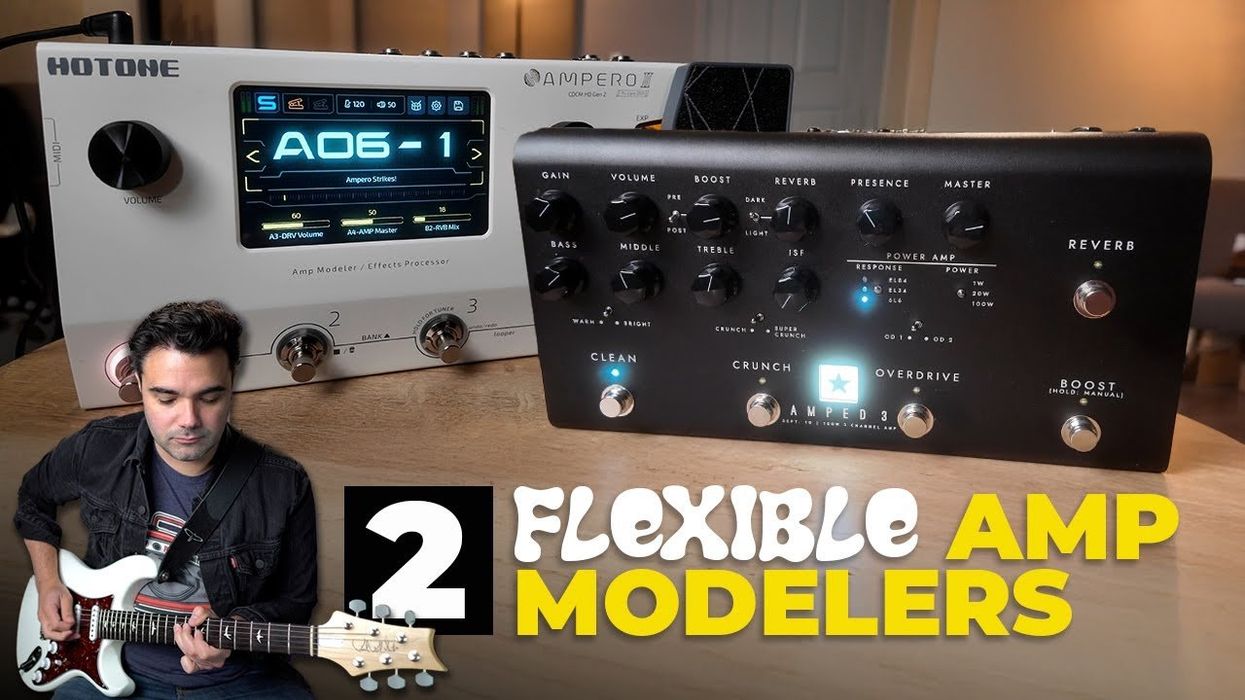
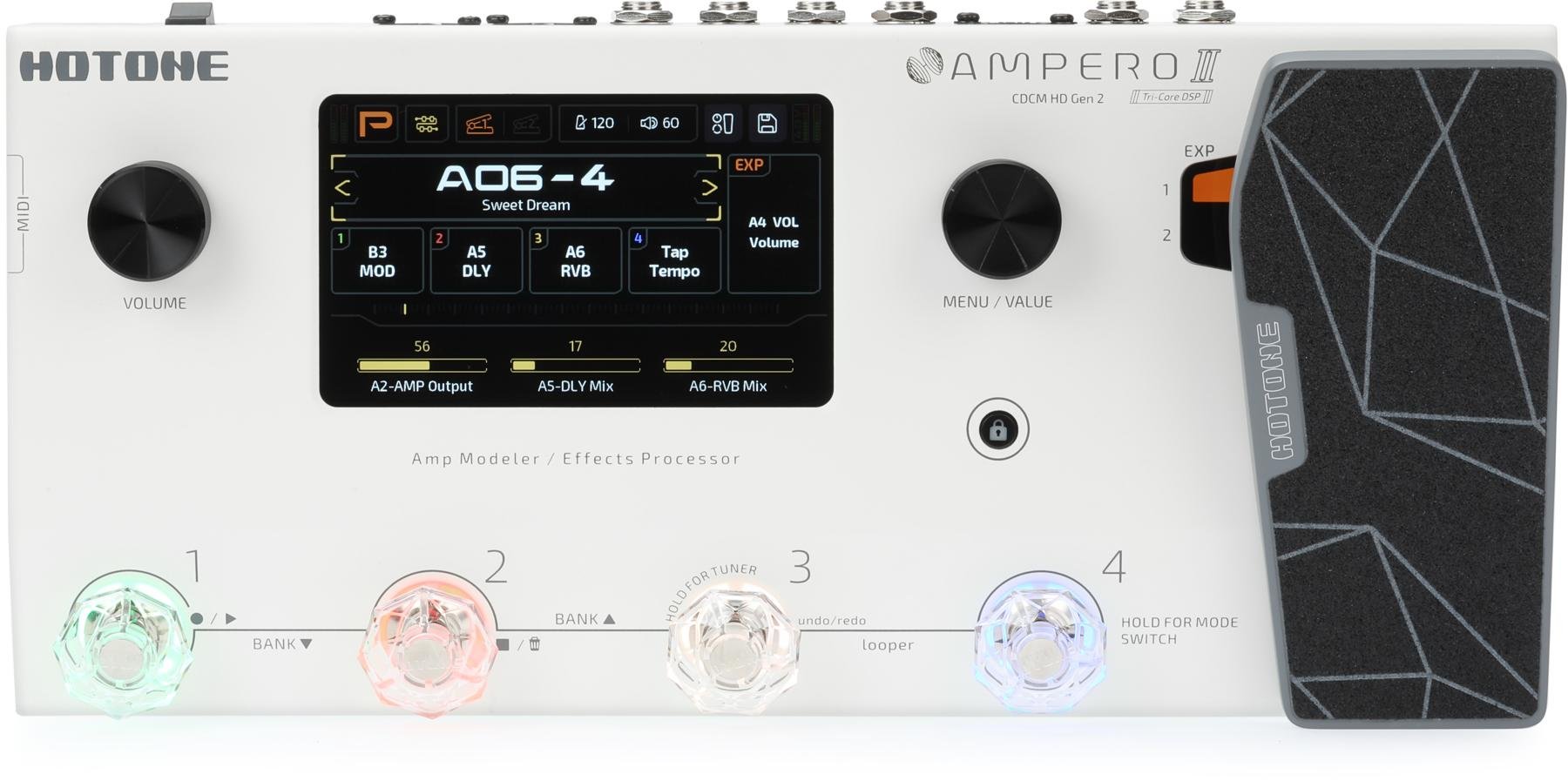
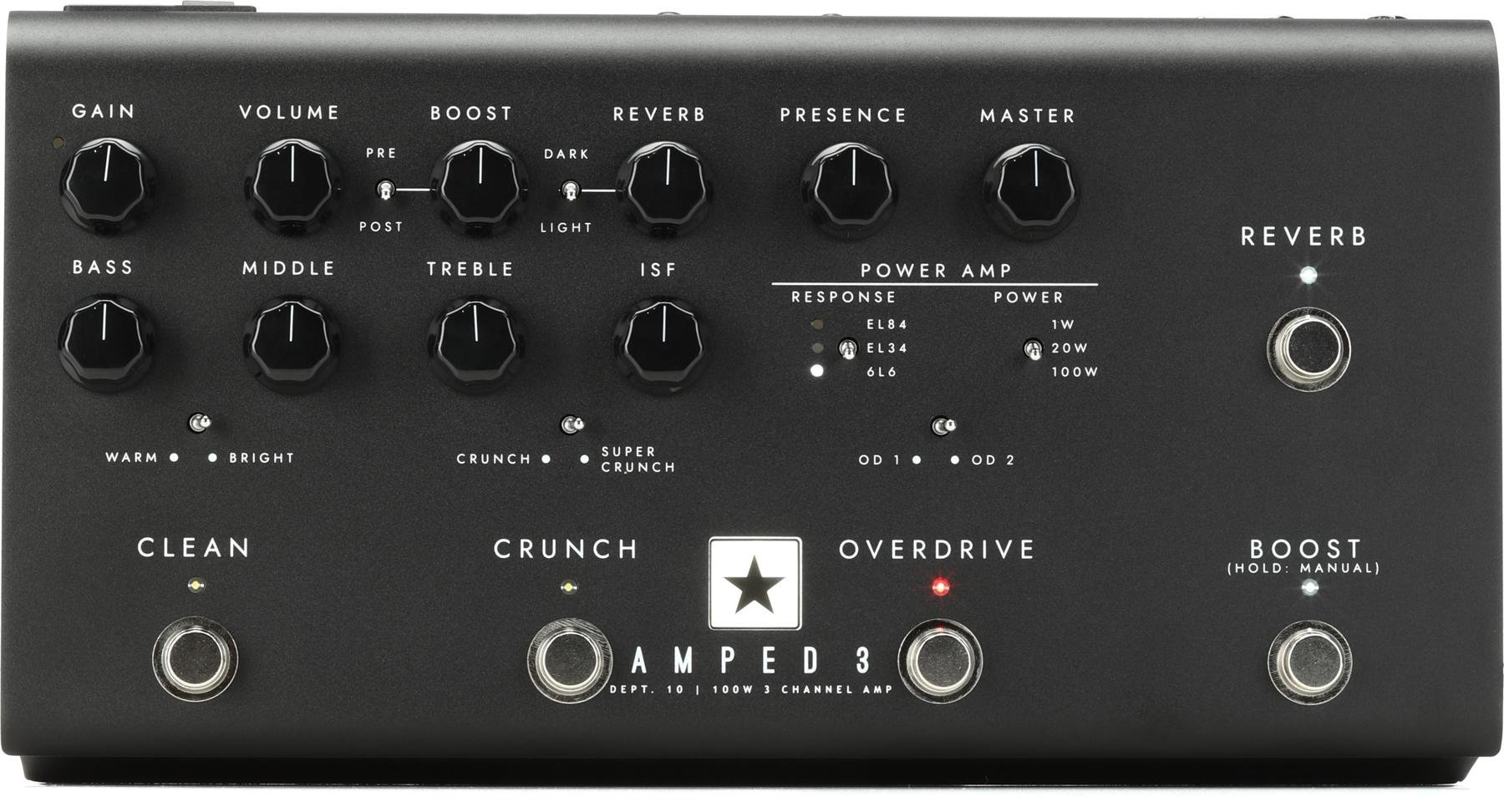
Are you looking for a flexible amp modeler for the stage, studio, or home? In this in-depth demo, PG contributor Tom Butwin takes you through gigging, practicing, and recording with two compelling options: the touchscreen-powered Hotone Ampero II and the tactile, amp-style Blackstar AMPED 3.
Editorial Director Ted Drozdowski’s current favorite noisemakers.
Premier Guitar’s editors use their favorite fuzz pedals in countless ways. At any point during our waking hours, one of us could be turned on, plugged in, and fuzzed out—chasing a Sabbath riff, tracking menacing drone ambience, fire-branding a solo break with a psychedelic blast, or something else altogether more deranged. As any PGreader knows, there are nearly infinite paths to these destinations and almost as many fuzz boxes to travel with. Germanium, silicon, 2-transistor, 4-transistor, 6-transistor, octave, multimode, modern, and caveman-stupid: Almost all of these fuzz types are represented among our own faves, which are presented here as inspiration, and launch pads for your own rocket rides to the Fuzz-o-sphere.
Ted Drozdowski - Editorial Director
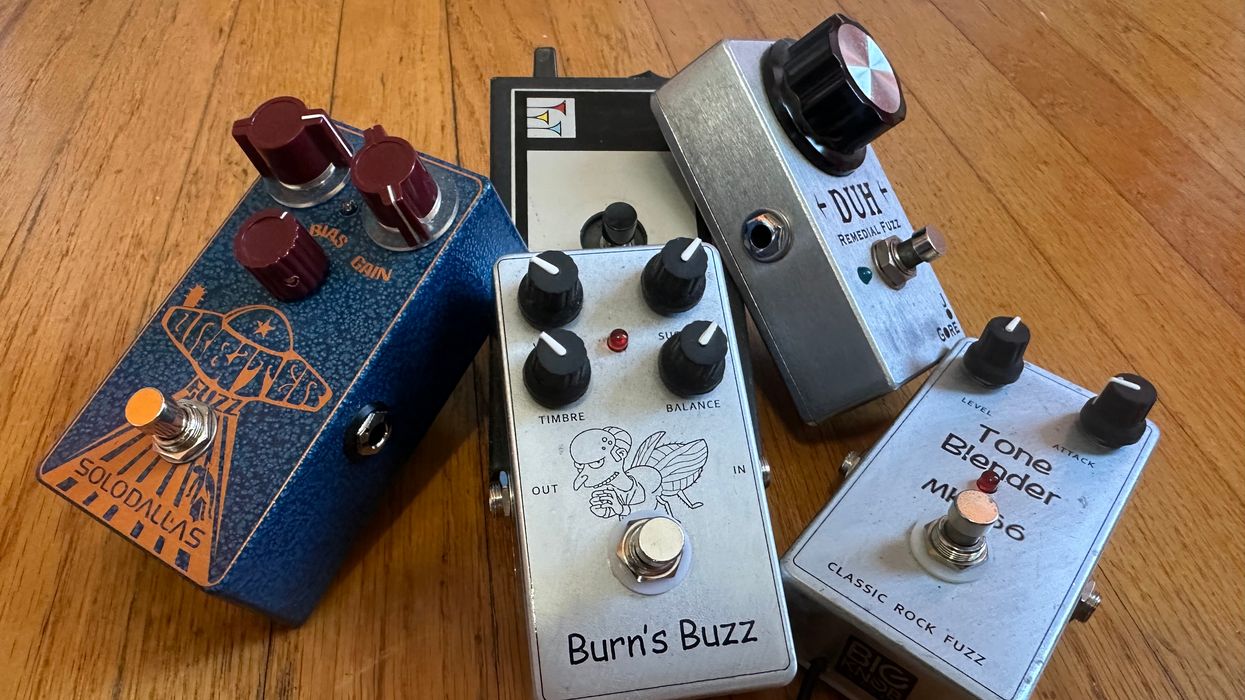
My favorite is my Burns Buzz, a stomp custom-made for me by Gary Kibler of Big Knob Pedals. Gary specializes in recreations of old circuits, and this Burns Buzzaround-inspired box has four germanium NOS transistors and sounds beautifully gnarly. It improves on the original, which Robert Fripp favored in early King Crimson, by adding a volume control. I went a little stir-crazy acquiring fuzzes during Covid lockdown and now have an embarrassing amount. My other current darlings are a SoloDallas Orbiter (which balances fuzz with core-signal clarity), a Joe Gore Duh (a no-nonsense, 1-knob dirt shoveler), and my Big Knob Tone Blender MkII 66, which taught me how smooth and creamy fuzz can be with carefully calibrated settings. These pedals allow me to cover all of my favorite fuzz sounds from the past 60 years. I do have one more secret weapon fuzz that only travels to the studio: an original Maestro FZ-1 that I picked up used for about $20 in the early ’90s. It’s banged up but functional, takes two 9V batteries, and is righteously juicy.
Nick Millevoi - Senior Editor
The two greatest fuzzes I’ve ever played are a Pigdog Tone Bender build and a Paul Trombetta Bone Machine. Both experiences will stick with me for decades to come. But creations by those two masters of fuzz come with a price tag high enough to keep my time with those pedals fleeting.
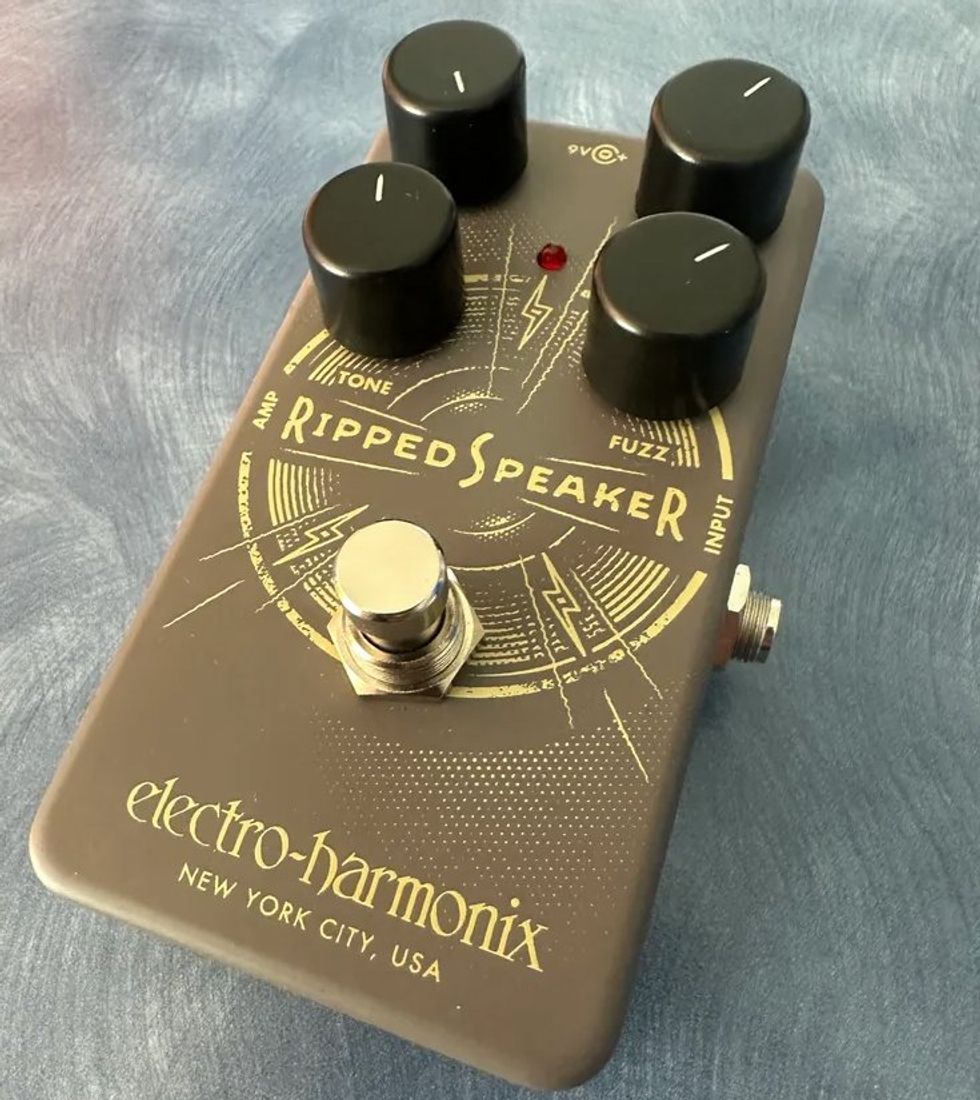
Instead, my favorite fuzz is an inexpensive, mass-produced pedal that hasn’t left my board since I reviewed and subsequently purchased it in 2021: the Electro-Harmonix Ripped Speaker, designed to emulate the distorted tones on ’50s and ’60s records that were created with broken or misused gear.
Retro inspiration is not all it has to offer though. The rip knob, which controls transistor bias, is the star of the show, interacting with the fuzz level to deliver everything from a smooth, mild fuzz to sputtery mayhem that can evoke a faulty channel strip or old tube combo that’s been set ablaze. I prefer to crank the rip knob and feed it to a phaser and slapback analog delay, which gives me a bit-crushed-like gnarliness. Pull back on the rip or add a boost in front of the pedal, and it has a more organic but still gated sound, which, for me, can be just the thing to set my sound apart in a more traditional setting.
For a cool $116, the Ripped Speaker, which seems to fly under most fuzz freaks’ radars, might be the special something that complements the rest of your board or just a tone you turn to on occasion. Either way, it’s a great deal.
Luke Ottenhof - Assistant Editor
You could give me the most powerful-sounding fuzz in the world, but if it was in a stupid-looking enclosure, I don’t know if I’d give it a second look. This is just how we operate: Vision is the sense we privilege most, even in matters of audio.
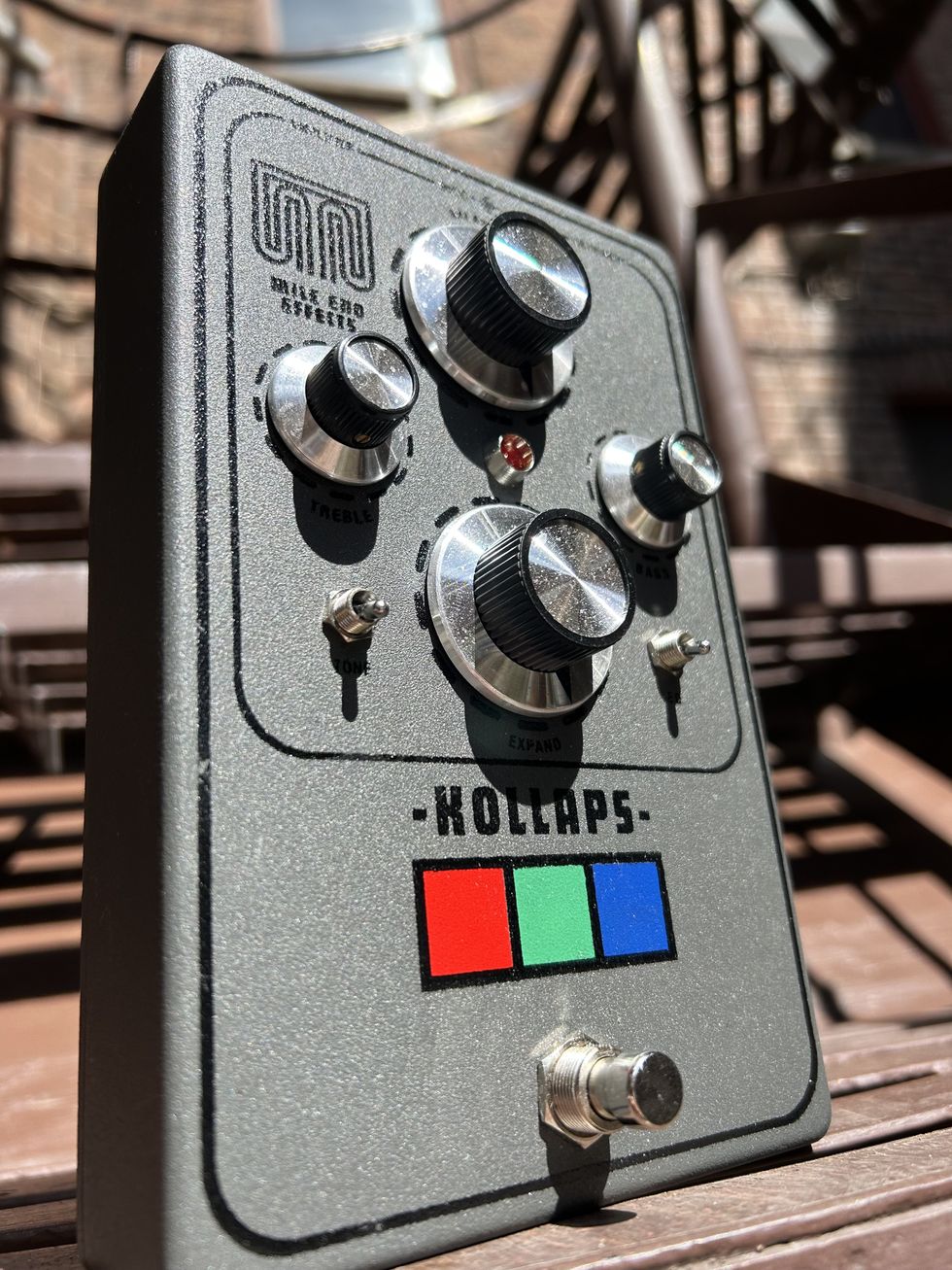
Luckily, the most seismic, monstrous fuzz I’ve ever heard also happens to come in a beautiful package. The Mile End Effects Kollaps, built by Justin Cober in Montreal, measures an elephantine 7 3/8" x 4 5/8" x 1 1/2", and its MuTron-meets-’60s-Soviet aesthetic matches the sounds its guts produce. The Kollaps is modeled after the nasty Univox Super-Fuzz circuit, and carries a few of that pedal’s hallmarks, including its use of germanium diodes and midrange boost control. Cober added a switchable Baxandall active EQ circuit, with up to 12 dB of boost and cut to both low and high frequencies. Coupled with the mid-boost toggle, this gives the Kollaps a shockingly broad range of tonality to play with.
With the mids off, the Kollaps is jagged and ruthless, a deafening turbojet of upper mids and chest-vibrating lows that yanks me toward the darker, less commercially successful corners of ’90s doom and noise rock. Kicking on the EQ circuit and boosting the lows turns it titanic. With the balance (volume) and expand (gain) controls maxed, the Kollaps starts to live up to its name, crumbling into a thick, overextended chaos in a way more polite fuzz circuits rarely do.
My favorite Kollaps sounds occur when the mids are engaged, for an articulate, deeply textured fuzz sound that retains your attack. Playing with your guitar’s volume knob, you can coax a range of EQ profiles and take advantage of the upper- and lower-octave content in the fuzz. With guitar volume lower, you can access some unbelievably emotive and sensitive sounds that still teeter on the edge of chaos and violence. It’s a rich, volatile circuit that gets as close as I’ve heard to a sound and physical feeling I’d call “planet-destroying.”
Charles Saufley - Gear Editor
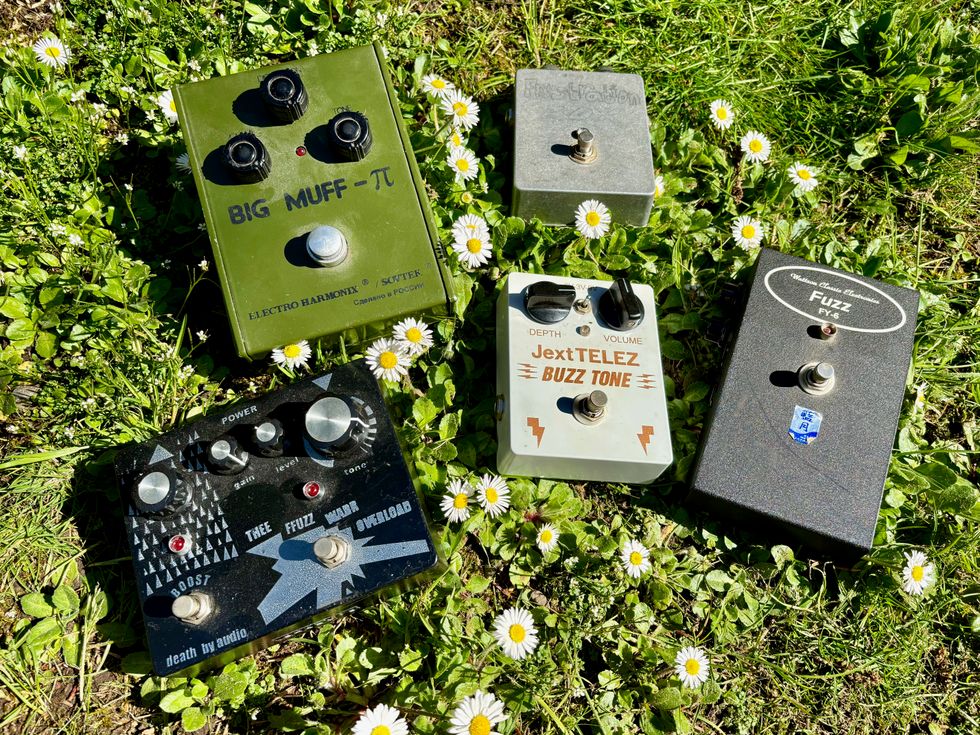
My first fuzz, A Sovtek Big Muff, remains tied for first place among many favorites. The pedal’s most famous virtues—corpulence and sustain—are among the reasons I treasure it. But the way the Sovtek pairs with a Rickenbacker 330 and Fender Jaguar, which were once my two primary guitars for performance and recording, made it invaluable in various projects for a long time. Neither the Ricky nor the Jag are sustain machines, but the wailing mass of theBig Muff makes their focused voices an asset—inspiring tight, concise fuzz phrases, hooks, and riffs as well as articulate chords.
A silicon Fuzzrite clone built by good pal Jesse Trbovich (long-time member ofKurt Vile’s Violators) runs second place to the Sovtek in terms of tenure, and is a very different fuzz. It’s a piercing, hyper-buzzy thing, but a perfect match for a squishy 1960s Fender Bassman head and 2x12 I adore. Perversely, I sometimes couple it with a Death By Audio Thee Ffuzz Warr Overload or Wattson FY-6 Shin-Ei Super-Fuzz clone. These tandems create chaos and chance, but sing loud and melodiously too—at least when I’m not intentionally bathing in feedback. The Jext Telez Buzz Tone, a clone of the mid-’60s Selmer circuit, is often my go-to now. It’s a low-gain affair compared to the other fuzzes here, and I use it in its even-lower-gain (and vintage-correct) 3-volt setting. It’s pretty noisy, but it is thick, dynamic, detailed, raunchy, and plenty trashy when the occasion demands it. It’s also a very cool overdrive when you back off the gas.
Jason Shadrick - Managing Editor
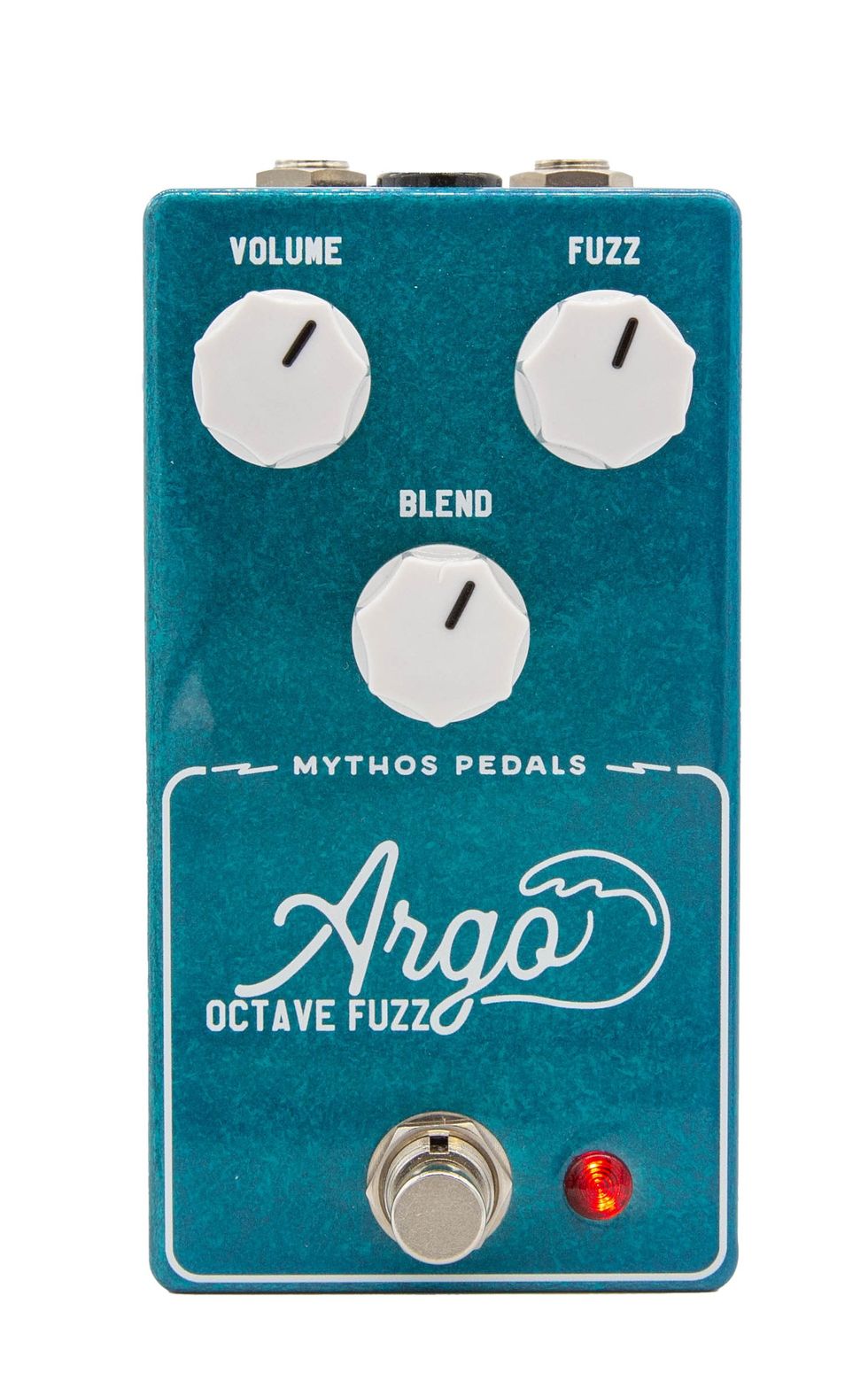
I rarely need fuzz in my everyday gigs, but it's one of the most fun effects to explore when I'm noodling around. At a NAMM show a few years ago I plugged into Mythos' Argo and as soon as I hit a note my eyes lit up. The sound of the fuzz wasn't unwieldy or hard to manage. It gave me the illusion of control while the octave was the magic dust on top. I knew right then I wasn't leaving the show without one. After I spent some time with it, I became enamored by how much more the Argo can do.
It's inspired by the Prescription Electronics C.O.B. (Clean Octave Blend), so the control set is similar. The octave is always present in the signal path, but you can dial it out with the blend knob. The fuzz and volume knobs are self explanatory, but dialing the fuzz and octave knobs all the way down gives you a killer boost pedal. I find my favorite settings are at the extremes of the fuzz and blend ranges. Typically, both are either all the way up or all the way down. Another great experiment is to turn the fuzz down and then pair it with a separate drive pedal. And in octave mode, Argo is one of those pedals that inspires you to head directly for the neck pickup and stay above the 12th fret.