
An all-analog flange and chorus with a lot of character.
Way back in the 2010s, before starting Mr. Black as his pedal-building outlet, when Jack DeVille was releasing effects under his own name, he created the Mod Zero. This multi-modulation unit covered flanging, chorus, rotary effects, and vibrato, and, with a limited run of 250 units, gained a reputation and is long sold out.
Although Mr. Black’s Mod.One is not that pedal, this all-original unit designed by DeVille follows a similar mission, and its reverential name is surely no accident. The Mod.One is a 100-percent-analog modulator that spans chorus, flange, and high-band flange with a unique control set designed for flexibility, sonic excitement, options and a lot of character.
Controls for the Curious
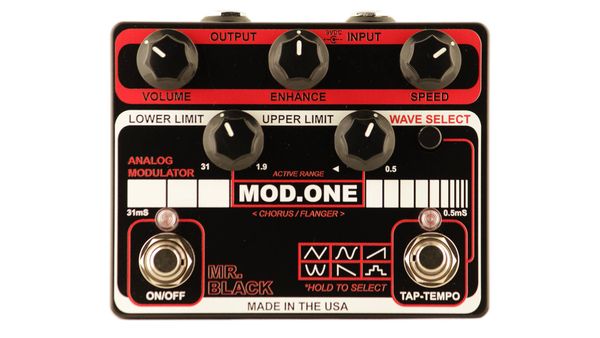
If you come to the Mod.One a little fuzzy on the differences between chorus and flange, here’s a brief explanation: Chorus is created using a slower set of delay times on a secondary, parallel signal. Flange uses shorter delay times, and high-band flange the shortest. On the Mod.One, a pair of knobs—one for lower limit and one for upper limit—allow users to set that range of delay times. The lower limit knob has a max delay of 31 mS and a minimum delay of 1.9 ms. The upper limit knob ranges from 1.9 ms to .5 ms. Within those ranges, you’ll find the difference between chorus and flanging, and the position of the two knobs, rather than a switch, determines which effect you’re using. Ultimately, I’m a firm believer that we should use our ears and not get hung up on definitions when listening to an effect. The Mod.One is a great example. Determining exact delay times and whether you’re chorusing or flanging is inexact but ultimately it doesn’t matter. What matters is what sounds good.
The lower limit/upper limit controls might frustrate purists that want to toggle between a clearly defined chorus and flange tone. But Mod.One’s controls, and its central premise, are all about sound sculpting and opening up creative options. And options abound: LFO speed, for example, reaches up to 20 seconds long when using the tap-tempo switch. Six waveform options also widen the sonic lane.
Let’s Get Exponential
The Mod.One is powerful in a literal sense. The active volume control provides plenty of juice, and is capable of really pushing whatever comes next in your chain. That lends a gooey vibe to everything that passes through the pedal. Whether you use that power to drive your amp or not, the combo of gain and all-analog circuitry give the Mod.One a warm, thick voice. This is not just another metallic-sounding flange device.
I found myself stomping on the Mod.One to add space and texture to rhythms, riffs, and leads that cover a lot of range. Sometimes, I was looking for subtlety—Andy Summers on “Walking on the Moon,” for example. For that, I kept the enhance knob, which determines the intensity of the effect, toward lower settings, and kept the speed on the slowest part of its range, which generates molasses-like movement. For more obvious results, I nudged the speed and enhance knobs. There’s a lot of play in each control, so it doesn’t take much to get things moving in a different direction. The enhance control can even self-oscillate at the top of its range, where more extreme sounds live.
Each of these controls interacts differently with alternate waveform settings, making the possibilities exponential. If there’s one complaint I have about the Mod.One—and I do think it’s just one—it’s that it’s hard to tell which waveform is selected. When experimenting by ear, that’s not the worst thing, but when searching for specific settings, it can be hard to tell if the single LED lights up in a sine, triangle, or other pattern. Eventually I got better at telling the difference, but I didn’t always nail it.
To get some ’70s pseudo-cosmiche tones for a recording project, I rocked the triangle, sine, and hypertriangle waveforms at varying levels of excess. And all three were useful for thickening up high-fretted chordage rather than just the crystalline kind of flange I tend to associate with Prince. I found true excess with the step wave selected and the enhance cranked to its fullest, and there are many experimental sounds to be heard in these wilder places. With so many variables at play, I know there is a lot to be discovered still, which makes the Mod.One compelling.
The Verdict
The Mod.One is a powerful flange and chorus with a strong, recognizable character and wide range. It’s not a do-it-all kind of modulator meant to compete with digital units. But this all-analog device can deliver texture to your sound at dosages that are easily controlled. The unique sculpting possibilities make it exciting and refreshing, and in my time with the pedal, I was impressed with how much I hadn’t yet discovered. It strikes a difficult balance between a quick learning curve and the kind of depth that’ll keep it in heavy rotation for a long time to come. It simply sounds excellent, too.