

Sometimes you’ll see a new bass and it seems
familiar—an instrument you’ve gotten used
to over the years. But then you look again and
realize your first glance deceived you. That’s
the case with the new series of basses from
Reverend, the company that brought you the
legendary Rumblefish before leaving the bass
business in 2004.
Reverend basses are back, but are now
being produced in a high-end Korean factory
rather than their US headquarters. The
designs and specs still spring from the brain of
Reverend’s founder Joe Naylor, who aimed for
seasoned woods, tight tolerances, and high-quality
components. Naylor also designed his
pickups with specific tonal characteristics in
mind—so that the bridge and neck pickup
each bring something unique to the sonic palette—beyond what comes naturally from their
onboard locations.
Like the original Reverend basses, these
new axes bring a fresh take on design, but have
only a slight resemblance to their predecessors.
Two of the five new basses were designed with
a set-neck, while the other three use a more
conventional bolt-on. For this review, Reverend
sent one from each group.
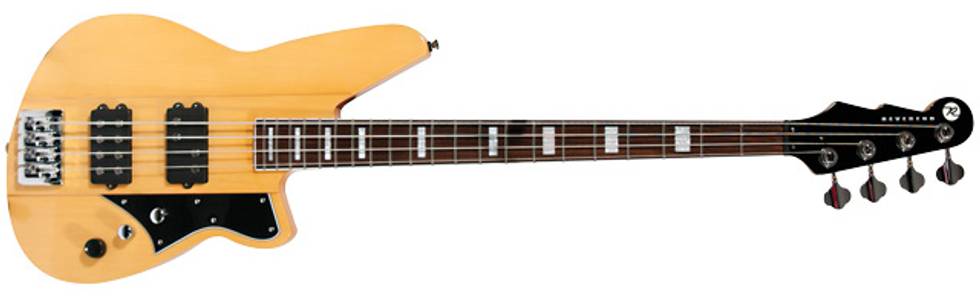
The set-neck Thundergun bass is reminiscent
of a well-known bass that also begins
with “Thunder,” while the Justice bass reminds
you of an old standby model that also has the
letter “J.” The two basses share some common
details including a 1 21/32" nut width, a
two-way locking bridge, a korina wood body,
and a bound-and-blocked five-piece maple/
walnut neck with a rosewood fretboard. The
bi-directional truss rod, tuners, and knob set
are the same too. But after that, the similarities
depart pretty significantly.
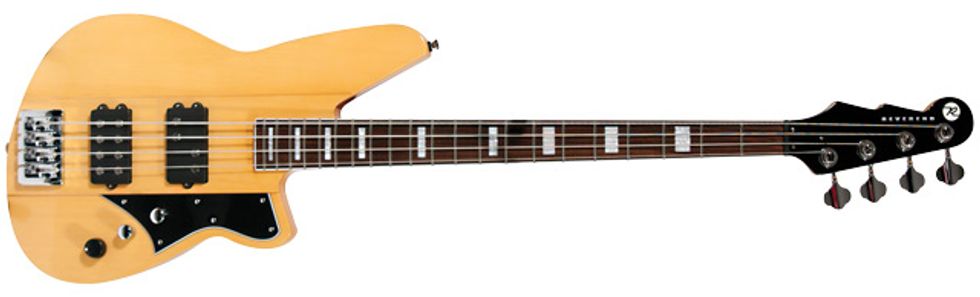
The Thundergun: Old-School
Meets Modern Sound
This bass has a striking look that makes you
want to go a little bit nuts by playing a little
harder and driving the music a little more.
It’s like getting behind the wheel of a muscle
car and feeling the need to drive a little more
aggressively. The Thundergun has a familiar
and sturdy feel in the hand, yet weighs in
lighter than expected at about 8 pounds. Its
Vintage Clear glossy finish was applied very
evenly, with nary a glitch on some of the more
difficult finishing spots like the raised lip of the
body’s center section.
The setup was carefully adjusted, and the
control knobs and tuners felt solid, smooth,
and consistent. One of my pet gripes about
many basses is that the nut slots aren’t cut
deeply enough at the factory. That wasn’t the
case with the Thundergun. The wiring in the
control cavity was tidier than most basses I see,
with less excess wire and a tie keeping things in
place. Shielding was accomplished via a good
coat of conductive paint.
As I mentioned, Naylor created pickups for
this bass with a specific sound in mind. The
Split Brick neck pickup is essentially a P-style
pickup in a humbucker case—with mighty
big magnets. Sound-wise, this pickup’s voice
is aimed toward the lows and mids. I thought
it served decently when soloed, much like a
P-style pickup should. The Thick Brick bridge
pickup, in contrast, provides mainly mids and
highs. I can’t imagine its somewhat nasally
sound being very useful on its own, except for
the muddiest of rooms.
Blending the bridge with the neck pickup
created several useful sounds with both body
and bite. This task was made easy with the
black plastic Blend control, along with the master
Tone and Volume controls. On most basses
with two pickups, there would be two volumes
and one tone instead. When the pickups were
balanced evenly right at the detent, I noticed
that the volume went down a little, but that’s
normal for any two-pickup, parallel-wired bass.
I can see this bass working well when edge
is needed rather than thump, as most of the
sounds lean toward the modern, but a simple
Tone knob adjustment imparted more warmth
and thump when needed. Another thing to
consider is the body edge shape, which is slab
cut on the front side. If you’re the type of
player who rests your wrist on the body top
while playing, the sharper edge could create a
pressure point on your wrist joint.
Thundergun Rating:
Buy if...
you’re after a dependable bass that’s eye-catching on stage and you like some edge to your sound.
Skip if...
you’re a traditionalist in both sound and design.
Rating...


| Street $1098 - Reverend Guitars - reverendguitars.com |
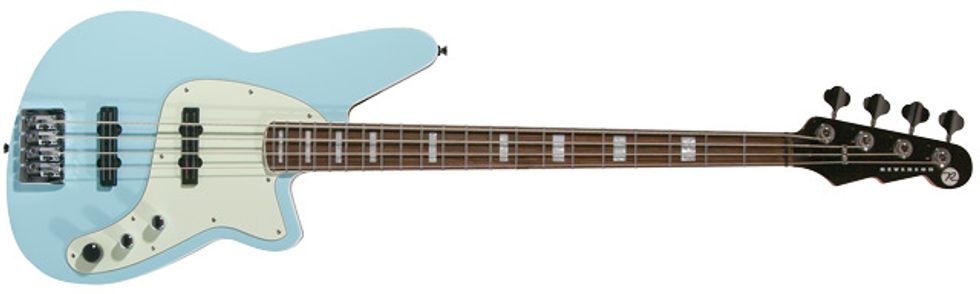
The Justice: A Twist on the Familiar
From the moment I pulled the “Chronic Blue” Justice from its case, I puzzled over the simultaneous familiarity and oddity of its design. Reverend admittedly dubs the Justice their “take on the classic ‘J’ setup,” and there should be an emphasis on take rather than copy. I’ve played a Fender Jazz since the late ’70s, so I know its nuances well. Like a J bass, the Justice bears a pair of skinny pickups in the neck and bridge positions. On closer look, these are not the usual noise-prone single-coils, but instead have a humbucking rail design and are appropriately named J-Rails. Unlike a J bass, you’re free to blend the pickups to any proportions without inducing hum— the neck or bridge can even be soloed with confidence.
This emphasis on take carries over to some other features. The body is certainly a departure, both in its shape and slab-cut top. The usual J-style design includes a pickguard that’s separate from a metal control plate, but the Justice combines everything on one plastic plate— much like a P-style axe. One of the attractions of a J bass is the skinny nut width, usually spec’d at 1 1/2". Instead, the Justice sports the same nut width as the Thundergun at 1 21/32". And the Volume-Tone-Blend setup is yet another departure from a traditional J bass with its Volume-Volume-Tone arrangement.
Some other design features help out in the resonance category. The bridge (same as the Thundergun) has a solid feel going well beyond the customary bent plate of a J bass. Locking saddles enhance the transmission of energy from the strings to the body, and stringing can go through the body or through the back of the bridge for a somewhat different attack and sound. On the flip side of the body, the neck is attached with six screws—rather than the usual four— also enhancing the instrument’s resonance.
Tone-wise, Reverend once again designed its pickups to work with the characteristics of their locations. They created a bridge pickup that emphasizes highs and mids, and a neck position pickup that covers the lows and less of the highs. In an instrumental blues rehearsal with electric guitar and drums, I favored the sound of the neck pickup with its warm and focused tones. Even though the neck pickup didn’t produce a lot of highs, its note definition made it easy to hear in the mix.
In all, the Justice might be a good choice for a J bass player looking for something a little different—both sonically and visually. And unless you’re a J bass traditionalist, the added benefit of humbucking pickups makes the Justice all the more appealing.
Justice Rating:
Buy if...
you like a bass designed from tradition yet with a take all its own.
Skip if...
you need a bright, aggressive bass, both in looks and sound.
Rating...
| Street $998 - Reverend Guitars - reverendguitars.com |
The Verdict
Reverend has returned to the bass scene after several years with some new designs that build on bass guitar traditions, yet head in new directions without blasting off to another planet. Like their predecessors, these basses bring a quality build with top-drawer components. While they are no longer made in the US, they are set up in Michigan by Reverend veteran Zach Green (look for the “ZSG” in silver ink alongside the serial number on the back of the headstock).
Although their appearance is based on familiar designs, the sound is not. Be sure to give a good listen to the Reverend you’re considering to make sure it meets your needs. The pricing is just on the brink—higher than a typical import, but a little lower than basic models built in the US.

![Rig Rundown: AFI [2025]](https://www.premierguitar.com/media-library/youtube.jpg?id=62064741&width=1245&height=700&quality=70&coordinates=0%2C0%2C0%2C0)
![Rig Rundown: The Black Crowes’ Rich Robinson [2026]](https://www.premierguitar.com/media-library/youtube.jpg?id=66952027&width=1245&height=700&quality=70&coordinates=0%2C0%2C0%2C0)