Rebecca Dirks graduated from the University of Iowa with degrees in journalism and art, and joined Premier Guitar as an intern in 2007. She lives in the Iowa City area with her husband, two giant dogs, and more cats than are appropriate to mention. When not petsitting, she enjoys challenging herself in the kitchen, watching the Packers dominate, and discovering new music or rediscovering old favorites.
Liz Phair and her Fender Mustang rocked the house in a miniskirt and heels as she played through her early hits and more recent fare at the IFC Crossroads House.
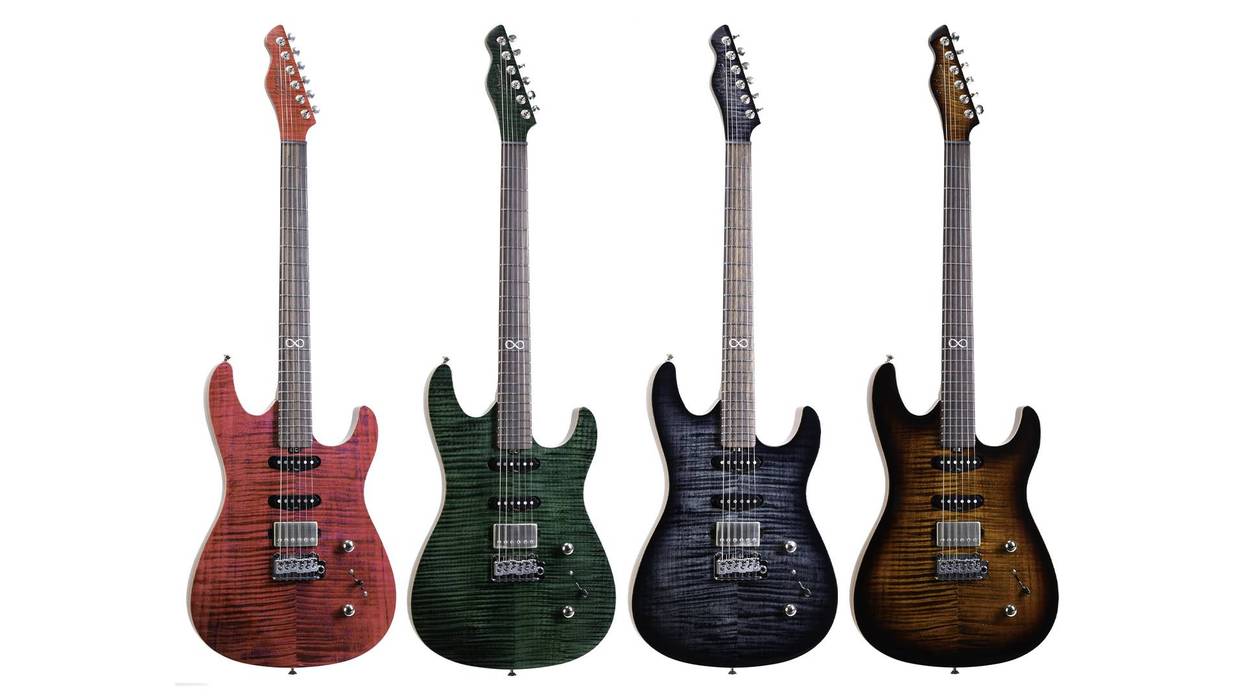
You could be one of THREE winners of the brand new "Swamp Critters" series of slides from RMSC! Three winners will select from The Devil Croc, Golden Gator and Swamp Rattler.
Nine designs but these are the first release of our latest series "The Swamp Critters"!! Made from Firecracker Aluminum and wrapped in the Meanest skins the Swamp can create. Thick walls and high impact resin coating deliver unique and funky sonics in tone and speed that hit you like a Python in Heat!! These are The Devil Croc, Golden Gator and Swamp Rattler. Stay tuned to see all the other releases from this series, all Bigfoot Approved!!! *Note: this series are available in 19mm inner diameter Only
Orange’s calling-card is, in the minds of many, a thick, coppery, and compressed high-gain roar. But for an amp that kicks this hard, the OR60 excels at translating the tonal qualities of a guitar with refinement and balance, and it’s a more subtle and nuanced creature than you might expect. In this respect, it’s much more like a late-'70s Marshall JMP with pre-gain than a hot-rodded Soldano or Bogner. The OR60 ably covers tones ranging from funky when clean to absolutely feral when cranked. And while the single-channel configuration suggests a narrow voice, there’s a massive range of timbres to explore—from chimey to chunky to charging-rhino, and all points in between.
Orange Appeal
Literal weight aside, the 43-pound OR60 is a heavy hitter that’s not mere high-octane hype. It doesn’t just sound good—it sounds vivid. Real. True. Three-dimensional. If it were an album mix, you might say it has terrific “imaging.” Even at the kind of high gain settings where Orange excels, it grabs onto the essence of your favorite axe without compromising it—a quality that defines most great classic amps. The OR60 is happy doing all this loudly, and no one is going to mistake the amp for a studio-specific low-watt boutique head or a Swiss Army knife modeling unit. Even through a modest Orange PPC212V 2x12 cabinet, this tangerine titan’s 60 watts of twin-6L6 power throw around the kind of sonic weight you’d expect from a 50- or 100-watt half-stack. Still, it has a great clean-to-dirty range.
In the half-stack configuration we used to test the OR60, it can get incredibly loud and still stay as clean as a Fender Showman at a surf competition. Its big, open headroom is part of the reason you’ll often hear the OR60 (and its little brother, the OR30) referred to as a great pedal platform, although in some ways this seems to be the least notable of the amp’s virtues. Sure, “great pedal platform” may be a perfectly reasonable descriptor for lesser amps with good, flat, clean frequency response, but it really undersells the wide, wicked timbral qualities of the big, bold OR60, which delivers grit very easily without pedals.
Preamp Pulp
Honestly, apart from the sounds you might add using cool “character” stomps and time-domain effects, if you can’t get utterly sick rhythm and lead tones from the OR60 alone then you’re unlikely to get them anywhere. For starters, it has a super-cool, foot-switchable secondary volume control for boosts and/or quieter passages. There’s also a built-in power-scaling switch that cuts the juice from 460V to 335V, so you don’t need to live at high volumes to get crushing Orange high-gain tones. Its 12AU7 tube-buffered effects loop delivers seriously hi-fidelity reverb and delay results.
Along with its impactful 3-band EQ, the OR60 sports a useful 3-way bright switch for treble contour, ranging from a fine treble boost (which really complements a midrange scoop), to the kind of barking upper-partial attack one associates with low-to-mid-gain vintage amps like the Marshall Super Lead 100. (The bright switch’s middle position offers the most neutral treble shape, theoretically ideal for use with those front-end gain pedals.) There’s more: A resonance knob lets you take your low-end from focused and modern bottom-end punch to a broader, boomier vintage bass shape; and the traditional presence knob adds sheen and sparkle. Frankly, though, I didn’t hear much need for it—the amp’s frequency range is already incredibly robust and tweakable.
With its six discrete EQ controls, and expansive gain stage options, it’s hard to imagine any amp-in-a-box pedal that can improve on the OR60’s basic voicing, tonal versatility, and body, or deliver better gain structure and warmth. These are the reasons one purchases a $2,500 all-tube head to begin with: because its own preamp gain probably dwarfs what you’re going to get from a $150 overdrive pedal. And even under-the-hood features like the OR60’s negative feedback loop, which keeps unwanted power tube distortion at bay, adds to the cohesive, high-quality feel of the amp.
The Verdict
If drive pedals are your superpower, and you’re looking for clean headroom and options for neutral frequency response, the OR60 has been tailored, at least in part, to make your stomps sing. But what you’re really paying for here, along with window-rattling power and headroom, are the harmonically rich overtones that will make a lot of pedals redundant. The OR60 accentuates the colors and character of guitars, whether you’re pushing the gain control to the hilt, hitting elegant in-between spots, or spanning the whole range of usable, musical saturation and clean tones that are available. As a live or studio all-rounder for classic rock, metal, soul, funk, and fusion players, the OR60 is full of potential that goes way beyond Orange stereotypes, and it’s ripe for the plucking.
Orange
OR60-V3 60-watt Amplifier Head
60W, 1-channel Tube Guitar Amp Head with Power Scaling, Bright Switch, Presence and Resonance Controls, FX Loop, and Volume Footswitch
Hello, and welcome back to Mod Garage. This month’s installment in our “Tonewood Teardown” series will be the most important one, dealing with the electrified tone of our guitar. We’ll start work on the wiring, which is the key component of every electric guitar. I really like the analogy that the pickup is the heart, the wiring the brain, and the wires themselves the neural system of an electric guitar. This means we should take care to do everything as carefully as possible here.
While playing our Harley Benton out of the box, I noticed that everything was okay with the stock electronics in this guitar; it sounds unmistakably like a Telecaster. The switch and the controls do what they’re supposed to, but the tone lacks in a few key areas: definition, clarity, twang, and string separation. Adjusting the height of the pickups didn’t change this, so it was time to have a look under the hood and think about a solution.
Both pickups are made by the Roswell company, which is the pickup-making branch of the WSC Music company (aka “Partsland”) with production plants in China and South Korea. Roswell is one of the biggest pickup factories worldwide, and it’s an open industry secret that they supply many guitar builders, including the leading big guys. Our Harley Benton comes with their Vintage Alnico 5 pickup set that is a modern interpretation of the ’50s-’60s Telecaster pickups. You can find a lot of good reviews about these pickups. For the price, they’re solid, but they definitely leave room for improvement, so out they come.
Under the hood of the control plate, I found decent-quality budget components as expected, and the soldering job was tight. I was surprised with the 3-way switch: It’s one of the typical budget switches with a PCB, but the switching haptics feel smooth and precise. Sadly, its lever is made for metric switch tips with a small slit; otherwise, I would have reused it with the new wiring. After detaching all components, the complete electronics system can be taken out in one piece.
There were several reasons behind my idea to turn this Harley Benton into a single-pickup Esquire-style guitar: It’s one of the most underrated electric guitars ever; it saves some weight thanks to having no neck pickup; and I really like single-pickup Esquires!
Because an Esquire typically sports only one bridge pickup, people usually think it’s a tonally inflexible guitar: Many view it as a poor-man’s Telecaster, but this is simply wrong. It is its own model, with its own tone. This is mostly because of the different wiring of the electronics, plus the lack of a neck pickup which causes less magnetic pull on the strings, a feature that further differentiates the sound of an Esquire from a Telecaster. Because of this, the Esquire is more responsive, and has a more percussive attack and more harmonic overtones compared to a Telecaster. With well-designed electronics, this single-pickup configuration is plenty of things, but definitely not inflexible, in my opinion.
Naturally, you can follow a different track for your own project: You could leave the stock pickups untouched, put in two new pickups of your choice, or even create an Esquire look with a neck pickup hidden under the pickguard—amazing your audience, who will wonder where the neck pickup tones are coming from! Maybe you want to follow the Keith Richards route, putting a humbucker in the neck position for some Micawber-style flair. It’s your guitar; you decide what to do with it. Remember, I’m showing just one possible way of doing this type of project.
To get closer to an early-’50s Esquire tone, I had a look at Reverb and eBay for a used Broadcaster/Nocaster-style bridge pickup that fell within our tiny budget. I ended up with a used Seymour Duncan STL-1B Vintage Broadcaster Tele bridge pickup from the mid ’90s for $40. This pickup is very close to the original Fender specs, including the slightly larger magnets, and is a perfect choice for an Esquire-type guitar. I’ve used this pickup on a few guitars before and they always sound fantastic, but many pickup makers will have a similar pickup in their portfolios, if you want to look for an alternative.
When the pickup arrived, I noticed that one of the previous owners used it within a 4-way switch configuration, because there was an additional third ground wire soldered to the baseplate to separate it from the ground of the pickup. You usually need this mod when you want to put two pickups together in series on a Telecaster, but we don’t need this option for our single-pickup wiring, so I removed the third wire and re-connected the baseplate to the pickup’s ground. Both pickup wires were shortened for some reason, but after a quick measurement, it turned out that the remaining wire lengths will suffice for our wiring. Another benefit was that the pickup was naturally aged, so no further work was required to give it an aged look. After a short check with a multimeter measuring DC resistance and inductance, it turned out that the pickup was very close to its factory specs.
After the pickup purchase, our remaining $259 budget went down to $219, but to top it up a little bit, I sold the two stock Roswell pickups for $35 total, so our budget is up to $254 again for the rest of the project.
Now, it’s time to plan the electronics. I wanted to stay close to early-’50s specs, which call for two 250k pots, a 3-way switch, and cloth wire, all of the highest possible quality within our budget. But I didn’t want to copy the original switching matrix with the famous “dark circuit” that Leo Fender thought would be perfect for guitarists playing bass lines. I decided to go with a kind of modified Eldred Esquire wiring with this switching matrix: first position, pickup with volume and tone control; second position, true bypass with pickup connected directly to the output jack; third position, pickup with an additional capacitor and volume control.
I’ll explain more about the individual switching positions and why I chose them in the next part, but for now, these are the parts I selected to set up this wiring:
—two 250k mil-spec pots with a 60/40 taper ratio, U.S. inch, solid shaft
—3-way Duesenberg switch (in my book, this is the best lever switch available)
—custom-made, vintage-style output jack
—Silver Mica treble-bleed network for the volume pot, film caps for the tone pot, and Eldred mod caps
With these parts, our budget is now down to $196, but I’m optimistic that we can finish the guitar without going over.
Next month, we will continue with installing the pickup, our wiring diagram, and an explanation of the individual switching positions. After that, the body of our Harley Benton will be completely finished, and we’ll continue with the neck, so stay tuned.
Somatics, a field within body work, originated as a product of a cultural movement in the 18th century that focused on physical activity and strength-building. The principal element of somatics, which has gained prominence in the past decades in wellness culture and therapeutic contexts, is soma. On a surface level, soma is the perceived experience of the body, as distinct from the intellectual response to stimuli in your brain. The divide is easy to grasp. Maybe your brain thinks you’re at ease, but your body tells you something different: It’s tense, shaky, locked up. Our bodies can send us messages that our cerebrum might not be able to parse in the moment. The thought can be unsettling, but it can also be empowering, even invigorating, to acknowledge that the body can communicate in a way that defies conventional logic and easy explanation.
Somatics can help explain why some bands choose to work at volumes that most people consider dangerous. And they’re especially pertinent when discussing Sunn O))). The American duo of guitarists Greg Anderson and Stephen O’Malley has been making intoxicatingly loud music since 1997, flanked by a fortress of 100-watt Sunn Model T amplifier heads (the band’s name is self-evident) atop towering stacks of speaker cabinets. They’ve been described as drone metal, noise rock, doom, and ambient, and aside from regular collaborations with vocalists like Attila Csihar and select other heavy-music singers, Sunn O)))’s music is largely instrumental.
“That’s our band practice—hiking in the woods.”—Greg Anderson
Their new, self-titled record certainly is, and there is only one type of instrument present: electric guitar. The album’s six tracks, entirely performed by Anderson and O’Malley, unfurl slowly over the course of roughly 80 minutes; in the most complimentary way, these are not thinking songs—this is music that is perceived and experienced more than it is understood.
Even through headphones, the compositions have a palpable, breathtaking sense of mass and space. Guitar may be the only instrument on the record, but it is not the sole source of sound. Throughout the fourth track, “Mindrolling,” we hear running water, recorded in the woods around Bear Creek Studio in Woodinville, Washington. Just northeast of Seattle, a large window in the studio looks out onto the perma-green of the northwest’s forest. You can feel the environment in Sunn O)))’s tracks. The power chords are as towering and knotted as an ancient Douglas fir; the distortion as enveloping and forgiving as the forest floor; the feedback as deep and powerful as the Pacific. This is music to listen to while lying back, spread-eagled, on a cliff face in a hard, thrilling wind.
For Anderson and O’Malley, though, the record is evidence of something else, something just as sacred. “It’s really, to me, a representation of my relationship with Stephen,” says Anderson. “I get a good feeling listening to it.”
O’Malley (l) and Anderson, out in the closest thing they have to a practice space.
Photo by Charles Peterson
Sunn O))), the band’s 10th LP, arrives seven years after Pyroclasts. That seems like a long time to most people, remarks O’Malley, but he considers those years a natural part of “the arc of the creative process.” The new record, he says, is like a flower that emerged over the years. The duo worked with producer Brad Wood, sleeping in a farmhouse on the same property as Bear Creek Studio, which is itself housed in an old barn. Anderson and O’Malley would wake up, have coffee, then hike for a few hours in the forest nearby. After lunch, they’d meet up with Wood in the barn to work.
Anderson lives in Los Angeles, while O’Malley lives in Paris. When pandemic restrictions on concerts began to loosen, they started playing shows as a duo as a way to mitigate risk: Plenty of international tours had been thwarted, at great financial loss, by sudden changes in regional gathering restrictions. But the two-piece shows quickly became more than a logistical necessity. They felt fresh and open, says O’Malley, and he and Anderson were coming up with new ideas based on the limitations of only having two guitars onstage. “The fundamental ideas of the ensemble instrumentation were all there in the distortion,” says O’Malley. “I felt like I could hear it clearer in that abstract distortion and saturation. So we’ve continued on.”
“Whenever we play as a duo, it’s somewhat nostalgic,” says Anderson. “I didn’t know that there was another path forward from that. It turns out there was, and that’s what we were really excited about capturing on the recording—the development of what the duo had become.”
“The fundamental ideas of the ensemble instrumentation were all there in the distortion.”—Stephen O’Malley
Anderson brings up the idea of shoshin, a Zen Buddhist idea that celebrates having a beginner’s mind for all things in life. In the context of the band’s post-pandemic creativity, it suggested embracing the joy he felt in the first days of the project, such that the entire process—playing as a duo onstage and in the studio, focusing only on his friendship with O’Malley—felt like an embodiment of shoshin. The two of them felt joy, but they also felt newness, and explored it. That’s why they decided to create a new album: to document this unexpected expansion.
There was little creative preparation to be done; songs would be captured in the moment as living, breathing things. Both Anderson and O’Malley have Model Ts stashed around the world, from Los Angeles, to Paris, to Amsterdam. The 100-watt heads all have different personalities, insists O’Malley, not least because of the different voltages between American and European power supplies and how the transformers respond. They shipped Anderson’s collection—including Marshalls, Fenders, Hiwatts, Soldanos, Ampegs, Oranges, and, naturally, Sunns—from California to Bear Creek, and rented cabinets in Seattle. Wood placed mics everywhere: on each speaker of the 4x12s, around the room, even outside the room. In another area, smaller combos—including a Fender Champ, Deluxe, and Twin—were used for re-amping and running tape effects on solos. The variety of perspectives allowed Wood to sculpt the mass of distortion and create the record’s cavernous spatial signature.
Anderson relied on an Electro-Harmonix “Civil War” Big Muff, paired with his Pro Co RAT, and the band’s own signature pedal, the EarthQuaker Devices Life, to generate his guitar’s pillowy, bottomless low-end across the record. He likens rediscovering the might of the Big Muff, after all these years, to smoking pot or having sex for the first time. “That’s kind of the shoshin concept, too,” he notes. “Playing with the joy that you had when you first started playing, and trying to get back to that. That can be applied to many different elements, including combining a Big Muff with the RAT circuit.” O’Malley, meanwhile, has used the same ZVEX Super Hard On since 1997. Beginner’s mind, indeed.
During a performance at Le Guess Who on November 6, 2025 in Utrecht, Netherlands, Anderson (l) and O’Malley make an offering to the old gods and goddesses of feedback, surrounded by their bandmates—their Sunn Model T heads.
Photo by Claire Alaxandra
Growing up, Anderson remembers seeing the Melvins in their early days, and the physicality of their gigs’ over-the-top volumes moved him. “That’s why I would follow them around like the Grateful Dead,” says Anderson. The same thing happened when he saw My Bloody Valentine in the early ’90s. “Of course you can hear the music, but to feel it in your bones, that was just something special,” he says. “I had a connection there that I got really addicted to. You can’t really get that on a recording, right?”
Part of the reason the band’s new record is self-titled is because it evokes the feeling of Sunn O))) at its most elemental: Anderson and O’Malley, together in a room, making electrifyingly loud compositions with their electric guitars. When the band first began, they weren’t concerned with playing live. Inspired by that mammoth wall of sound, the idea was to simply get in a room with as many amps as they could manage, get high, and play music together. When they caught on to the physical aspect of the project, they began to think about taking it to the realm of live performance. But that’s not an easy thing to do: The logistics of transporting and operating multiple 100-watt stacks are sticky, and even if you figure out how to do it, there are few venues willing to host such a performance. If a club can’t accommodate Sunn’s backline, or if they require acts to abide by a decibel limit, the band won’t play. (Anderson knows their backline is a lot: “It’s a mountain,” he says.) That can cross out certain cities entirely, but it’s non-negotiable. The volume is part of the band.
“I enjoy the aspect of danger, and I feel like a lot of that has been removed from art and music and film,” says Anderson. “I get it, I understand health and safety, but it also sort of bothers me, because then you’re taking that away from people. There are things that can be done to protect yourself. You’ve taken away that choice and that ability for people to experience it. It’s really loud, but it’s not a painful loud. It’s nearly all low end and low frequencies. There’s not that high, ice-pick, piercing sound in what we do. I equate it more to a warm bath. We’re not trying to damage people’s hearing. It’s not this aggressive moment at all. I understand why it could be interpreted that way, but that’s not the case. To me, the music is very soothing, and I’m grateful that people have gotten that and connected with it.
“It is overwhelming, and to be immersed in that, it does have this kind of comical angle to it sometimes,” Anderson continues. “Oftentimes, Stephen and I will laugh and say, ‘This is insane and amazing that we’re in this right now!’ I think that in itself is a reason to celebrate. It has this kind of celebratory atmosphere to it.”
“I enjoy the aspect of danger, and I feel like a lot of that has been removed from art and music and film. I seek out things that have that edge to it.”—Greg Anderson
Anderson is pictured here lifting aloft his main instrument of worship: a goldtop 2005 Gibson Les Paul Deluxe.
Photo by Claire Alaxandra
Greg Anderson’s Gear
Guitar
2005 GibsonLes Paul Deluxe goldtop with black DiMarzio P90 Super Distortion pickups
Amps
Mid-’70s Sunn Model T
Sunn 2000S
Sunn 1200S
Ampeg SVT “Blueline”
Effects
Pro Co Turbo RAT (with LM308 chip)
Electro-Harmonix/Sovtek “Civil War” Big Muff Pi
EarthQuaker Devices White Light
EarthQuaker Devices Life Pedal
Aguilar Octamizer
Ernie Ball VP JR
4-way splitter box
Anderson notes that he and O’Malley have always delighted in pushing the boundaries of their own expectations, to the point of deleting them entirely. That attitude is one of the keys to their longevity. “It sounds cliche, but I keep saying it over and over again, and it’s true: It’s about being open to different possibilities and ideas,” Anderson explains. “That’s why we’ve sustained, and that’s why it continues to be interesting. Every single band in my life that I’ve been involved with had an ending point. But Sunn O))) has transcended a lot of that.”
“Over time, each person grows in innumerable ways and transforms, and their tastes transform, their perception transforms,” says O’Malley. “It’s like you’re constantly shedding possible versions of yourself.” When you rewatch a film that you haven’t seen in five years, it might mean something entirely different to you. “I think that’s one of the strengths of our music, and the longevity of it, too: the openness to not only changing things, but changing the point of view of what it is.”
Onstage, O’Malley turns sound into a physical force with his Travis Bean “Deo Dei” TB1000A.
Bright Onion Active Splitter Pedal with Phase Switching
ZVEX Effects Super Hard On
So what exactly does “openness” mean? For Anderson and O’Malley, it’s throwing out the “rules” for being a band. They don’t practice; soundchecks before shows are the closest thing they have to rehearsals, and Anderson admits that he despises conventional “band practice.” He casts the idea of practice in a different light. For he and O’Malley, it’s not about strapping on their guitars and going over ideas together. While they were in Illinois to attend a celebration of life for creative collaborator Steve Albini, the two of them went swimming in Lake Michigan. Being present together, at the memorial, going for a swim—that was practice. While they worked on the new record, they took plenty of hikes together in the Washington woods. “That’s our band practice,” says Anderson. “Hiking in the woods.” It doesn’t seem like a coincidence that communing with their surroundings, being present in their bodies, is central to their creative relationship.
“If I remove the word ‘band’ from ‘band practice,’ it makes more sense,” says O’Malley. “It’s the practice of being together. Music is about relationships and interaction.”
O’Malley continues. “I’m not saying going swimming gives me riff ideas, but when you’re in the waves, it’s quite immersive. Being in Illinois, to celebrate the life of a great master who also happened to be a friend, and then taking time to have pleasure by engaging with the ancient lake, it’s pretty powerful.”
Gibson proudly announces the debut of the Sadler Vaden SG™ Standard, the first-ever signature guitar for acclaimed guitarist, producer, songwriter, and longtime member of Jason Isbell and the 400 Unit, Sadler Vaden. Inspired by Vaden’s road‑tested 2005 Gibson SG Standard, this new model brings the sound and character of his most trusted instrument to players everywhere. Vaden’s original SG, discovered in Memphis, TN, and gifted to him by producer Paul Ebersold after his band suffered a devastating gear theft in Philadelphia, became the anchor of his sound for nearly two decades. It is the guitar he continues to rely on nightly with Jason Isbell and the 400 Unit, and its voice and feel form the foundation of this new signature edition. The Gibson Sadler Vaden SG Standard is now available worldwide at authorized Gibson dealers, at Gibson Garage locations, and on www.gibson.com.
“There’s going to be a certain amount of people that are fans of me and the band and want it as a collector’s item, but aside from that, I really wanted to have something out there that’s a great instrument,” says Sadler. “That’s what that guitar means to me. My SG was a gift to me, to keep things going, to take on the road—it’s a tool. What I hope is that someone buys this guitar—whether they are a fan of me and the band or not—and they pick that thing up and are like, ‘This is a great guitar! This sounds good! I can take this on the road and in the studio.’ It’s a workhorse guitar. Say a producer in Nashville needs an SG, and they pick that thing up; this thing will do anything they want it to do. I wanted it to be an inspiring guitar.”
Sadler Vaden’s musical journey has been defined by versatility, taste, and an unshakable commitment to great songs. Before joining Jason Isbell and the 400 Unit, Vaden came up through the Southeastern rock scene, touring heavily with Drivin’ N’ Cryin’ and honing the style that would make him a sought‑after collaborator in Americana and rock circles. As a producer, he has shaped celebrated albums for artists including Morgan Wade, while as a solo artist, he has released critically praised records that showcase his sharp songwriting and expressive guitar work. Throughout his GRAMMY®-Award-winning career, the SG has remained a constant companion and a defining element of his sound onstage and in the studio, in addition to his solo work across four albums: Radio Road (2012), Sadler Vaden (2016), Anybody out There? (2020), and the recent Dad Rock (2024).

Read the brand-new Q&A with Sadler Vaden on the Gibson Gazette, watch his interview on Gibson TV about the Gibson SG Standard HERE, and check out the GRAMMY® Award-Winning songwriter’s unique take on songcraft as he chats with Gibson Gear Guide Channel host Dinesh Lekhraj HERE.
Modeled carefully after Vaden’s own 2005 SG Standard, the Sadler Vaden SG Standard features a solid mahogany body with the iconic double‑cutaway silhouette and the pronounced bevels that make the SG both comfortable and unmistakably bold. Its Natural Burst gloss nitrocellulose finish is precisely shaded to match the matured, slightly darkened look of Vaden’s original guitar. A mahogany neck carved to his preferred Rounded profile is paired with a rosewood fretboard featuring 22 medium jumbo frets and acrylic trapezoid inlays. The headstock carries a mother‑of‑pearl Gibson logo and crown, while a Graph Tech® nut and Vintage Deluxe tuners provide reliable, stage‑ready tuning stability. A personalized touch appears on the two‑ply truss rod cover, which bears Vaden’s initials in place of the standard SG engraving.
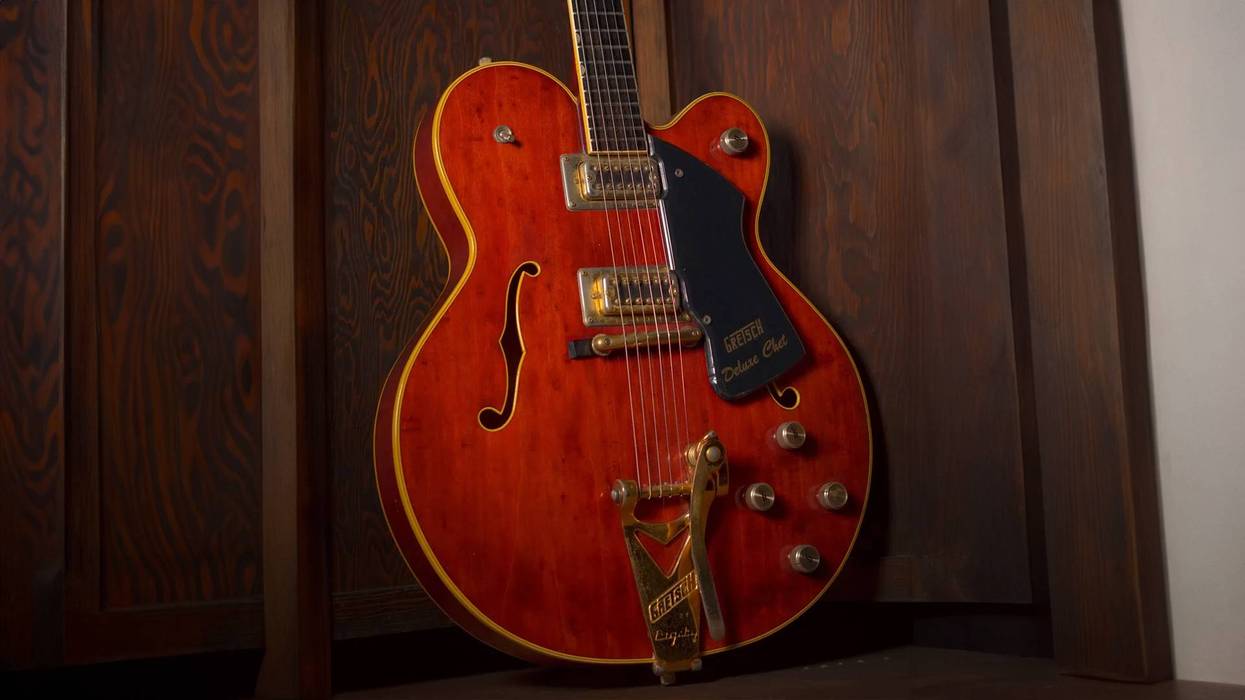

The new model features chrome‑plated hardware, including an aluminum Nashville Tune‑O‑Matic™ bridge and matching aluminum Stop Bar tailpiece, ensuring precise intonation and full adjustability for any playing style. Its five‑ply, full‑face “batwing” pickguard houses a set of Sadler Vaden Signature humbucker™ pickups with exposed zebra coils and Alnico 2 magnets. The neck pickup delivers moderate output with warm, vintage‑leaning clarity that responds beautifully to volume changes, while the bridge pickup provides higher output with Patent Applied For‑style punch and midrange focus designed to cut through a live mix without sacrificing body or depth. Each pickup is controlled by its own volume and tone knobs topped with black Top Hat reflectors, with a traditional three‑way toggle switch offering a broad range of tonal options.
Every Sadler Vaden SG Standard is shipped in a brown hardshell case and includes exclusive extras: a Sadler Vaden trading card, unique stickers, and a custom guitar strap. Built for players who value expressiveness, reliability, and character in equal measure, this guitar brings Sadler Vaden’s tone, formed over decades of touring, recording, and refining, to musicians everywhere.