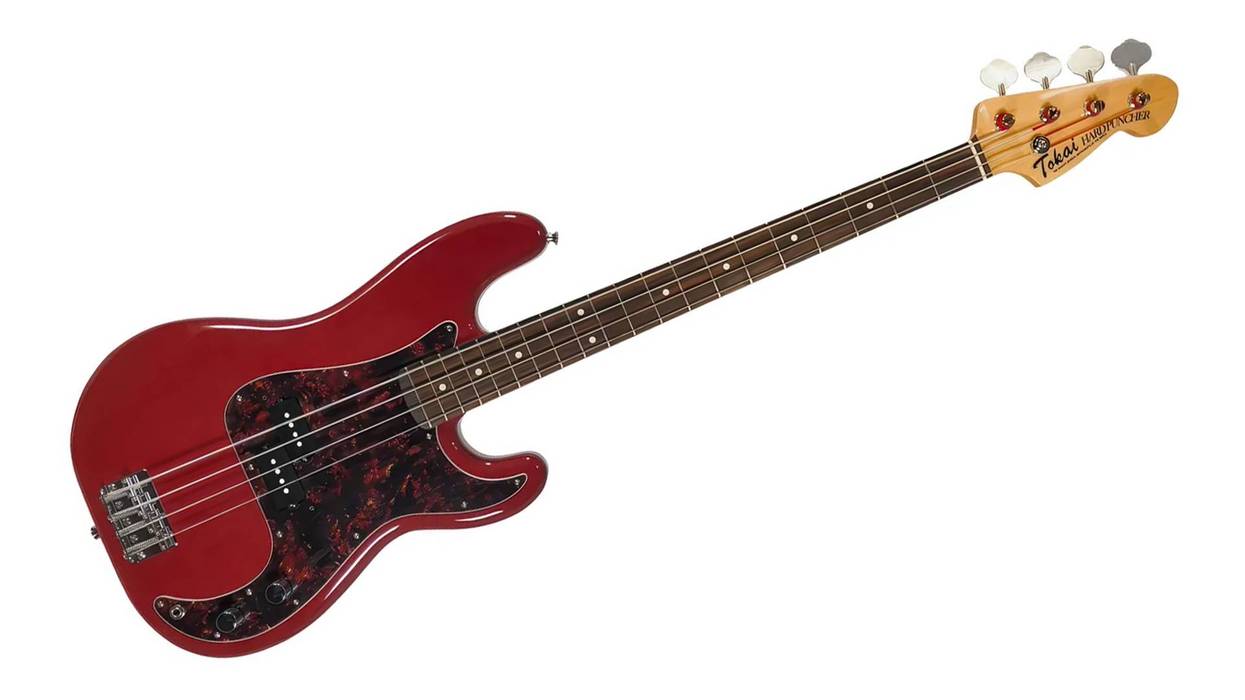



What’s the first thing that catches your eye when shopping for a new guitar? Is there a certain aspect of an instrument that draws you in and makes you want a guitar even when you aren’t in the market? I’d guess that most of the time it’s the body. Either a shape or a flashy finish stops you in your tracks and triggers your GDR (guitarist drool reflex). And before long, you’re calculating the amount of old gear you could sell off to buy your new object of desire.
Where the Magic Happens
Unless a guitar has some really unique and awesome inlay, the neck usually plays second fiddle to the bounty of the body. But it’s the neck (and its soul mate, the fretboard) where the magic really happens. It’s the part of the guitar you hold in your hand to make the music and is responsible for the pitch, vibrato, and voicing of your sound. One half of the strings’ vibration connects directly to the neck, and only after the neck has done its work does the body enter the sonic equation.
The mass of your neck has a distinct bearing on how your guitar sounds. The trend back to thick, meaty vintage-style necks has been in response to the perception that thin, shredder necks produce thin sound. Is it really true? (I don’t think it’s just the thickness, but I do prefer the feel of a fatter neck because it puts your hand into a more natural and relaxed shape, which is more comfortable for extended playing.)
The nose of the note is where tone lives, and up until the bloom of that note, the body is mainly a neck- and bridge-locating device that also allows you to hold your instrument. That’s not to say that the body is irrelevant, but it’s certainly worth noting that a neck can be the deal breaker.
Before You Pass the Joint
Some players gravitate to certain construction types without knowing exactly why. The primary two methods are either a glued joint or a removable type that utilizes screws. A third option is the neck-through-body style. It’s an entirely different approach in which body parts are added on to each side of the neck like wings, totally blurring the line between neck and body.
Even in a glued joint, there are variations that affect performance to some degree. Probably the most common is the simple tenon joint—a staple of the furniture trade—where a straight-sided finger (tenon) is glued into a slot (called a mortise) in the body. As neck joints go, the mortise and tenon variety are popular for their ease of construction, clean appearance, strength, and excellent transmission of vibration.
One of the oldest glued-joint configurations is the dovetail, so named because the tenon in this case is triangular in shape and resembles, well, a dove’s tail. This arrangement has been used on stringed instruments like violins and cellos for centuries, and is sometimes referred to as a classical joint. It’s a bit more labor intensive to fabricate the matching slot, but when done correctly, it is almost self-clamping. (The use of CNC routers has made this joint much more production friendly.) The dovetail also hides the actual joint, and is very popular with acoustic builders to whom tradition is important. As far as passing vibration along, this type of neck joint is quite good when properly fitted. Of course, removing any glued neck is going to be a pain.
Screwed Not Glued
The most ubiquitous joint is the venerable bolt-on, which actually uses wood screws (not bolts). Although Fender didn’t invent the removable and replaceable neck, they certainly popularized it. Most of the vibration that moves between neck and body is accomplished through the bottom of the neck where the screws exert the pressure against the body mortise.
Some builders pride themselves on their ability to keep close tolerances that allow the sides of the neck to contact the body—claiming increased sustain as a result. Others feel that it’s the lack of connectivity (compared to a glued joint) that gives a bolt-on guitar its percussive nature. As much as I recognize that a screwed-together joint has a signature sound, I’d have to come down on the side of a tighter fit myself. I think it makes for a livelier instrument without sacrificing the spanky-ness of a Strat or Tele. And the ability to easily remove the neck is a repair shop’s dream when it comes to refretting, or replacing a damaged neck or body.
Material Issues
Wood is probably the most significant consideration for any neck. The wood species certainly helps define the sound of your guitar, but also has a major bearing on its strength. The softer woods like mahogany, cedar, and even walnut have a particular tonality which some describe as warm. Being softer, they are easier to bend with a truss rod, but also easier to break.
Maple is a very strong wood and a brighter tone is a direct result of its hardness. It’s not as porous as the previously mentioned varieties, but maple is extremely smooth, easy to paint, and doesn’t require any grain filler. Once maple necks settle in, they often require less maintenance than those made of softer woods.
Will a better understanding of construction make you consider the neck before the body of a guitar? I doubt it, but it can certainly temper your overall desire for any guitar when you factor in the huge contribution it makes first to your sound, and then to your experience down the road.