
 | |
 | Download Example 1 Vol. & Tone 9 o'clock |
| Download Example 2 Vol. noon, Tone noon |
| Download Example 3 Vol. 5, Tone 3 o'clock |
| Recorded with a Nash S63, clip 1 w/ Lollar neck & middle pup; clip 2 w/Lollar bridge pup, Vol. 3 - 8; clip 3 w/bridge pup, Tone 3; all clips recorded in Sound Studio on a MacBook Pro using Digidesign Mbox (SM57; MXL 990). | |
Apparently, Wohlwend’s dissatisfaction with off-the-shelf gear and his interest in tube amps lead him to start building for himself, which is all to the good; his success with simple designs and affordable materials apparently lead him to question why so many of the so-called “boutique” amps of similar design cost so much more. That’s a “big” question, but to be frank, I have to say that the chip-on-the-shoulder, “anti-boutique” stance of the website seems a bit strident for me. That said, I know plenty of players feel the same way he does.
Power to the People
The expanding diversity of the market, the integration of modern production methods and a DIY ethos, even the unrestrained scrapping that flourishes in discussion forums—all of this is good news for guitarists. It’s true that some parts of the market are witnessing skyrocketing prices, but that isn’t restricting our freedom of choice. Choice is good; choice means you can get what you want. The first step to figuring out what to do with the fact that some gear costs much more than other gear is in not confusing cost with value. The value of your gear is not what it costs you, but rather what it’s worth to you. A dollar figure is never going to sum that up by itself. Some players want lots of features, while others prefer to think of them as frills. Some are satisfied only when they know they have the best quality components they can get; others will swear that if they don’t hear or feel the difference, then no one does. Add to these differences a huge range of options in construction, versatility, availability, aesthetics, etc.—if freedom of choice makes us crazy, we’re all crazy now.
What's in a name?
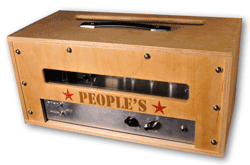
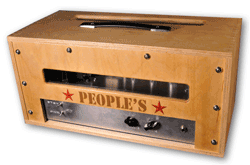
Sometimes less is more; sometimes less is just less. Whether or not a stripped-down, minimalist offering like the People’s Amp falls into one category or the other depends entirely on what you want and how you measure it. For example, we could take first impressions. Do you like kitsch? The stenciled “People’s” label bookended by a pair of red stars immediately calls to mind a piece of Soviet-era military surplus hardware. Even if the design is an ironic send-up of the motivation behind the amp, providing old-school tube tone to the masses, it’s still a bit of a mixed metaphor: slightly kooky, but potentially quite cool, depending on who you are.
How about features? With nothing but On/Off and Standby switches, a volume knob and a single tone control, is the People’s Amp unpretentious and user-friendly, or is it a substitute for cash-strapped, tone-hungry players who can’t afford more? You can dial up a really classic glassy EL84 bite in seconds, but that’s all you can do; is that good or bad? That’s hard to say, but it’s only a moot point if People’s Amp is your only amplifier.
Like everything else about it, cabinet construction is motivated by cost saving, which could mean a trade-off, depending on what you expect from your gear. It’s built out of 1/2" voidless Baltic birch plywood, which means it’s not shabby, and it has been given a hand-rubbed oil and wax finish to give it some durability, but there’s nothing particularly attractive about uncovered plywood, and I don’t personally think of Tolex as an extravagance. Plastic handles are fine with me, but some are better than others. On the other hand, I can see how the difference in appearance might appeal to some. I can’t say how long it would take for the amp to start showing the signs of belonging to a working musician, but if it were my amp, I’m pretty sure it wouldn’t be a long, long time. At the very least, it should have corner protectors—our review model has already recieved one noticeable corner dent, and that’s just from being moved around our offices during a recent jam session (sorry, Karl).
In some ways, it does just look low-grade: the labels on the control panel face are hand engraved, uneven and somewhat ham-fisted. I wonder what would’ve been so expensive about a stencil. The screws holding the plexiglass to the inside of the front opening start to poke through the wood on the valence, and the telltale bumps are a little too “shop class” for me. On the other hand, Wohlwend has made it clear that it’s the sound and feel of the People’s Amp and not its looks that engaged his attention. On that score, he deserves compliments—and some respect. It is indeed what a good amp ought to be: an instrument that responds to the guitar you plug into it, as well as to the way you play. It’s got plenty of sensitivity, and though it’s not the most dynamic amp I’ve played recently, controlling it with only the guitar’s volume knob is no chore.
Hit Page 2 for plugged-in impressions and the rating.
Plugging In
There is only one tone in this box, but it’s a good one: a nice sag and lots of compression, so it’s very warm even on the cleanest settings; obviously, there’s not a ton of headroom, but it doesn’t lose any of its clarity as you crank it up. An amp like this doesn’t call for lots of clean time anyway, since classic blues-rock is where this thing lives—and it’s got its act together. If you like that sound, this amp will reward you, and no need to screw around dialing in the sweet spot. If you want the smoothest overdrive, this amp is not for you; but if you dig the raw edge and bite of the EL84, you’re not going to be disappointed. I could wish for a bit more fine control over the tone shaping. The amp has a very bright character, so you have to be careful about the guitar you plug in. Hotter pickups can push into harsh territory pretty quickly, and I haven’t been able to push the single tone past 3 o’clock without gritting my teeth—but it’s perfectly usable up to that point.
When you push the People’s Amp, it’ll give you a lean, sinewy distortion that’s not too creamy or fat; at lower volume it’s a bit dry, so greater sustain would be desirable. Of course, the cabinet you run this amp through will make a big difference, too. I happened to have on hand Category 5’s slant-front 2×12 loaded with G12H Heritage speakers. That seemed like a pretty righteous match, but I have to say that even with the ample low-end response of this cabinet, the amp is much stronger at the top end. I thoroughly enjoyed the pushed tone with my Nash S63 strat outfitted with Jason Lollar’s pickups—straight up with pedals, very Texas blues sounding. Plug in some mellow humbuckers, crank the volume, dial up the tone just to the edge of brittle, and you can do gritty slide blues à la ZZ Top all day.
The Final Mojo
For the recording studio, or someone who’s looking to expand a collection of smaller, lower power amps, the price tag on the People’s Amp would make it a pretty easy choice. For small club gigs, rehearsal, or a full PA setup, the choice gets a bit harder to make. For a big stage, or regular road trips, I’m not so sure. It has its limitations, but it does what it does pretty damn well. While I wouldn’t recommend it as a workhorse, it would make a solid addition for players who want that sound, or who find its unorthodox looks appealing.
Buy if...
you're looking for an inexpensive low-power amp for blues-rock.
Skip if...
you need more control over your tone.
Rating...

| Street $650 - People's Amplifier - peoplesamp.com |


![Rig Rundown: The Black Crowes’ Rich Robinson [2026]](https://www.premierguitar.com/media-library/youtube.jpg?id=66952027&width=1245&height=700&quality=70&coordinates=0%2C0%2C0%2C0)