
Just like their records, the Australian rockers’ road gear is eclectic and adventurous, ready to cover ground from metal to microtonal Turkish psychedelia.
You could throw a dart at a board of all the world’s music genres, and chances are fair that you’d hit a sound that Melbourne band King Gizzard and the Lizard Wizard have explored. King Gizz started life as a bluesy garage-rock outfit, but over the past 14 years, they’ve leapt into metal, jazz, folk, electronic, and even microtonal music. They’ve spread their adventures over 26 LPs—five of them released in 2022 alone.
On tour this summer in support of their latest, Flight b741, the band stopped at Nashville’s Ascend Amphitheater, where Premier Guitar’s Chris Kies caught up with guitarists Joey Walker and Stu Mackenzie for a look at how they navigate the Gizzverse onstage. Here’s a preview of some of the goods, but tune into the full Rundown to catch all the details—including Mackenzie’s famed Flying Microtonal Banana, the namesake of their 2017 album.
Brought to you by D’Addario.Turkish Delight
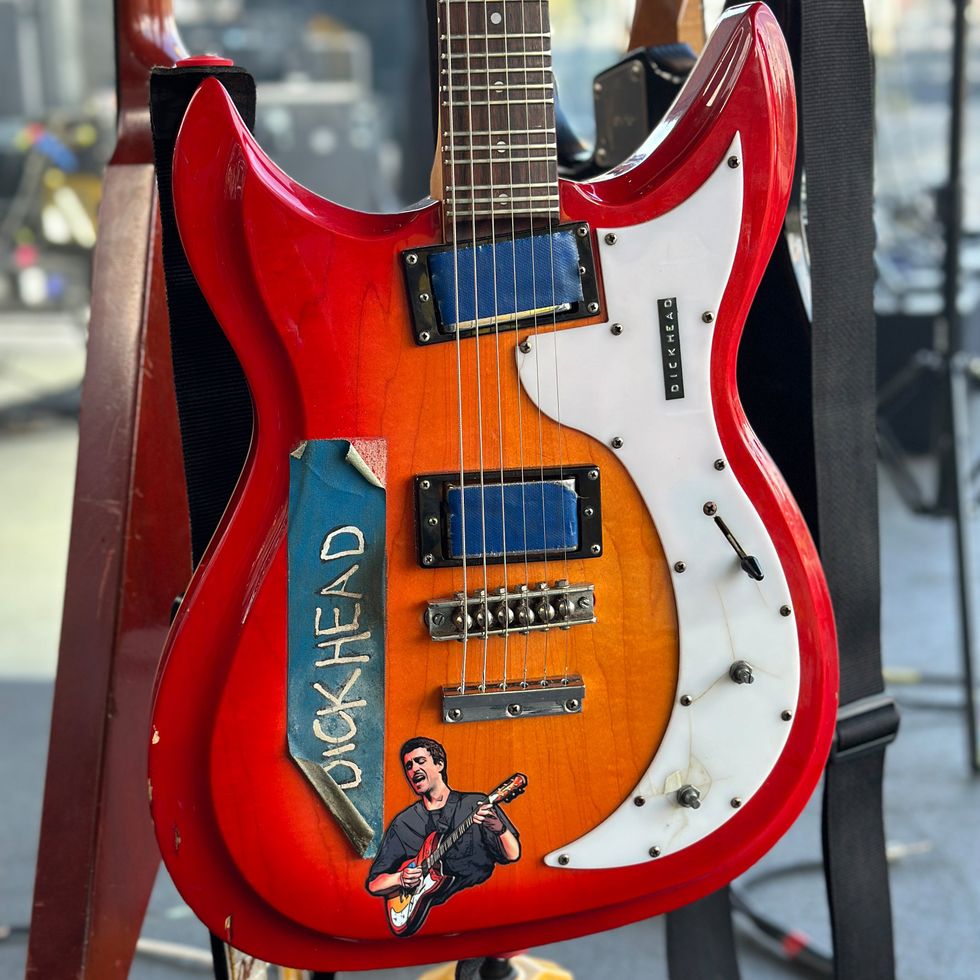
Walker’s Godin Richmond Dorchester has been subjected to a few changes. When King Gizzard entered their “microtonal phase,” influenced by Mackenzie’s travels to Turkey, the guitar was modified by a luthier friend with a fret arrangement (identical to Mackenzie’s Flying Banana) that permits microtonal intervals, like a Turkish bağlama. Walker explains that it’s like adding extra frets between the traditional 12 notes, so there are quarter-tone intervals rather than just semitone steps. It took some learning to figure out how to play, but at this point it feels like muscle memory for Walker.
The Jammer
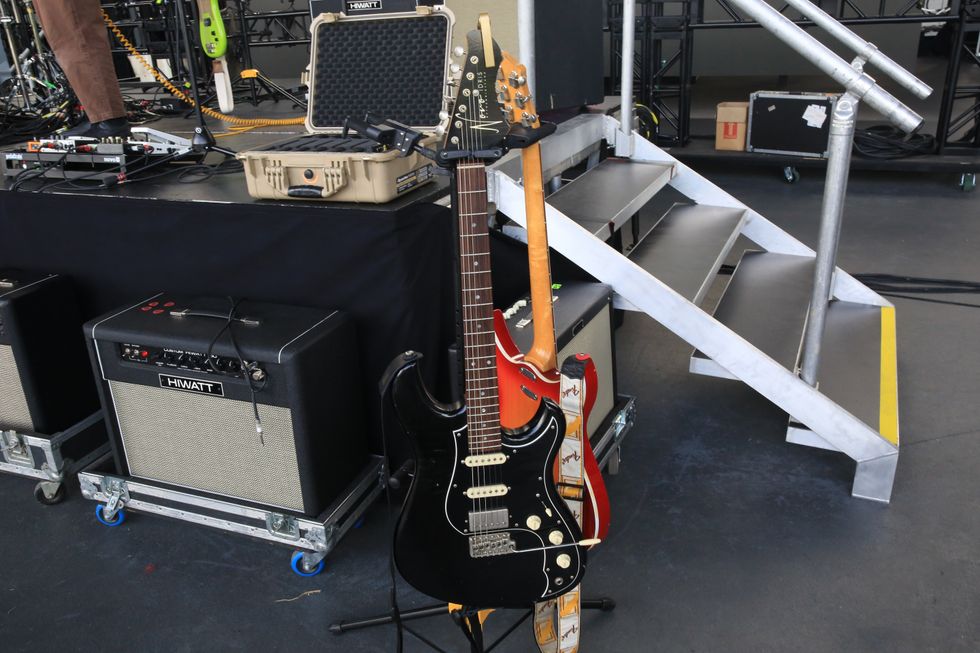
This H-S-S Novo Idris does the heavy lifting for Joey Walker playing deep into King Gizzard's expansive, extended sets.
Samurai Sword
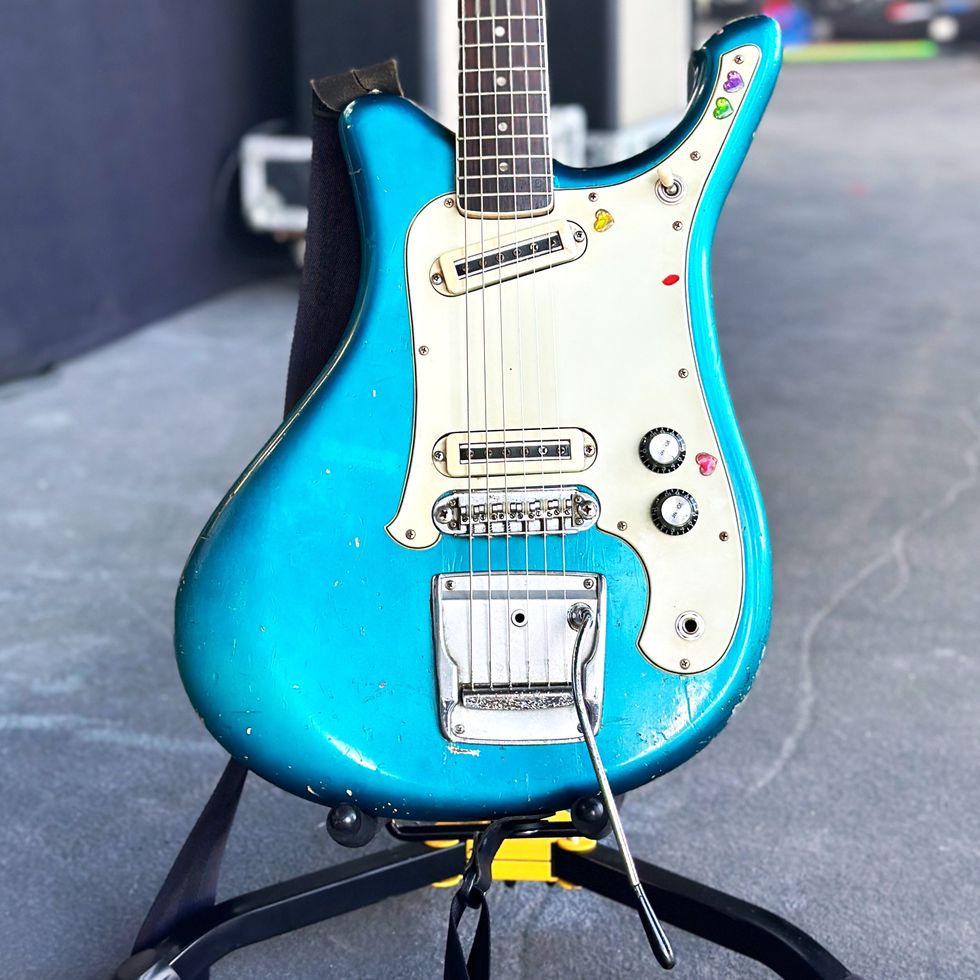
Mackenzie admits that he’s not picky with his guitars: He likes unpredictable gear, and he’s prone to impulse-buying weirdo axes. He picked up this Yamaha SG-2 in 2013, and it sounds like no other guitar he’s played. The weird, noisy pickups cause interesting microphonic glitches, and while it’s a bit of a pain to keep in proper playing order, Mackenzie knows his way around the guitar and trusts it. The SG-2 is strung with .011s and handles standard-tuning numbers.
Stu Mackenzie's Pedalboard and Amp
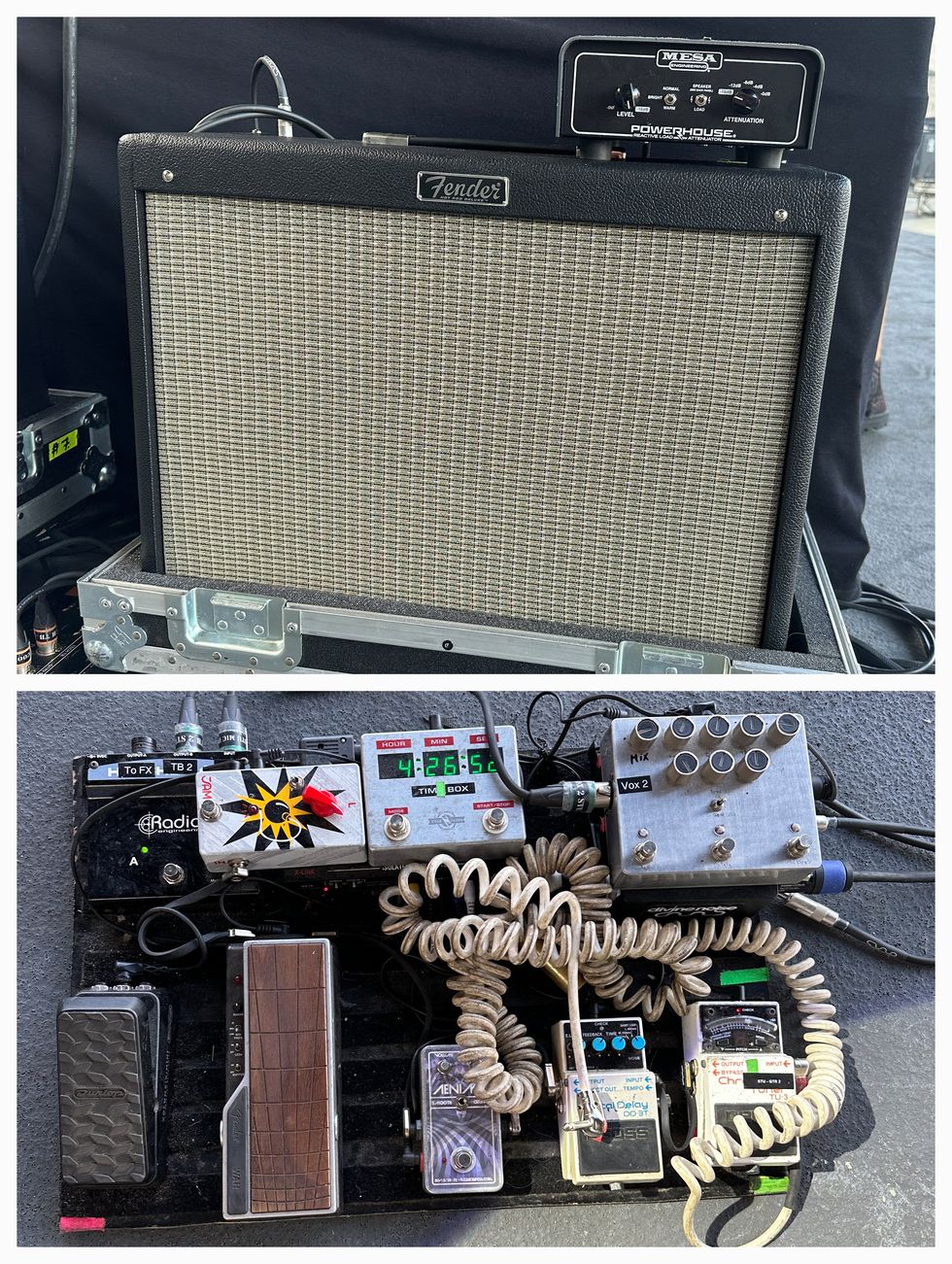
While Mackenzie’s guitar selections are rather offbeat, his pedalboard and amp setup are fairly straight-laced; in fact, 70 percent of the set is played with no effects on at all. His signal runs first into a Boss TU-3 tuner and DD-3T delay, then to a Devi Ever Aenima, a Jam Pedals Boomster, a Fender Tread-Light Wah, and a Dunlop Volume (X) Mini. His vocals run into a custom multi-effect pedal by EarthQuaker Devices, which features both overdrive and a gated echo, preventing ambient noise from triggering the effect. A VVco Pedals Time Box helps Mackenzie keep the set from running over.
From the board, his signal runs to a Fender Hot Rod Deluxe, an amp he can pick up virtually anywhere in the world. He runs it fairly clean, but adjusts it between every song for varied gain-staging. A Mesa Boogie PowerHouse Attenuator keeps the stage volume in check.
Hefty Hitters
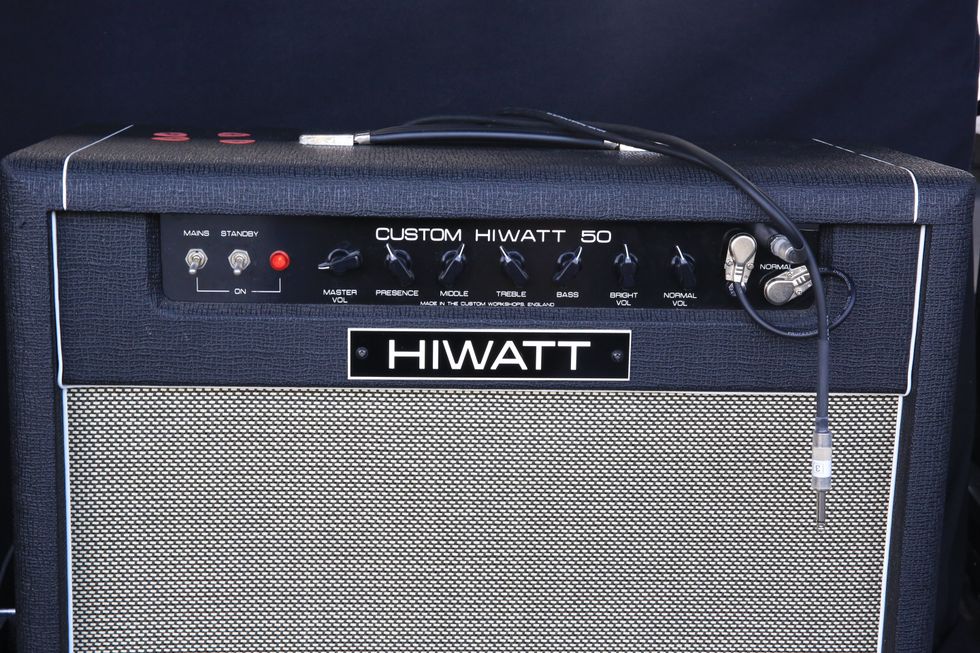
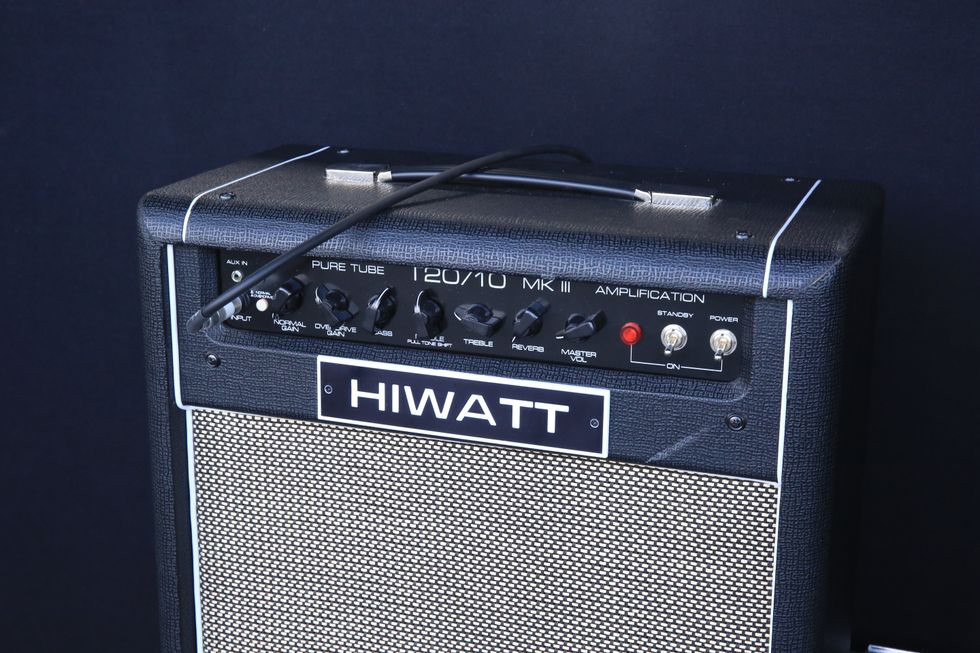
Joey Walker uses two different Hiwatt combos — a Custom 50 and T20/10 MkIII — that both serve a purpose during the Gizzverse throwdown. The bigger Custom 50 is EQ'd for clean tones, while the smaller T20/10 MkIII is goosed with gas for gained-up tones.


Joey Walker's Pedalboard

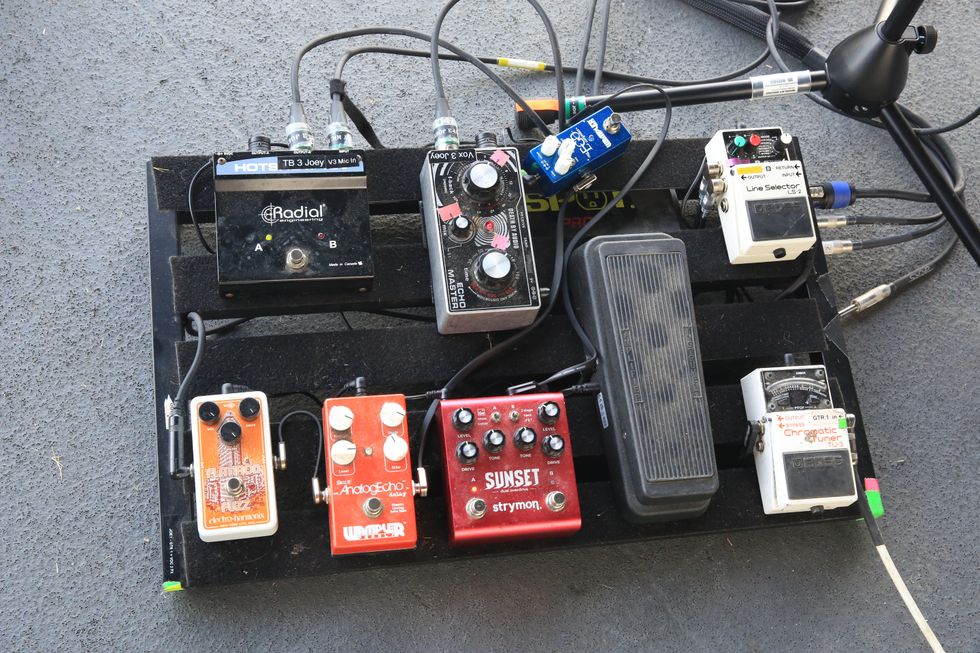
The guitarist's stomp station is surprisingly sparse for the melody and mite that swirls in a King Gizz performance. He has five key signal sizzlers: an Electro-Harmonix Flat Iron (fuzz), Wampler Faux Analog Echo (delay), Strymon Sunset (overdrive), Dunlop Cry Baby (wah), and Wampler Mini Ego (compressor). He uses a Death By Audio Echo Master for his vocals, a Boss LS-2 Line Selector & Radial Engineering HotShot to handle amp & mic switches, and the Boss TU-3 Chromatic Tuner keeps his instruments in check.

- King Gizzard & the Lizard Wizard's Gear ›
- Microtonal Madmen: King Gizzard and the Lizard Wizard’s Stu Mackenzie and Joey Walker ›
- King Gizzard & the Lizard Wizard’s Psych-Rock Album Flight b741 ›
On this Wong Notes, the legendary Doobie Brother, Steely Dan member, and session weapon talks the science of music and how to defuse conflict—whether on the world stage or in the sound booth.
“Skunk” Baxter has had an interesting career. The Washington, D.C.-born musician was one of Steely Dan’s founding members in the early 1970s, and played on some of their most iconic numbers, like Can’t Buy a Thrill’s’ “Reelin’ in the Years” and “Do It Again,” or Pretzel Logic’s “Rikki Don’t Lose That Number.” Then, he moved on to join the Doobie Brothers, from roughly 1974 to 1979, where he fatefully invited Michael McDonald into the band. After that stint, he became a go-to session player for artists like Rod Stewart, Joni Mitchell, Dolly Parton, and Donna Summer, and a touring performer for Elton John and Linda Ronstadt, among others.
That was just the beginning. Baxter’s interest and background in electronics, science, and recording technology gained him a position in the U.S. defense industry. Turns out, a lot of digital music gear shared similar principles with emergent defense tech. “Basically, a radar is just an electric guitar on steroids,” says Baxter, noting the same four fundamental forces at work over everything in our universe.
Wong and Baxter trades notes on how to navigate studio sessions (“Just shut the hell up,” offers Baxter), early conversions of pitch into digital signals, and how Baxter cut his solo on Donna Summer’s “Hot Stuff” on a $25 guitar. And can mediating between artists and producers feel like high-stakes hostage negotiations? Sometimes. Tune in.

Wong Notes is presented by DistroKid.
Use this link for 30% off your first year.
Featuring presets by Jack White, this pedal is designed to offer intuitive control, precise filtering, and flexible expression pedal integration.
Eventide, in collaboration with Third Man Hardware announces Knife Drop, a commanding new effects pedal that merges aggressive octave fuzz with earth-shaking analog synth tones.
Born from the collaborative vision of two pioneering forces in music technology, Knife Drop opens a new chapter in effects processing. The pedal combines Eventide’s decades of digital audio mastery with Third Man Hardware’s innovative vision, resulting in a product that’s as intuitive as it is deep, as fresh as it is familiar.
"The Third Man crew have amazing product design instincts and we learned so much throughout our collaboration. It didn't feel like work, it felt like Rock 'n Roll.” —Russell Wedelich, Eventide Audio CTO
"Collaborating with Eventide on the Knife Drop has been an inspiring and exciting experience that expanded into some amazing sonic possibilities. We're so excited to get the Knife Drop into people's hands, to make their own sounds and feel the same excitement we had." — Dan Mancini, Third Man Hardware
Core Features:
- Rich blend of octave fuzz and analog synth capabilities
- Dual octave control with dedicated footswitch
- Precise filtering options with pre/post distortion routing
- Intuitive preset system with instant recall
- Stereo I/O with switchable guitar/line level inputs
- Flexible expression pedal integration for dynamic control
Intuitive Control
The Synth Mix knob allows players to blend between raw guitar signals and bold synthesized tones, while the Drive section delivers everything from a subtle boost to intense, biting distortion. The expressive filter section includes responsive envelope control, adjustable resonance, and switchable routing, putting total tonal flexibility firmly in the user’s hands.
Knife Drop features an LED ladder display for precise preset navigation and a secondary function layer that unveils additional sonic territory. The dual I/O configuration supports both mono and stereo operation, while the switchable input accommodates various signal levels for versatile applications, whether onstage or in the studio.
Knife Drop will be available for purchase on October 29, 2024, in the United States through Third Man Records’ website and internationally through Eventide's authorized distributors, with an MSRP of $299. Additionally, a limited-edition yellow model will be offered exclusively on Third Man Records' website for $333.
For more information, please visit eventide.com
Knife Drop Pedal: Presets Playthrough and Sound Demo - YouTube
Enjoy the videos and music you love, upload original content, and share it all with friends, family, and the world on YouTube.PG contributor Tom Butwin details RAB Audio GSRS – a studio racking system purpose-built for guitarists looking to declutter, customize, and elevate their creative space. Whether you’re a pedal enthusiast or amp collector, RAB Audio has a solution for your recording setup.
RAB Audio ProRak SRS1 Guitar Studio Racking System
3 adj amp head decks, laminated plywood, Blk TrimHandcrafted in the USA, the JEL-50 features 50 watts of all-tube power, two channels, and a transparent effects loop. The JEL-212 Cab is loaded with Celestion Creamback speakers.
Jake E. Lee ranks high on the shortlist of influential gunslinger guitarists that emerged as the heroes of a new generation in the early ‘80s. Best known for the burning guitar work and innovative songwriting, Lee contributed to two of Ozzy Osbourne's most revered albums, 1983’s Bark at the Moon and 1986’s Ultimate Sin.
With Ozzy, his post-Ozzy band, Badlands and most recently, with his own group, Red Dragon Cartel, Lee’s playing embraced the athleticism of the ‘80s while remaining firmly rooted in the hard rock fundamentals of the ‘70s. Jake’s tonal choices provide the evolutionary glue between the sonics of those two great eras. Jake E Lee and Dave Friedman combined their legendary ears and talents to create the new Friedman JEL-50, a signature amplifier that offers Lee’s ultimate tones in a boutique hand-wired package.
In Lee’s own words, “this amp puts the two specific tones I use to create my sound in one head: The sweetness and warmth of a classic Plexi and the more aggressive slant of the master volume amps of the ‘80s -- all tweaked to my taste. Dave has an innate understanding of where I’m coming from as a player and we’re alike in the way we hear tones. Dave doesn’t hear things as a technician, he hears things like a musician, and that made him really easy to work with. I grew up in the ‘70s and those muscular, articulate rock tones were the tones I always sought, but I made a name for myself in the ‘80s when you needed a little more aggression and a little more scream. I’ve always tried to retain a little of that ‘70s heart and I still do, and that’s what this amp does -- though it’s got plenty more on tap if you need it!”
The JEL-50 was specifically designed to take pedals well especially boosts, ODs, phasers, flangers, tremolos, and wahs. The ultra-transparent buffered, series effects loop takes time-based effects pedals and rack units equally well. This is the exact same FX loop Friedman uses on all its amplifiers including the legendary BE-100. The head cabinet features beautiful red tolex, white piping and solid Baltic Birch construction.
SPECIFICATIONS
- 50-Watt all-tube head
- Two channels
- Handwired in the USA
- Custom USA made transformers
- 2 x EL34 power tubes
- 3 x 12AX7 preamp tubes
- JEL channel - Gain, Master, 3-way Bright switch
- JEL Channel Hi/Lo (Push pull gain switch)
- Plexi channel - Gain, Volume, 3 way Bright Switch
- EQ- Bass, Middle, Treble shared with Ch1 and CH2
- Ultra-transparent series effects loop
- Thump knob - ( Rear ) Varies lowered response of the amps power section
- Presence - ( Rear) Varies high end content of the amps power section
- Single button foot switch for channel selections
- 4, 8 and 16 ohm Impedance jacks
- Limited Lifetime Warranty
- Dimensions: 8.75″ (D) x 24″ (W) x 10″ (H)
- Weight: 33.5 lbs
2x12” Celestion Creamback Loaded Extension Cab
The Friedman JEL 2x12” is a rear ported closed-back extension cabinet which utilizes tongue and groove Baltic Birch construction to deliver the bass, mid response and great sound you would expect from a Friedman cab. The JEL 212 Cab features red tolex, white piping and black grille cloth, designed to cosmetically match the Friedman Signature Jake E Lee heads.
At the heart of the cab is a Celestion G12M-65 Creamback 16 Ohm speaker. The G12M Creamback is perhaps the definitive vintage Celestion ceramic magnet guitar speaker. Developed in the mid-sixties, it was quickly adopted by players like Hendrix, Beck and Page, who typified the louder and more aggressive blues-rock playing styles that came to characterize that era. The higher power handling G12M-65 Creamback used in the JEL 1x12 produces that familiar woody tone, making it ideally suited when both vintage and modern tones are desired. The increased power handling brings with-it low-end grunt complementing the warm and vocal mid-range, crunchy upper mids and sweet, refined highs.
As with all Friedman cabinets, oversized 12-gauge speaker wire is soldered between the speaker and terminal, assuring you capture every ounce of valuable tone. This compact monster not only excels in the studio, but the perfect compliment to your stage rig. The Friedman JEL-212 Cab is handcrafted with pride in the U.S.A. and designed to withstand the rigors of the road.
SPECIFICATIONS
- Hand crafted in USA
- Cosmetics to match the Jake E Lee Signature Heads
- 2 x Celestion G12M-65 12" Creamback Speakers
- Nominal impedance - 8 Ohms
- Closed back -rear ported cabinet design
- Limited lifetime warranty
- Dimensions: 12" (D) x 30" (W) x 20.75" (H)
- Weight: 58 lbs.
The Friedman JEL-50 Head carries a street price of $2999.99 and the JEL-212 Cabinet carries a street price of $999.99.
For more information, please visit friedmanamplification.com