
Chris Kies has degrees in Journalism and History from the University of Iowa and has been with PG dating back to his days as an intern in 2007. He's now the multimedia manager maintaining the website and social media accounts, coordinating Rig Rundown shoots (also hosting and/or filming them) and occasionally writing an artist feature. Other than that, he enjoys non-guitar-related hobbies.
The Australian shredder keeps things simple with signature PRS, Orange, and Gibson gear.
Australian guitarist Orianthi, known for her blistering solo work in addition to her collaborations with superstars like Carlos Santana, Alice Cooper, and Carrie Underwood, stopped through Nashville on her current tour. PG’s John Bohlinger joined Orianthi to get a look at her rig, and it turns out she doesn’t need too many tools to get the job done.
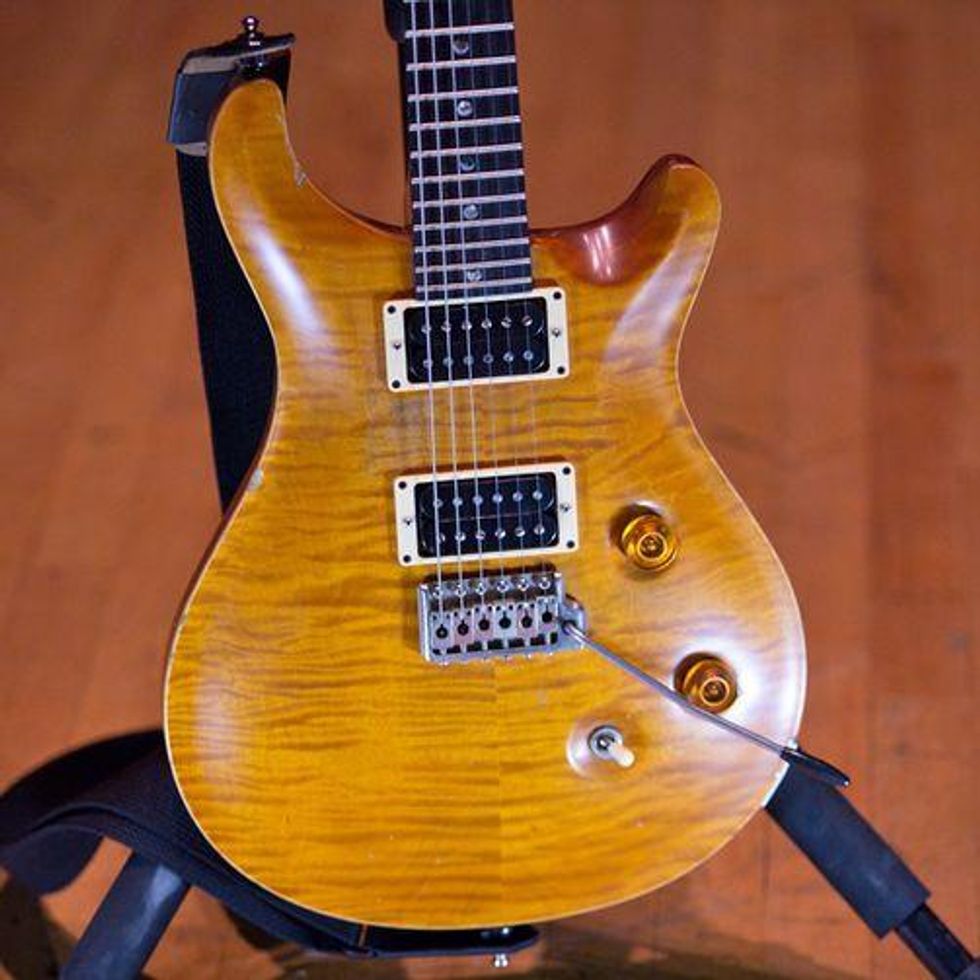
Orianthi’s signature PRS, based on the Custom 24 and made of Brazilian rosewood, honors the color of her very first Hendrix t-shirt, finished in blooming lotus glow. It’s got custom pickups created by Paul Reed Smith himself, and it’s strung with Ernie Ball .009-gauge strings.
Cherry Bomb
This is Orianthi’s signature, cherry-finish Gibson SJ-200, which she helped create in Montana with her friends Rae Vinton and Robi Johns. They built it with a thinner, ES-345-style neck, and modded the pickup with L.R. Baggs over Zoom.
Orange-ianthi
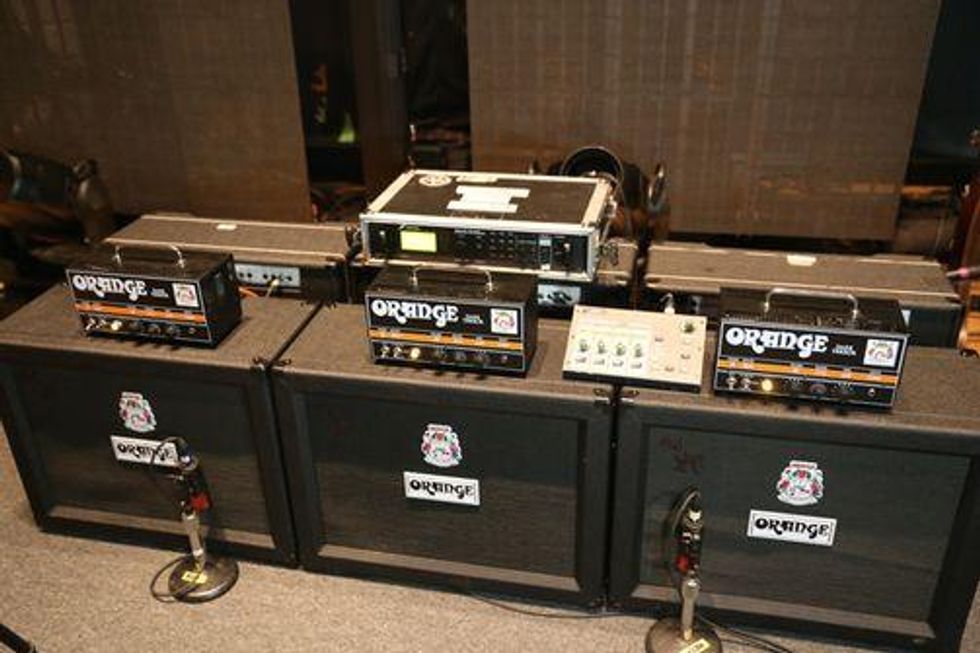
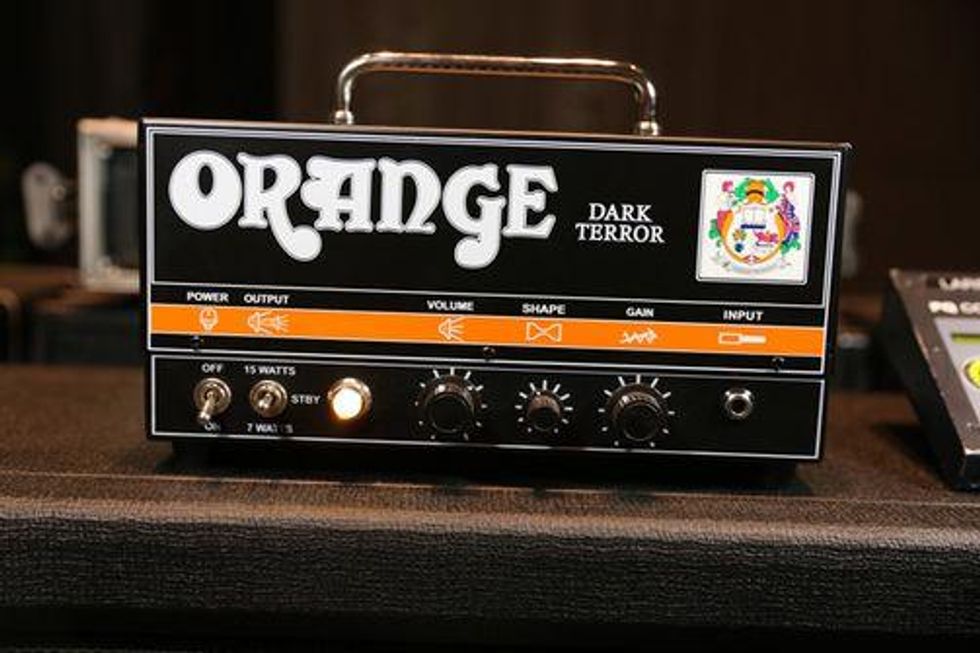
Orianthi’s signature 50-watt Orange Oriverb was put together with the late designer Pat Foley, a close friend. The main trick is that it’s loaded with plenty of reverb, a taste Orianthi developed early on thanks to her father’s Fender Twins and Music Man amps.
Orianthi’s Pedalboard
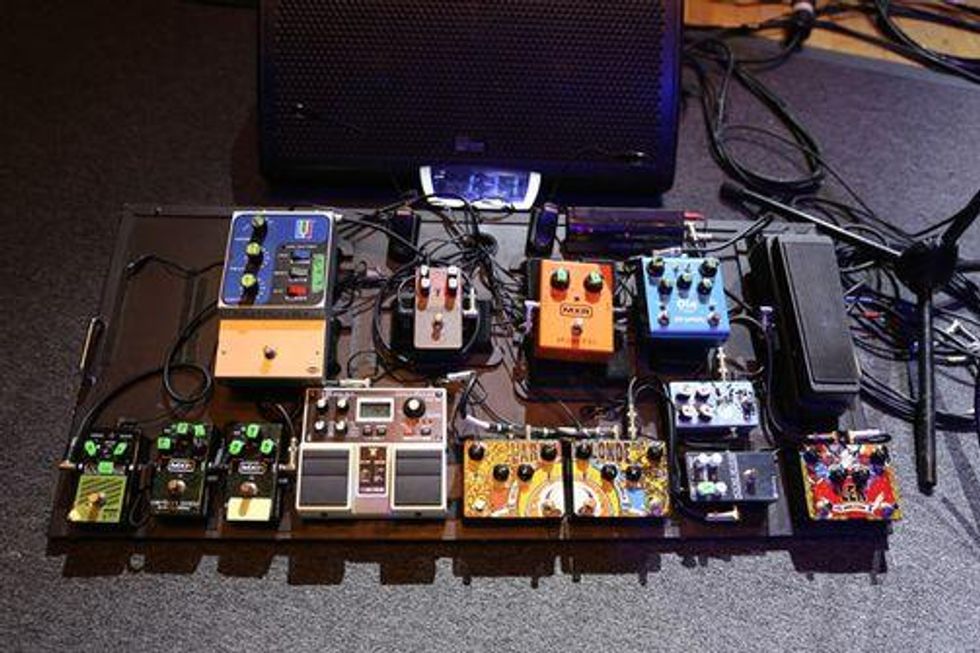
Orianthi’s playing does most of the heavy lifting, but this humble board contributes some muscle. There’s a Dunlop Cry Baby EVH wah, Dunlop Authentic Hendrix ’68 Shrine Series Octavio, Dunlop Authentic Hendrix ’68 Shrine Series Uni-Vibe, MXR Analog Chorus, Boss BF-2, Boss DD-3, and a Boss TU-3.
The long-running punk quartet pick prototypes, P basses, and Pauls for their latest live shows.
On tour supporting their 12th full-length record, Silver Bleeds the Black Sun…, California rockers AFI rolled through Nashville’s Marathon Music Works in October. After first running down their rigs in 2017, PG’s Chris Kies linked up again with guitarist Jade Puget and bassist Hunter Burgan to see how their gear has evolved in the past eight years.
Puget found this Les Paul Standard hanging at Guitar Center 15 years ago, and it’s still his go-to live guitar. A surprisingly light specimen, it’s had a Seymour Duncan pickup swapped in, and it’s strung with Ernie Balls—usually .010s.
Throughout AFI’s set, Puget switches between tunings: D sharp, drop C sharp, D standard, and E standard.
Silver Surfer
This new Schecter, a prototype made for Puget, is his first ever silverburst, which saw service in the music video for “Holy Visions.” It’s loaded with a Sustainiac system in the neck position.
Willing and Ableton
Puget has experimented a lot to get his rig to this point. His signal runs through a pair of rack-mounted Line 6 Helix units in a stereo configuration, and also through a computer running Ableton that triggers the exact sound designs he created while recording. The RJM Mastermind and Effect Gizmo are programmed to control all pedals, the Helix, and Ableton.
Jade Puget’s Pedalboard
Most of Puget’s effects come from the Helix, but he also runs a few pedals in his rack, including an MXR EVH 5150 Overdrive and Carbon Copy, Boss DC-2W, RV-2, and BF-2, and a Keeley Compressor.
Another board carries a Boss TU-3, TC Electronic Mimiq, EHX The Clone Theory, TC Electronic Arena, MXR Echoplex, and L.R. Baggs Venue DI.
Blackout
In live contexts, Burgan uses Fender P basses exclusively. This is his No. 1, which he’s had since 2012.
Pinky
This dazzling Fender P was made custom for Burgan before this tour.
Triples is Best
Burgan runs this trio of Ampeg SVT Classics.
Hunter Burgan’s Rack Setup
Burgan uses a RJM Mastermind GT to control his in-show switching. In his backstage rack, there’s an EHX Bass Big Muff, Micro Synth, Satisfaction, Nano POG, Bass Clone, and Graphic Fuzz, and on a second shelf, there’s the rest of the collection: a Bass Soul Food, Battalion, Lizard King, Neo Mistress, and Memory Toy.
Thanks to some key years working at a celebrated music store, this band of brothers has the goods.
The Band Royale, the Chicago-based brotherly “yacht metal” outfit, know a thing or two about gear—guitarists Joel and Zach Bauman, plus bassist Marc Najjar, all worked at Chicago Music Exchange, one of the premier music shops in North America. PG’s Chris Kies traveled deep into the band’s bunker in Chicago for this Rig Rundown with Najjar and the Bauman brothers.
This 1972 GibsonLes Paul Custom was Joel’s first “real” guitar, which he bought from CME. It’s all original except for the tailpiece, and weighs in at a whopping 11 pounds. Joel keeps it in open D6 tuning.
Mock Mockingbird
Someone brought this fake Mockingbird into CME one day, and Joel decided he had to have it. It boasts neckthrough construction with maple and mahogany, a Bill Lawrence dual blade pickup, brass nut, and heftier .012-gauge strings. The original builder must’ve liked the sticker he added to the body; it’s underneath the lacquer.
Warming Up
While Brian Carsten was still an amp tech at CME, Joel bought this Carstens Amplification Warm Machine off of him—the first he ever made. It’s designed around a master-volume, 50-watt Marshall head circuit, with a bit more warmth. Joel has had this one for over two decades now, and runs it through a Fender Bassman 2x12 cab with Celestion Creamback speakers.
He’s also been experimenting with a Quilter Overdrive 200 for a lighter solution, which he runs through a Bergantino 2x12 cabinet—Joel calls the cab and Quilter combo a “game-changer.”
Joel Bauman’s Pedalboard
The jewel of Joel’s board is a 1981 Ibanez Tube Screamer, gifted to him by Josh Klinghoffer. There’s also a Durham Electronics Sex Drive, EHX Micro POG, Xotic EP Booster, Friedman BE-OD, Boss CE-2W, Strymon El Capistan, and Strymon Flint, plus a Korg Pitchblack Advance tuner.
Holesome
Zach Bauman isn’t bothered by the gaping hole in his 1990 Gibson SG; it gives the guitar a whole lot of character. This guitar has a Gibson T-Top Burstbucker in the bridge, and has been modded to have just two pots for master tone and volume. Zach strings it with .011–.052s.
Painted Paul
Zach snagged this 1979 Les Paul while working at CME, and scraped off a nasty previous paintjob with a card before getting to work making it his own. A friend painted the headstock, and another made him this custom pickguard. It’s also got T-Tops in the neck and bridge.
Mig Buff
Zach loves his Sovtek Mig 60 head, which he plays through a cab he built himself at a pipe-organ shop in Denver. Every glue joint is lined with thin leather for maximum air tightness, and it’s stocked with Celestion G12M Greenback speakers.
Zach Bauman’s Pedalboard
On Zach’s board, we find a Klon clone, Ibanez Tube Screamer, Boss VB-2W, Ibanez Mini Chorus, Strymon Flint, and Strymon El Capistan, along with a Dunlop Volume (X) pedal and a TC Electronic PolyTune.
Bergantino’s Best
Najjar has deep love for Holly and Jim Bergantino and their Bergantino Audio Systems products. He plays with both a Forte and Forte HP Ultra—a 2000-watt prototype—through a Bergantino HDN112 cab and special 3x10 cab.
Bass for Babies
Najjar’s Sandberg Forty Eight finished in shoreline gold, nicknamed the “golden baby,” was the first of its kind.
Going to California
This Sandberg California TT4 has ’70s-style J-bass pickups and a 34” scale. Najjar gets a “Geddy Lee-style” vibe from it.
Marc Najjar’s Pedalboard
Najjar’s tone temple is topped off with a Bergantino Super Pre brass preamp into his Neural Quad Cortex.
Henri and Bill Cash, the brotherly guitar duo behind Los Angeles glam-rock band Starcrawler, linked with PG’s John Bohlinger before their gig at the Pinnacle in Nashville to show off some rose-colored rock tools. Check out highlights of their dazzling setups below, and tune into our full Rig Rundown to scope the full details.
This China-made Gretsch Electromatic Double Jet has just a single TV Jones Power’Tron Plus pickup, but beneath the hood, it’s also got a Rangemaster-style treble-boost circuit (as does another 3-string Electromatic that Henri plays). Henri traced out and applied sparkle-pink paper to give the guitar its memorable finish.
This pink powerhouse is tuned to open G.
Flying Bigsby
Daniel Slusser of Slusser Guitars in San Luis Obispo, California, built this custom V-style according to Henri’s requests, borrowing from a design by Japanese builder Saraso Ju. It’s made from pine from Home Depot, bound with leather, and outfitted with a Bigsby and a Filter’Tron pickup for Gretsch groove.
Triple Threat
Cash runs his dry signal to either this Satellite Amplifiers Neutron head or Vox AC15 combo, and his effects go to the Magnatone Twilighter Stereo on the right.
Henri Cash’s Pedalboard
After a pair of Boss TU-3s and a Boss ES-8 switcher, Henri’s board has a pair of DigiTech Drops, TC Electronic Shaker, R2R Electric Preamp, Boss GE-7, MXR Carbon Copy, Way Huge Red Llama, custom “Lamb’s Head” fuzz designed by Henri and Desi Scaglione, EarthQuaker Devices Tentacle, EQD Bit Commander, and Strymon Flint. A Lehle P-Split sends his signal to either the Neutron/AC15 and the Magnatone.
Tweaked Tele
Bill’s main axe is this heavily modified Fender Noventa Tele, with a Curtis Novak P-90 and a Glaser B-bender system.
Slide Away
For slide parts, Bill uses this GFI Expo pedal steel.
Souped-Up Super
Bill plays through this modded Fender Super Reverb Reissue. The tweaks included inserting a 5E3-tweed-Deluxe-Style circuit in first channel that switches to a handwired Super Reverb-style circuit in the second channel so he can use the tweed channel on guitar and clean black-panel tone on pedal steel. It was inspired by a mod he saw Colleen Fazio did to a friend's Bassman where she changed the first and second channel to be channel switching as well.
Bill Cash’s Pedalboard
On his sprayed-painted pedalboard, Bill runs a Boss TU-3, custom “Lamb’s Head” fuzz by Henri and Desi Scaglione, Way Huge Red Llama, Way Huge Conquistador, MXR Micro Amp, DigiTech Drop, Catalinbread Belle Epoch, MXR Reverb, MXR Tremolo, EarthQuaker Devices Levitation, Electro-Harmonix C9, and a Nocturne Brain Mystery Brain.
The in-demand gunslinger brings a load of silverware to arenas across the world.
Devon Eisenbarger, session ace and touring shredder for stars including Chappell Roan and One Direction’s Zayn Malik, met up with PG’s Chris Kies at Nashville’s Bridgestone Arena before hitting the stage with Katy Perry to show off the sleek 6-string rig she’s using on Perry’s Lifetimes tour.
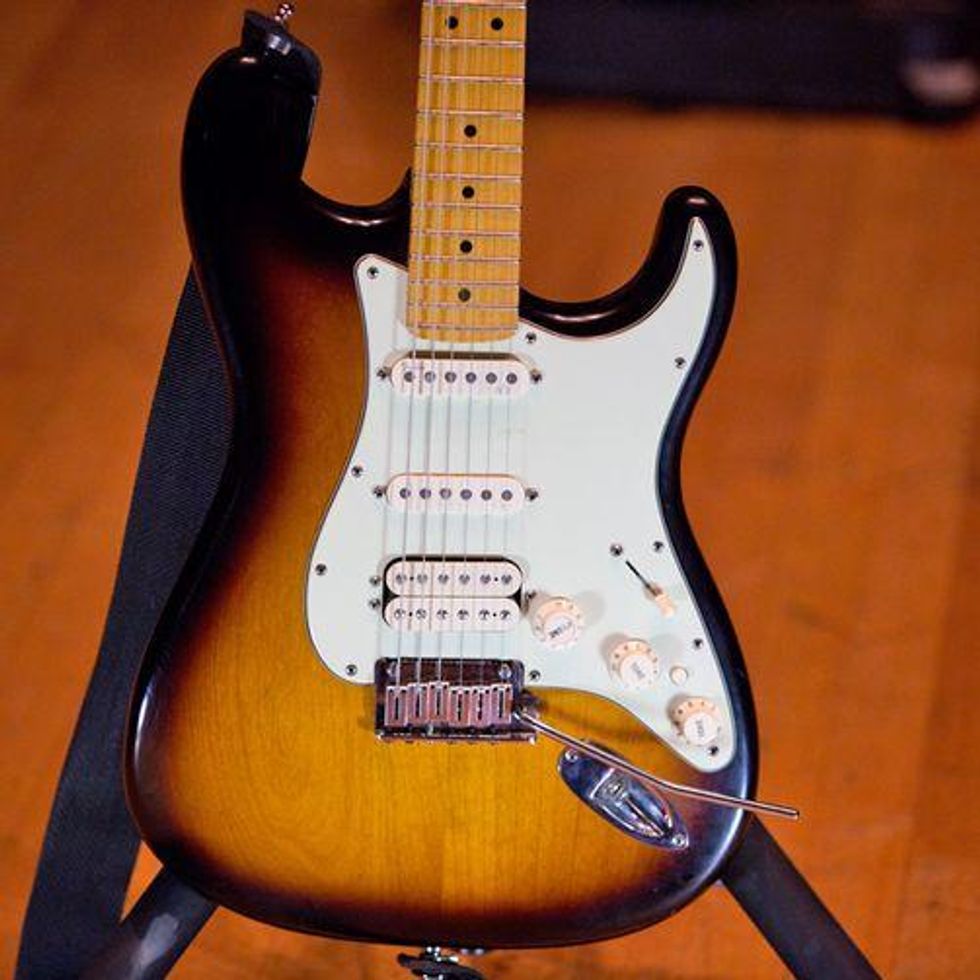
Eisenbarger cut her teeth on a Stratocaster, and its sonic character still feels like home. She filmed a demo for Fender using this American Professional II Strat with a coil-splitting humbucker in the bridge—the best she’s heard so far. This one and all other electrics run D’Addario strings (.010–.046).
Fiery Fiore
Eisenbarger just scored this PRS Fiore before this tour. It has a beefier, slightly more midrange-y sound than the Strat.
Silver Surfer
This Ernie Ball Music Man StingRay II, designed in collaboration with Cory Wong, was made for Eisenbarger just before this run of shows.
Saintly Signature
Eisenbarger uses this Ernie Ball Music Man St. Vincent Signature for “I Kissed a Girl.”
Taped-Up Taylor
This Taylor 814ce, wrapped in silver tape, comes out for a mid-show acoustic set.
Devon Eisenbarger’s Rack Setup
Eisenbarger runs an all-digital rig, contained in this rack backstage. The key pieces are a Radial JX42, two Shure AD4Ds, a Kemper Profiling Amplifier, and a Fractal Axe-Fx. The Kemper runs a SELAH SOUNDS pack of profiles and impulse responses.
With no onstage monitors, Eisenbarger’s signal runs only to in-ear monitors and front of house.