

Hi Jeff,
I have a ’66 Fender Bassman AB165 with the 2x12 cabinet that just isn’t getting me there. Not
enough high end, and I really need that famous Fender sparkle and shimmer. Unfortunately, when
I look to trade it in at a music store, they can’t even get me all the way to a silverface Princeton.
Money is an issue. Of course, modding is an option, but I’m concerned that if I’m not happy
with the basic tone now, I never will be. I tried taking the back off the cabinet to open it up,
but that didn’t really help. Should I try changing to such an extent that it’s something entirely
different? On the other hand, I can’t afford a boutique-quality, handwired amp any other way. I
have this amp because a friend helped me out by selling it cheap. I play blues and rock, nothing
heavy. Any ideas? Thanks!
—Shawn
Hi Shawn,
Well, you certainly have a nice
blackface-era amp there, and
the fact that your friend was
nice enough to give it to you
at an affordable price makes it
even cooler! However, I understand
your frustration with the
amp. While the Bassman was
designed for amplifying a bass
guitar, most players today use
them for guitar, since these
amps are able to get a nice
overdriven tone at a somewhat
useable volume. Many guitarists
play their 4Ω Bassman
heads into a 16Ω 4x12 cabinet,
thereby reducing the available
clean output power and
enabling smooth, creamy overdrive
at a substantially lower
level. Unfortunately, this sounds
like what you’re not looking to
achieve. But I believe we can
help you turn the amp into
something you’ll be much happier
with. Let’s start by examining
the amp’s front end.
The Bassman has two channels— the Bass instrument and Normal. The Bass channel is substantially different from the typical front end of any Fender blackface or silverface guitar amp, so we will leave this channel alone. Who knows? Maybe someday you’ll invite a bass-playing friend over for a low-volume jam, and you’ll actually use the amp the way it was originally designed: Amplifying one bass plus one guitar—a completely acceptable idea at the time.
Moving on to the Normal channel, the circuit and values are identical to the inputs of most blackface or silverface amps, so nothing really needs to be done here. One option you have, however, would be to have a midrange control installed. Simply substitute a 10k—or even a 25k—pot in place of the 6.8k fixed resistor at the bottom of the tone stack. This can easily be mounted in the No. 2 input of the channel without any modification to the chassis. I recommend your tech install a new single jack and remove the dualjack assembly as a pair so you can reinstall them as a pair if you wish to return the amp to stock.
Bringing a Blackface Bassman in from the Cold BY jeff bober
Now let’s move to the
mixer circuit and the output
stage. Though your amp is a
blackface, the AB165 circuit is
a transitional unit. Although
it was made just a short time
after the point CBS acquired
Fender—and prior to the
silverface-era Fender amps—
the new group of engineers
had started to “improve” the
designs of a few amps, this
being one of them. Removing
some of these “improvements”
should yield you a Bassman
much closer to the sound and
feel you expect from a traditional
Fender amp. These
simple changes can easily be
 reversed if you wish to put the
amp back to stock condition.
reversed if you wish to put the
amp back to stock condition.
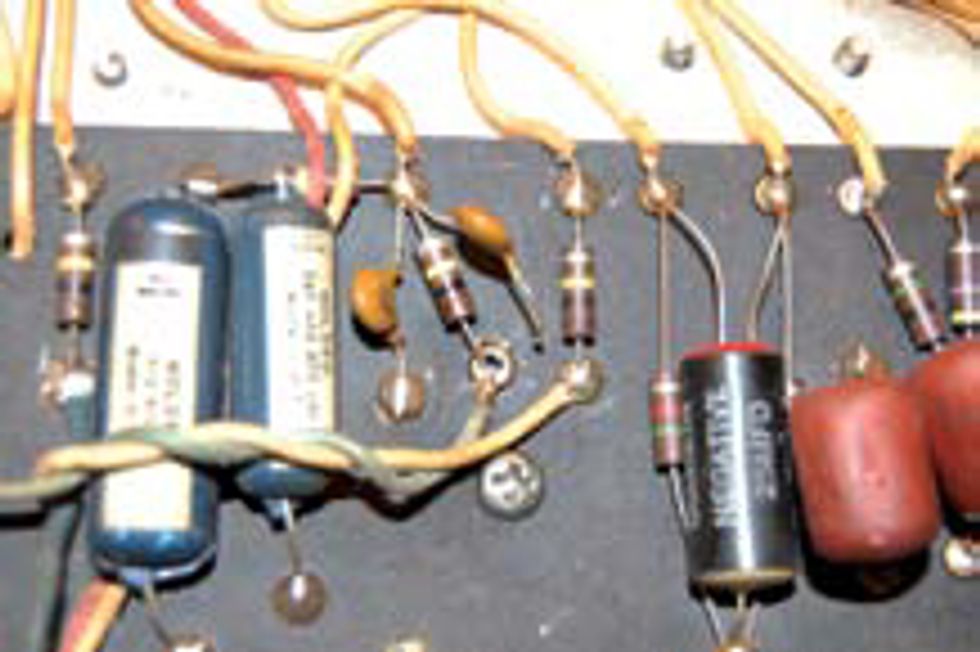
Let’s start with the first stage of the Normal input. There should be a 500 pF ceramic capacitor in parallel with the 100k plate resistor connected to the plate (pin 1) of V3. (Note: this capacitor shows up on the AB165 layout diagram, but not on the schematic. As I said, it was a transitional time at Fender.) Removing this cap will put a bit more sparkle in the amp’s top end, (See photo 1.)
Next, we’ll move on to the
mixer circuit where the Normal
and Bass channels are combined
and amplified one more
time prior to the phase inverter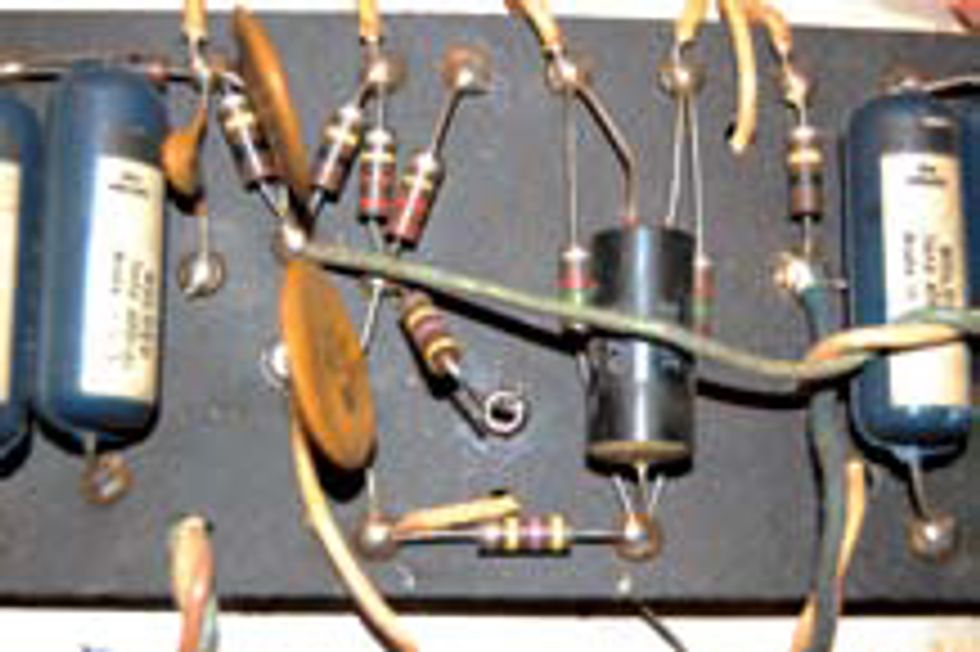 (driver) circuit. Here we find a
470k resistor connected from
the plate (pin 1) of V2 to the
input grid capacitor. This resistor
induces negative feedback
in this circuit and gives it a
bit of compression. On the
surface, this has the potential
to be a good thing in some
instances, but I feel that when
the volume is turned up, the
result is fairly non-musical.
Removing this resistor will
open the amp up a bit, again
improving its response and
sparkle, and making the whole
amp more musical when it’s
pushed. (See photo 2.)
(driver) circuit. Here we find a
470k resistor connected from
the plate (pin 1) of V2 to the
input grid capacitor. This resistor
induces negative feedback
in this circuit and gives it a
bit of compression. On the
surface, this has the potential
to be a good thing in some
instances, but I feel that when
the volume is turned up, the
result is fairly non-musical.
Removing this resistor will
open the amp up a bit, again
improving its response and
sparkle, and making the whole
amp more musical when it’s
pushed. (See photo 2.)
Now, let’s tackle our final
and most drastic change.
There are a couple of alterations
that the CBS engineers
made to this circuit. The first
is the negative feedback loop.
I’m choosing to leave this one
alone, as I don’t feel that modifying
it would yield a great
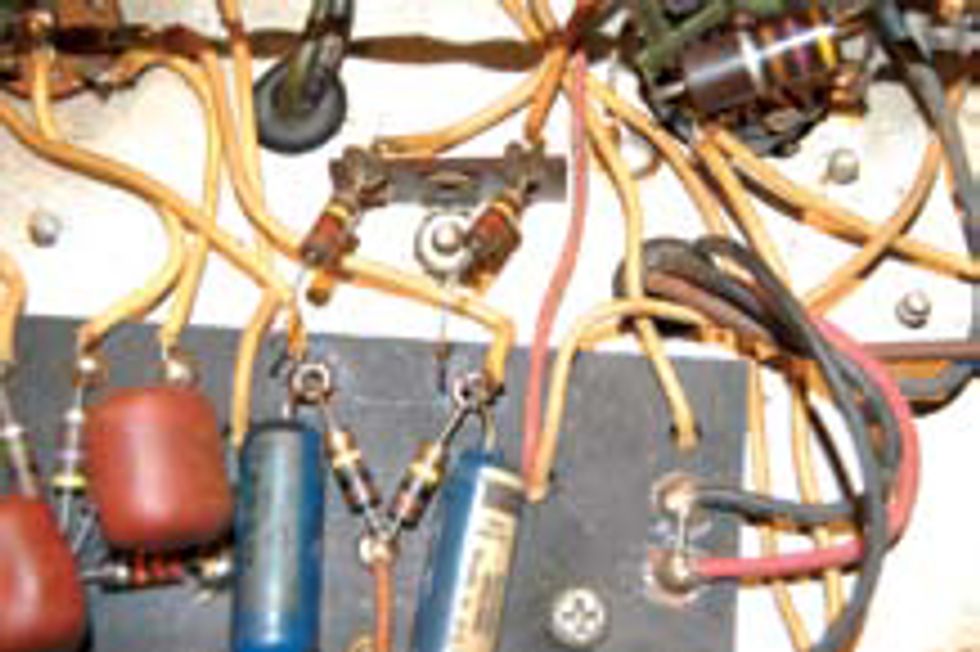 enough result to warrant the
changes involved. The other is
an additional form of feedback
that was added to these amps.
(Boy, these guys were big on
negative feedback!) You’ll find
two 220k resistors connected
between the plates of the phase
inverter V4 and the plates of
the output tubes. These will
be easily recognizable, as one
end of each is connected to a
terminal strip. (See photo 3.)
Removing these resistors from
the circuit will substantially
increase the amp’s headroom
and make it sound larger and
feel more responsive.
enough result to warrant the
changes involved. The other is
an additional form of feedback
that was added to these amps.
(Boy, these guys were big on
negative feedback!) You’ll find
two 220k resistors connected
between the plates of the phase
inverter V4 and the plates of
the output tubes. These will
be easily recognizable, as one
end of each is connected to a
terminal strip. (See photo 3.)
Removing these resistors from
the circuit will substantially
increase the amp’s headroom
and make it sound larger and
feel more responsive.
Of course, there are additional modifications you could do to your amp, but I feel these three little changes will take the Bassman from having potential to something that you’re going to be much happier playing.
 Jeff Bober is one of
the godfathers of the
low-wattage amp revolution,
co-founded and was
the principal designer for
Budda Amplification. Jeff recently launched EAST
Amplification, and he can be reached at
pgampman@gmail.com.
Jeff Bober is one of
the godfathers of the
low-wattage amp revolution,
co-founded and was
the principal designer for
Budda Amplification. Jeff recently launched EAST
Amplification, and he can be reached at
pgampman@gmail.com.