

RatingsPros:A warm, thick-voiced fuzz with heaps of gain when you want it, and a very original take on the format overall, for those seeking alternatives in the dirt department. Cons: Simply be aware that use and performance are quite different from traditional fuzzes overall, if that’s more your line. Street: $199 Pettyjohn Electronics Rail pettyjohnelectronics.com | Tones:  Ease of Use: Build/Design:  Value:  |
Ain’t it something—that more than five-and-a-half decades after the first commercial fuzz was introduced, clever companies still build creative new takes on the form? Pettyjohn Electronics definitely took the path less travelled with the new Rail fuzz, which forgoes transistors and clipping diodes for a circuit that utilizes op-amps and voltage rails to generate complex overdrive to full-on fuzz tones. While this approach to fuzz building is unusual, Pettyjohn is not the only builder to employ a variation of this design technique. Yet the Rail often feels and sounds unlike anything else out there.
Compact and Flexible
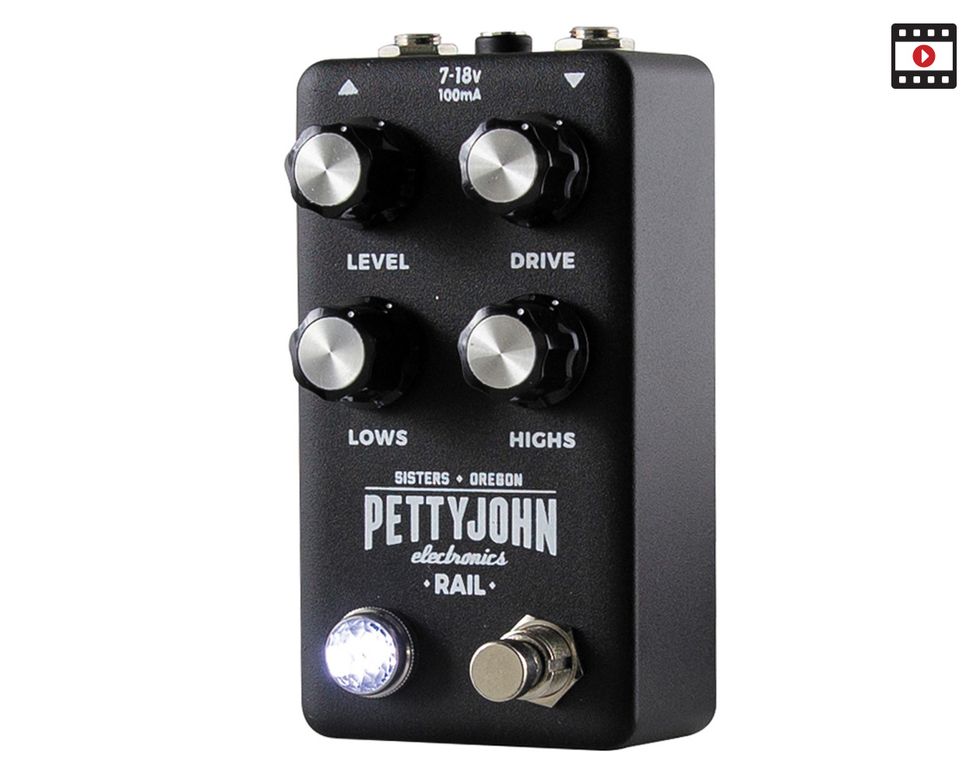
The Rail, which is from Pettyjohn’s new, more compact Core Series, is a comparatively streamlined affair. There’s not a mini toggle or tiny knob anywhere, and the enclosure is downright austere compared to its bigger, more feature-rich cousins.
Controls on the Rail are mostly simple and self-explanatory, though the drive knob, in a departure from convention, is an 8-position rotary switch. The level governs overall output, and the “highs” and “lows” tap wide-ranging active EQ stages. The lows control sweeps from 30 Hz to 1 kHz and is situated before the gain stage, which can add considerable heft to the distorted output. The highs control sweeps from 1 kHz to 22 kHz and is situated after the gain stage, which enables you to hype or tame distortion-accentuated high harmonics. Both the level and highs controls are independently buffered from the rest of the circuit, to avoid loading the signal. (Pettyjohn also claims that this arrangement makes the Rail more stackable than many fuzz pedals.) As with other Pettyjohn pedals, on/off status is indicated by a big Fender-amp-like jewel light. The footswitch is a soft-relay true bypass unit, though a hard-click true bypass is available as a Custom Shop option.
Riding the Rails
Rather than relying on transistor and/or diode clipping to excite the guitar signal like most traditional fuzzes do, the Rail uses op-amps to crank extremely high gain into the circuit’s voltage rails, which produces dynamic fuzz and distortion. Additionally, the pedal’s voltage-doubling power circuit will mirror the input from any regulated, isolated DC source of 7–18V, and because the effect generates clipping by overdriving the power rails, the voltage you employ shapes the sonic character and response of the fuzz considerably.
I used a tweed Deluxe-style combo, a Freidman Small Box head and 2x12 cab, a Novo Serus J with P-90s, and a Hahn 228 with single-coil Tele pickups to test the Rail. And even with these very familiar instruments and amplifiers, the Rail opened up scores of new and unfamiliar tone flavors. It takes a little time to understand how the Rail’s controls translate to specific sounds, and the powerful EQ controls can significantly transform the output in ways that seem less than immediately familiar. But that doesn’t mean the pedal isn’t ultimately intuitive.
The 8-position drive knob sometimes seems to transform the Rail into a different pedal at each position. But while the gain profile can be profoundly different from position to position, each voice shares the same girthy core sound and impressive capacity for articulation.
As great sounding as the lower gain settings are, the Rail is really about the distortion and fuzz. And from the 4th through 8th positions, the Rail reveals many interesting and individual fuzz tones. The sounds are predominantly thick, creamy, warm, and soulful. And the Rail often has the feel of a hybrid distortion and fuzz because there’s less of the raspy, spitty, Velcro-y tones that distinguish many pure fuzz circuits. The big payoff is that it can simultaneously be heavy, musical, and clear.
The 8th position, Infinity Mode, is genuinely gnarly—generating temperamental, gated fuzz sounds with unpredictable decay characteristics. At 15 volts, the distortion sounds even more extreme and, in general, higher voltage makes each voice hotter and tighter with discernably more headroom.
The Verdict
The ruggedly built Rail is a creative twist on traditional fuzz circuitry. Deviation from same-old transistors and clipping diodes fuzz formulas adds up to an impressive variety of overdrive-to-fuzz settings. It’s also surprisingly dynamic and responsive. It may not replace every fuzz in your collection, particularly if you love the compression, sag, and unpredictability of vintage circuits. But if crafting tight, articulate, and controlled fuzz-tinged distortion is your obsession, the Rail hits the nail on the head.
Watch the Demo: