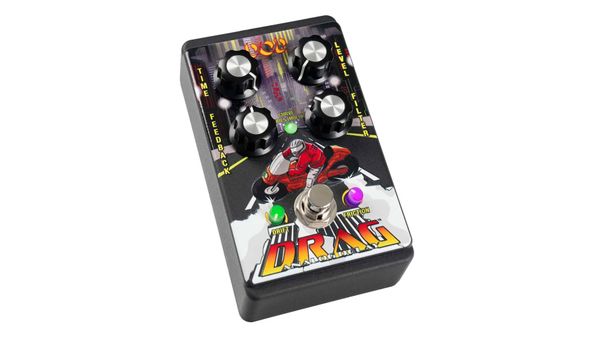
You need only read the first two pages of the DOD Drag’s palm-sized manual to glean that a sense of unfinished business went into the development of this unorthodox analog delay. In the space of those tiny pages, senior hardware engineer Parker Coons and vice president of engineering Roger Johnsen both trace the origins of the Drag back to the DOD Rubberneck—a unique modulated analog delay that Coons and Johnsen developed.
When DOD and DigiTech were resuscitated five years later, Coons and Johnsen came along for the ride, and the Drag is, in many respects, an evolution and rethink of the Rubberneck. Like the Rubberneck, the Drag can warp and stretch analog delay signals to somewhat unnatural ends. But the extra malleability in the Drag makes the Rubberneck look tame. With that expanded functionality, the Drag can be tricky to use at times. But if you can hang tight through the get-acquainted phase, you’ll find it can transform pedestrian echoes into unique shards of song and solo punctuation, food for musical cut-up collage, or subtle psychedelic shading behind your base tone.
Time Scramble
One could fill whole journals describing the sounds the Drag makes, which sometimes feel infinite. In fact, keeping an analog diary for this analog delay goes a long way toward making sense of its functions and tendencies.
The friction control is the most significant new feature. It’s helpful to think about it as a pitch control in the sense that speeding up or slowing down a tape shifts pitch. At these “de-tuned” settings, the friction function stretches the bucket brigade chain beyond its comfortable limits, which here are 60ms minimum delay time and 750ms at maximum. Manipulating echoes via the friction control introduces analog smearing that can take the shape of distortion, noise, or feedback aliasing. Abundant oddities live on the pitch-up side of the spectrum too, though they tend to be slightly less in-your-face. All of these echo profiles can be modulated by the drift control, which, via a single knob, governs modulation speed across three different depth ranges, and altering either can dramatically reshape the friction response.
If those two instruments of warpage weren’t enough, a button between the delay feedback and filter (tone) controls selects between three modes known as slidestop, rubberneck, or evade mode. Each of these modes affects the pedal’s pitch dynamics when you press and release the footswitch. And depending on where it’s set (and where the other controls are situated), you can bring the repeats to a sudden stop, generate staccato de-tuning effects, or boomerang pitch bends that de-tune, return, and pitch up beyond the original signal before returning to normal.
As you might have surmised, these pitch effects can sound a lot like a motorcycle revving, stopping, and restarting again, which is where the pedal gets its name. But depending on where you set the other controls, echoes can sound less analogous to motorbike sounds and more like massive planetary bodies colliding in slow motion. Introducing additional pedals, particularly modulation, reverb, and distortion, can transform all of these effects even more drastically. The Drag will do about a million things on its own, but experimenting with other effects—especially at the Drag’s surreal slow echo/pitch-down settings—is highly recommended. Many very big-sounding, corrupted, and ultra-hazy sonic spaces await here. I found strange crosses between tape flanging and Mu-Tron Octave Divider sounds, Jonny Greenwood Space Echo warps, and dramatic hard-stop effects that each had the potential to become hooks and defining, foundational textures. And these are just the tip of the iceberg.
The Drag will do about a million things on its own, but experimenting with other effects—especially at the Drag’s surreal slow echo/pitch-down settings—is highly recommended.
Accessorizing Options
There is one thing worth keeping in mind when considering the Drag’s $219 street price; the pedal reveals the most of its potential when used with the optional 3-button FS3X foot controller, which sets you back as much as 59 bucks. At the very least, the FS3X opens up the possibility of foot-controllable self-oscillation and tap tempo. It also offers a little extra control over the same functions activated by the Drag’s own onboard footswitch. It’s hardly mandatory. But if you do get hooked on the Drag’s possibilities, you may want to factor in the extra cost and space of the foot controller. I didn’t have one and found that the sounds made possible by the Drag on its own could be mind-boggling in number. I can also see how the Drag could become essential enough to some players that it merits the investment.
The Verdict
Though you can end up down very deep rabbit holes using the Drag, it does the basic duties of an analog delay with aplomb. It works well as a hazy thickening agent the way any good analog delay does. But it does that especially well when you add just a touch of chaos via the level knob. And while the Drag’s most radical sounds may be the primary draw, its ability to background and blend these textures into your essential tone—or for that matter a signal mutated by other pedals—is both practical and magical.
The Drag’s outer limits aren’t for everyone, and corralling and controlling them takes time. But knowing how to bend them to your will can really broaden your songwriting and studio palette. I loved how readily I could get into riffs with de-constructive, chopped personalities, and these often became creative prompts I didn’t know I needed. And while it took practice to get there, the Drag never seemed frivolous. If you can get to a shop. I’d advise playing the DOD alongside a decent, simple analog delay to see if the weirdness is worth the extra $60 to $70. But I’d guess that players that spend the extra money will realize a lot of compound return as they delve deeper into its extensive capabilities.
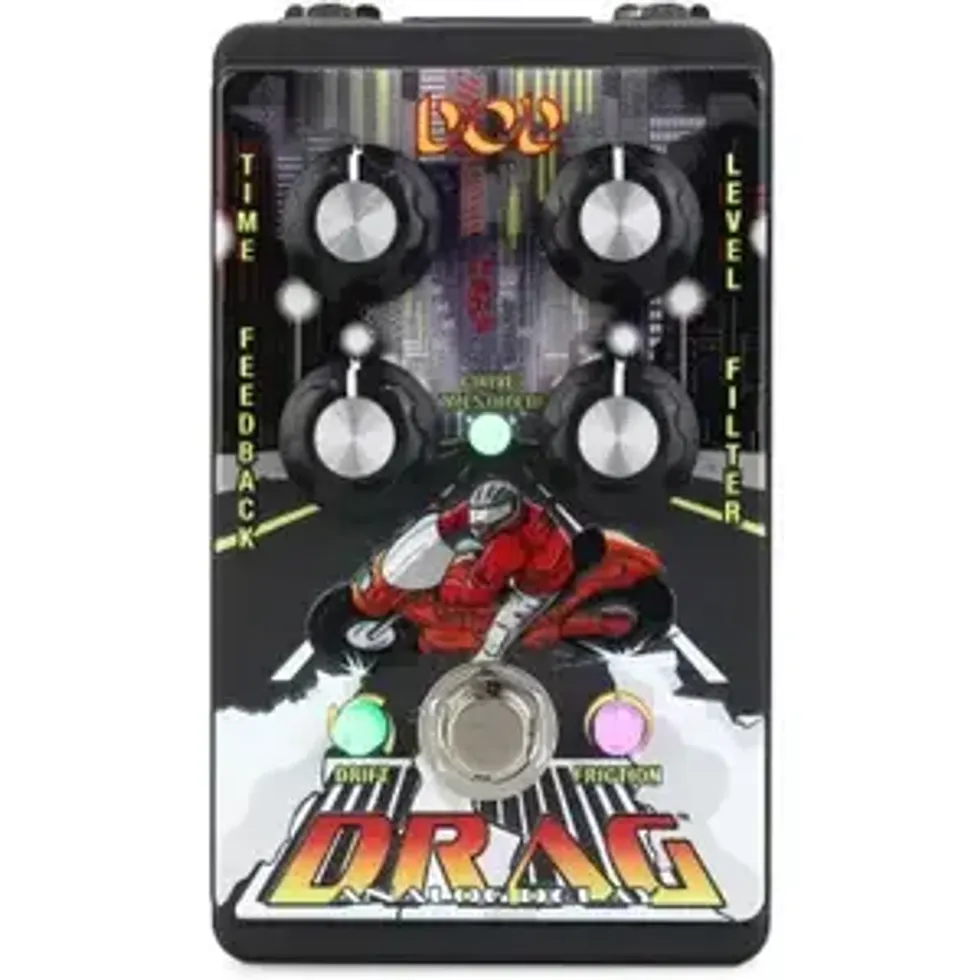
Drag Analog Delay
Analog Delay Guitar Pedal with Time, Level, Feedback, Filter, Friction, and Drift Controls, 4 Modulation Waveforms, 3 Modulation Ranges, Curve Tails, True Bypass, and FS3X Input