
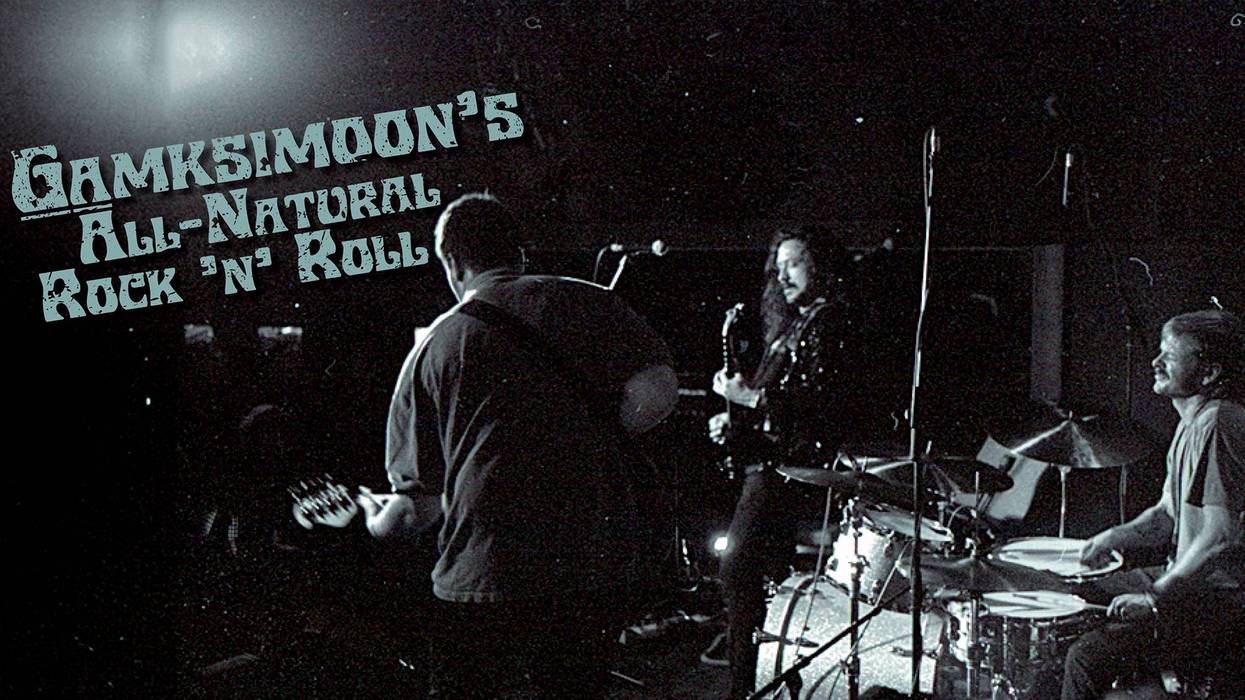

For the past decade, Gitga’at Ts’msyen musician Jeremy Pahl had been performing under the moniker Saltwater Hank, a known and beloved commodity in Canada’s blues and roots communities. A few years ago, he started yearning for something different, something heavier and harder. It was around that time that one day, mid-conversation, an elderly member of his community hit him with some blunt criticism: “You know, that name Saltwater Hank is kind of dumb.” Pahl’s friend reasoned that, since he was singing in Sm’algyax, their people’s language, he ought to have a name from the language, too. This “cousin-uncle” suggested a new name: G̱a̱mksimoon. Pronounced “gum-ksi-moan,” the word means “water spout” or “sea tornado.”
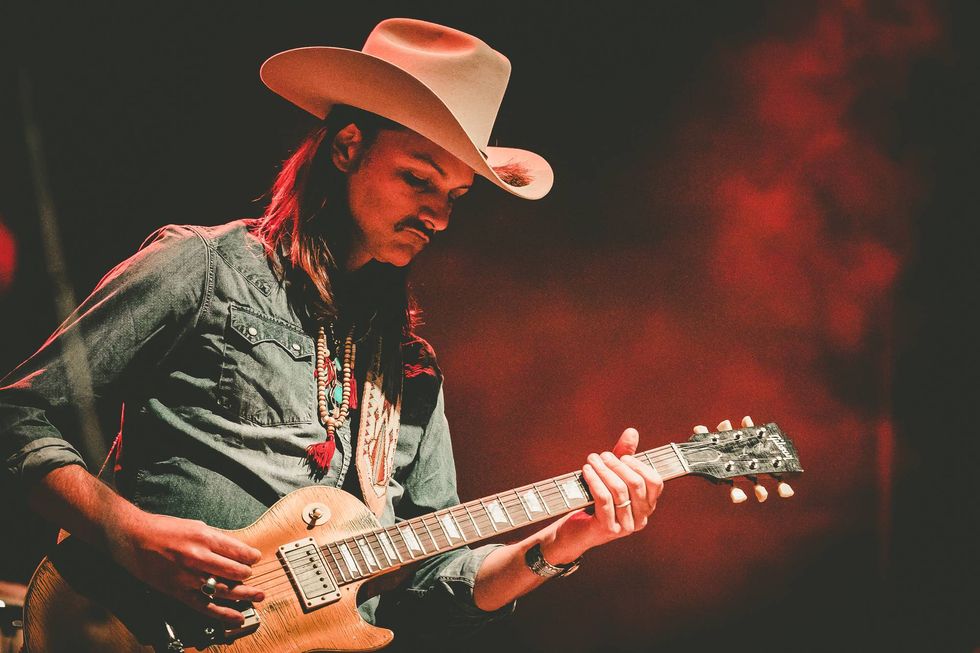
Gyiin Naxnox, G̱a̱mksimoon’s inaugural record, opens with the fantastic, mountain-moving twin powers of ancestry and rock ’n’ roll: A recording of the voice of Ts’msyen and Nisga’a anthropologist William Beynon rolls at the outset of opener “‘Wiileeksm Yee,” and Pahl’s Gibson Explorer shivers and squeals with feedback through his Orange TH30. The squalls give way to towering chords, bursting under a fuzz pedal, that soundtrack a song welcoming the salmon into the rivers of Ts’msyen territories. On “G̱awoo Üüla,” the high-flying cries of seagulls herald the voice of another Ts’msyen elder, before a gunshot cracks the scene and a monstrous, moss-covered riff stomps to the forefront. “‘Nüüm La̱xyuubit a” is a brilliant slice of methy Motorhead metal, then there’s the stoner-rock opus “Moolks,” which clocks in at over eight minutes. (The next track, a sliver of hardcore, takes all of six seconds, a nod to Napalm Death’s one-second-long “You Suffer.”) The voices of Ts’msyen elders—Darlene Leland, Velma Nelson, Theresa Lowther, and Ellen Mason—are heard across the record. They were the women who taught Pahl how to read, write, and speak Sm’algyax.
“The thing that I’m trying to convey is that the supernatural is actually just the natural.”
The record’s title—Gyiin Naxnox—means “feeding the supernatural” in English. But Pahl has a different idea about what “supernatural” means. “The thing that I’m trying to convey is that the supernatural is actually just the natural,” he says from his home in Terrace, British Columbia. Colonialism in North America fractured our relationships with the land around us, to the extent that the coincidence of certain natural events—like a certain species of bird appearing at precisely the right time to harvest berries—would scan as preternatural. “All of this stuff seems like magic, because there’s not an empirical data set that’s telling us when each of these things are happening, but with us living in the same place for thousands of years, it makes sense to us,” explains Pahl.
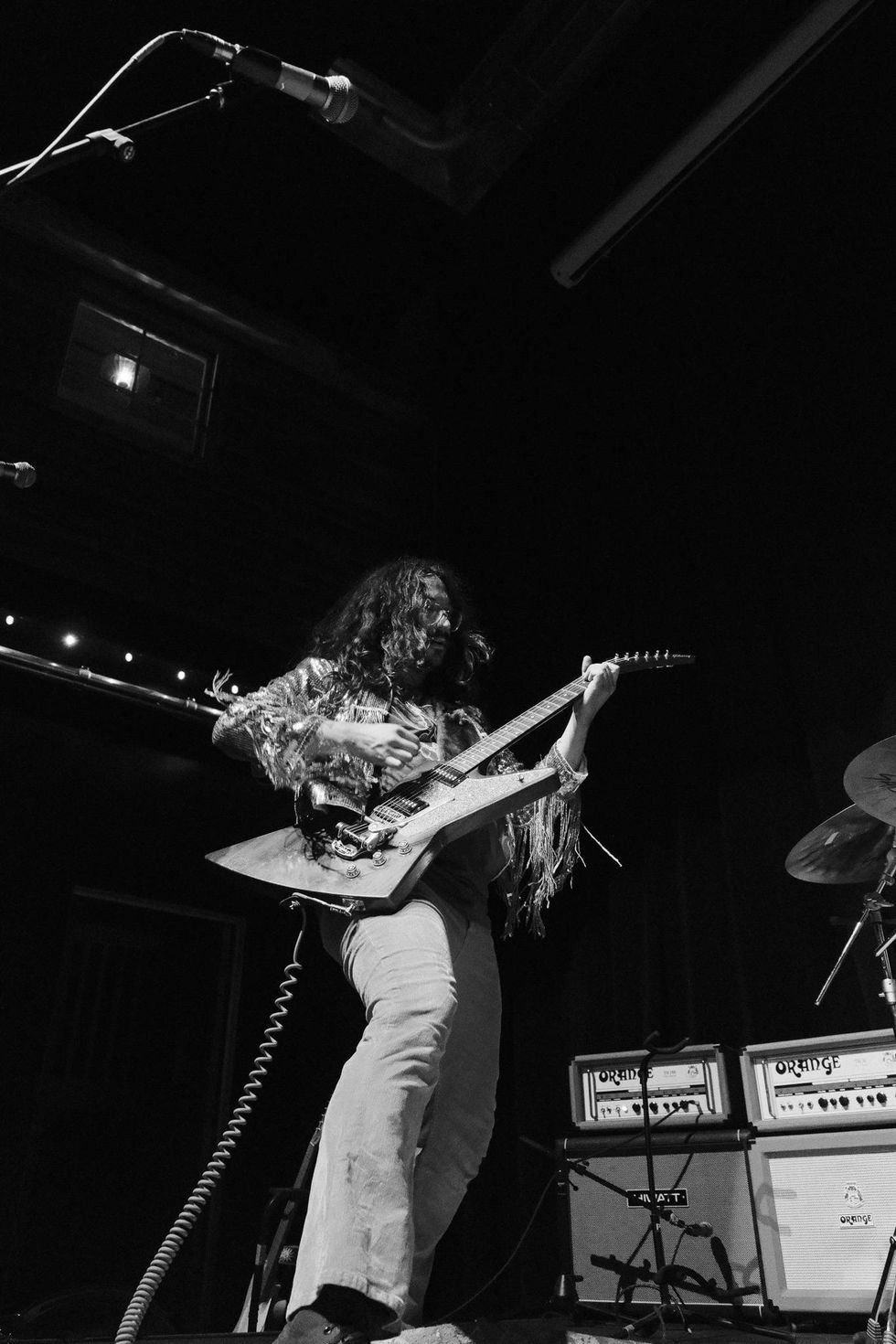
Photo by Cameron Cerant
In his teens, growing up in Chilliwack, British Columbia, Pahl was a punk-metalhead hybrid, mastering Reign in Blood for fun with an Ibanez IC400 and Peavey Bandit combo. Dimebag Darrell, Daron Malakian, Death’s Chuck Schuldiner, and Emperor’s Ihsahn were critical teachers in those years. As time went on, he was pulled to the softer sides of guitar music—bluegrass, country, and classic rock were where he made a name for himself as Saltwater Hank. And besides, bluegrass licks felt like a mirror image of death-metal shredding, but in a major key and without all the distortion.
When Pahl saw the documentary Rumble, which spotlights the contributions of Indigenous rock ’n’ rollers, he felt an itch to make heavier music again. Around that time, he was helping repatriate recordings of Ts’msyen traditional songs that had been gathering dust in museums, far from their people. “I got to hear firsthand what pre-colonial Ts’msyen music sounded like,” says Pahl. “A lot of our traditional melodies have a bluesy cadence to them already. I was like, ‘Man, this is perfectly transferable to rock ’n’ roll.”
“A lot of our traditional melodies have a bluesy cadence to them already. I was like, ‘Man, this is perfectly transferable to rock ’n’ roll.’”
Ts’msyen songs are protected under a system that Pahl describes as his nation’s own stringent reproduction and copyright laws, so he used the inspiration from them to write his own—except these were set to mammoth, hulking guitar riffs. Pahl, bassist Karl Wyssen, and drummer Danny Bell recorded live off the floor and direct to tape at Afterlife Studios in Vancouver. Looseness—a flubbed note here or there, a waver in the tempo—is part of the work. “I’m a human being, and that’s gonna be the best that I’m gonna do, and there’s nothing wrong with that, you know?” says Pahl. “To us, that just feels the best.”
Jeremy Pahl’s Gear
Guitars
2008 Gibson Explorer w/ Stonewall Pickups Slutty Wolf H90 set and added Bigsby
Amps
Orange Rocker 30
1960s Fender Bassman cab with Jensen C12 speakers
Effects
Ibanez GE 9
DOD Rubberneck analog delay
Sleep Champion Devices Horse Cult
Strings & Picks
Ernie Ball strings (.010–.046)
Dunlop Delrin 500 .96 mm picks

Gyiin Naxnox (Feeding the Supernatural) is Ts’msyen musician Jeremy Pahl’s first record under the name G̱a̱mksimoon.
Pahl used his 2008 Gibson Explorer, loaded with Stonewall Pickups’ Slutty Wolf H90 set and a Bigsby that he installed himself. Live, he plays through an Orange Rocker 30 and a vintage Fender Bassman cab with Jensen C12s, but at Afterlife, recording Gyiin Naxnox, small amps were used to produce big sounds. A vintage Magnatone combo and a ’60s Fender Vibrolux—both dimed—were recorded simultaneously; the duo is responsible for the record’s gnarliest tones, says Pahl. In addition to his go-to stomps—a Sleep Champion Devices Horse Cult, Fulltone OCD, DOD Rubberneck, and Ibanez GE 9—an EarthQuaker Devices Life Pedal tapped in for some vast, droning soundscapes. As G̱a̱mksimoon, Pahl—called Wil Uks Batsga G̱a̱laaw in Ts’msyen—is building a new musical tradition on hallowed and ancient practices. Listen to Gyiin Naxnox, and you’ll hear the bluesy, rootsy churn of “Lag̱ax Ba’wis” erupt into hypnotic, crushing doomgrass. (A shorter, folkier version of this track appeared on a 2023 Saltwater Hank record.) Read along with Pahl’s translations while you take in the proto-punk knife-fight of “K’ap Ha’yin,” and you’ll learn how the Ts’msyen living in Prince Rupert rioted in 1979 against police brutality. The melding of these two worlds—English and Sm’algyax, crushing riffs and ancestral knowledge—might seem novel to an outsider. For Pahl, it’s just natural.