
Chris Kies has degrees in Journalism and History from the University of Iowa and has been with PG dating back to his days as an intern in 2007. He's now the multimedia manager maintaining the website and social media accounts, coordinating Rig Rundown shoots (also hosting and/or filming them) and occasionally writing an artist feature. Other than that, he enjoys non-guitar-related hobbies.
Classic-rock legends Heart, led by iconic sibling duo Nancy and Ann Wilson, tore across the United States last year on the Royal Flush tour. The show touched down at the Pinnacle in Nashville on December 21, and prior to the festivities, PG’s John Bohlinger met up with lead shredder Nancy Wilson and her tech/“guitar butler” Nathan McMurdo, plus guitarists Ryan Wariner and Ryan Waters. Check out some highlights from their rigs below, and tune in to the full Rundown for more!
On the advice of a former roadie, Wilson picked up this Lake Placid blue 1963 Telecaster when she was “nouveau riche” in the early ’80s, thanks to Heart’s success. Some encourage her to leave it at home, but Wilson insists she “can’t live without it.” Its neck pickup was changed to a PAF humbucker. Most of Wilson’s electrics use D’Addario NYXL strings (.010–.046).
Here, Fishy, Fishy
After retiring a ’60s SG, Wilson now brings this early-’80s model on the road. It sees use on “Barracuda.”
Sisters’ Signature
This custom-built acoustic was brainstormed by Nancy and the folks at Martin as a signature gift for her sister, Ann. Adorned with interstellar artwork, it’s one of only two ever made—one for each sister. All of Nancy’s acoustics use Go Acoustic pickups.
Buddhist Temple
<p>Nancy’s electrics run through a Budda Superdrive 30 head, with a second on hand as a backup, and out to an Orange 412 cabinet with Celestion Gold speakers.</p>
Nancy Wilson’s Pedalboard
McMurdo handles effect changes backstage throughout the show. Nancy’s board has a Line 6 HX Stomp, T.E.A. Barracuda, Revv G2, Keeley El Rey Dorado, MXR Studio Compressor, DigiTech Drop, Revv Tilt, and a channel switch pedal for the Budda. There are also Radial Big Shot ABY and Headshot utility boxes, and an Endorphines Plus 3 expression pedal.
Classic ’Caster
Ryan Waters bought this 1972 Telecaster Thinline in a New York City guitar shop in the mid-’90s. Loaded with Lindy Fralin pickups, it’s his top pick.
Thin Lindy
This thinline Telecaster serves as a loyal backup, with the same Lindy Fralins that are in his number-one, plus a Bigsby system.
… And Don’t Call Me Dirty Shirley!
Waters’ Friedman Dirty Shirley is his main amp, with an 18-watt Marshall plexi-style head as a backup. An Orange 412 pumps out the sound.
Ryan Waters’ Pedalboard
Waters’ board includes a TC Electric PolyTune Mini, TC Electronic Sub ‘N’ Up, MXR Phase 90, Mr. Black Tremolo, Keeley Super Rodent, Revv G2, Strymon Deco, Recovery Effects Moonstruck, and a Dunlop Volume Pedal.
MI6-String
This 2014 Les Paul is from Gibson’s Collector’s Choice series, and thanks to its serial number 007, it’s earned the nickname “Bondburst.” It has a Tom Holmes bridge pickup, and comes out for “Magic Man,” as well as Led Zeppelin covers in the set. Like Wilson, he uses D’Addario NYXLs (.010–.046) and D'Addario Nickel Bronze strings on his acoustics.
Double the Fun
Wariner acquired this lightweight double-neck from Gibson when he joined up with Heart for this tour. It has a Seymour DuncanJimmy Page pickup in the bridge, and is used for a cover of Zeppelin’s “Rain Song,” as well as the title track off of 1977’s Little Queen.
Bringing Plexi Back
Wariner’s top dog is his 1973 100-watt Marshall head, modded by Dave Friedman. Another 1970 Marshall JMP head with the same mod is on deck as a spare. The heads run through a Friedman cab with a mix of Celestion Greenbacks and Vintage 30s.
Ryan Wariner’s Pedalboard
To the left of Wariner’s main board sits a smaller rig with a Peterson StoboStomp Tuner, a UAFX Heavenly, and a Grace Design ALiX Preamp. On the motherboard, there’s an Ernie Ball volume pedal, a second StroboStomp, MXR Phase 95, MXR Super Badass, DigiTech Drop, Klon clone, Pete Cornish NB-3, T.E.A. Barracuda, Analog Man GE-7, Crowther Hot Cake, Strymon Volante, EarthQuaker Devices Dispatch Master, and Strymon Cloudburst.
MGK—formerly known as Machine Gun Kelly—released his seventh studio record, Lost Americana, last August. When he took it out on tour, he hired two firebreathing fretboard masters, Justin Lyons and Sophie Lloyd, to knock his audiences dead. Ahead of their gig at Nashville’s Bridgestone Arena, PG’s Chris Kies met up with Lyons and Lloyd to get the lowdown on how they bring MGK’s music to life. Scope some of the highlights below.
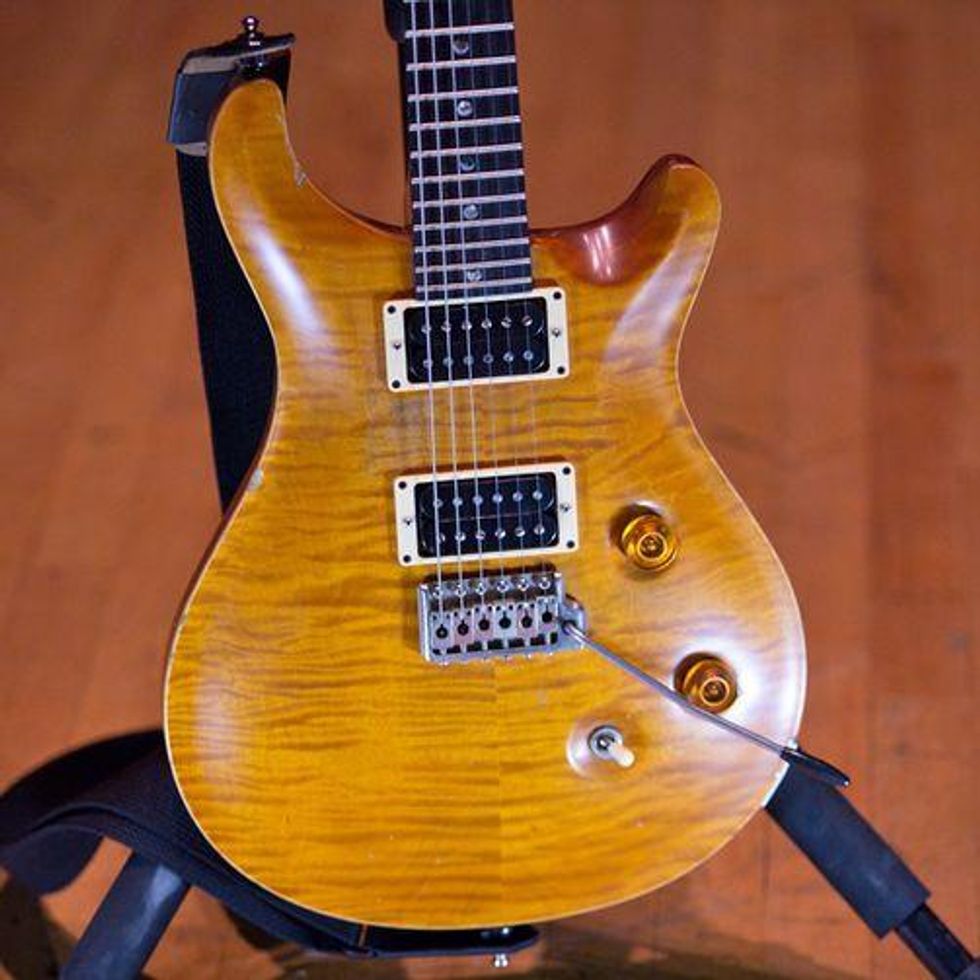
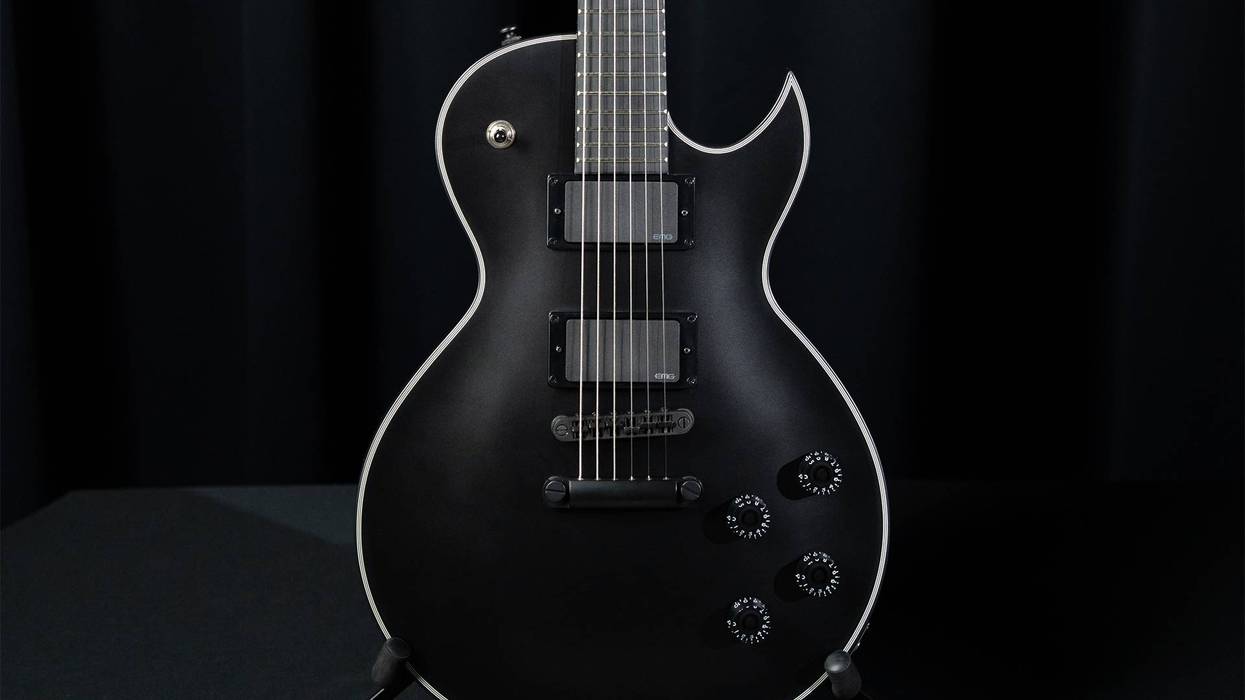
This PRS Mark Tremonti is one of Lyons’ current favorites, despite the black finish—typically, he’d never take a black guitar, but this one’s so good that it gets a pass.
Bow Down
Just before Christmas, Reverend sent over this Sensei model, along with a Roundhouse. Lyons, who’s in talks with the company to build a signature model, can’t put the Sensei down.
Justin Lyons’ Tone Master Rig
For their amp-free, in-ear monitor stage setup, Lyons loves the Fender Tone Master Pro unit, which lets him emulate his treasured Mesa/Boogie amps. Tack a TS-style boost in front and he’s in tone heaven. He also digs Mark Lettieri’s patch pack.
Kiesel Engine
Lloyd was Kiesel’s first female signature artist, and she brought a stable of them out with MGK. Lloyd’s models feature black limba bodies and walnut necks, with Kiesel Lithium pickups in the bridge position. Her signatures are unique because they include a Sustaniac in the neck position, which makes the guitar “ring out forever” and offers different octave options. Lloyd uses the kill switch on her guitars during the show for “big ending” moments. She runs her Kiesels with Ernie Ball Paradigm strings (.010–.046).
Sophie Lloyd’s Kemper Rig
<p>Back home, Lloyd likes playing through a Neural Quad Cortex, but on this tour, she’s running a Kemper Profiler like the rest of the band. She was skeptical at first that it could replicate that magic of her favorite Diezel amp, but it does the job—and then some.</p><p>The rack backstage carries the Profiler brains, plus the Radial JX42 and Shure AD4Q units that handle Lloyd’s and Lyon’s signals.</p>
When GWAR stomped through Nashville with the goriest gear of all, we had to take a look. PG’s Chris Kies caught up with the band at Marathon Music Works to hang with Grodius Maximus, Bälsäc the Jaws ’O Death, and Casey Orr (aka Beefcake the Mighty). The band rolls cab-free, armed with a stack of dangerously signature gear.
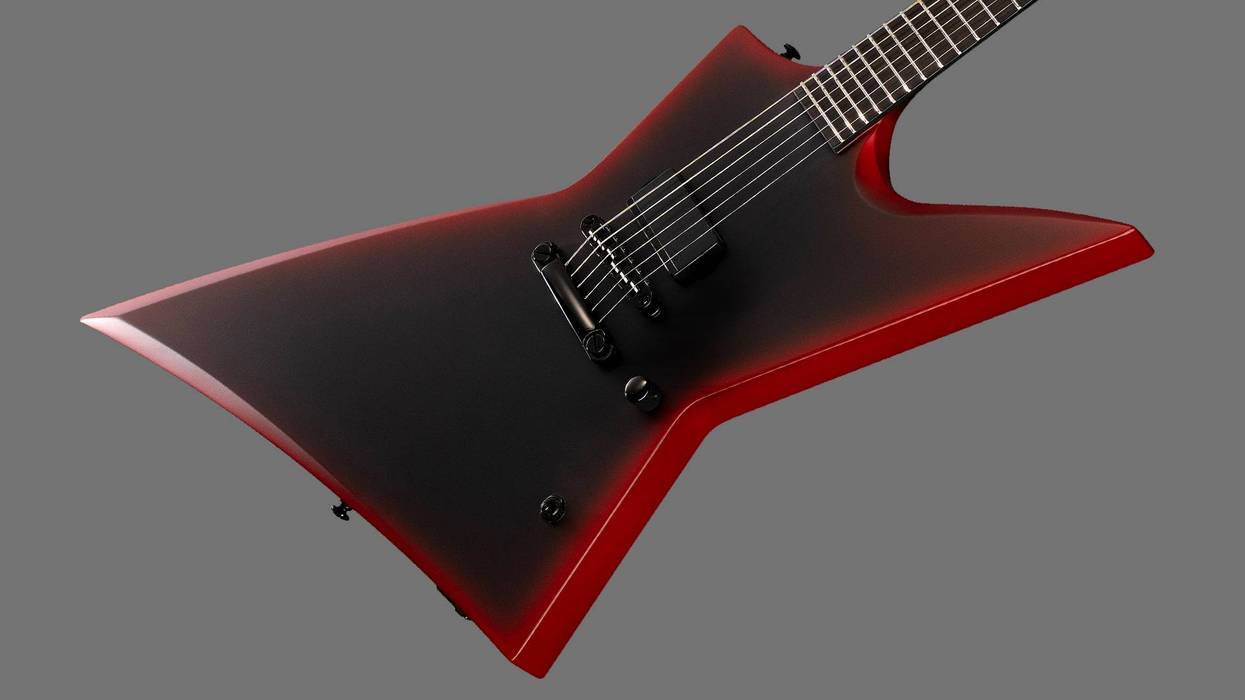
Grodius Maximus’ rig is all about spectacle, aggression, and controlled chaos—designed to sound less like a guitar and more like a “big crazy animal.” His primary instruments come from Radical Instrument Products in Salt Lake City. His go-to is pointy, pink, and equipped with a locking tremolo and a single humbucker. He also carries a gold neck-through model loaded with a pair of humbuckers and a coil tap.
Inspired by Buzz
Rounding out the guitar lineup is an Electrical Guitar Company instrument—something Grodius was turned onto by Buzz Osborne of the Melvins. That guitar features dual humbuckers and a Mastery bridge, adding a slightly more refined edge to an otherwise savage setup.
Dark Favorite
Grodius calls the Orange Dual Dark 100 his favorite amp of all time. While it’s not being used onstage for this show, its DNA is still present via a Kemper, which houses a model of the Dual Dark that anchors his core tone.
All Sorts of Nasty
Effects are where things get truly unhinged. On his rack, a Line 6 Filter Pro handles “all sorts of nasty tones,” while a lineup of Bananana Effects pedals sit in reserve, ready to be unleashed when needed. Switching duties are handled by a Voodoo Lab Guitar Audio switcher, and he also shows off a Death By Audio prototype, alongside trusted staples like the DBA Echo Dream 2 and DBA Robot.
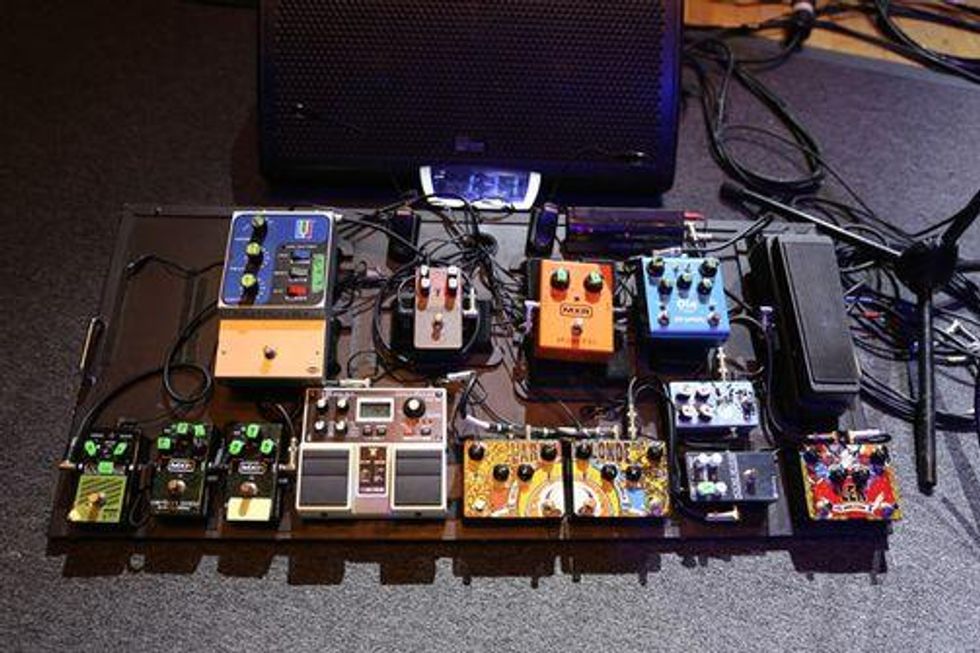
His actual pedalboard is deceptively compact but vicious: a Boss Chromatic Tuner, a Line 6 FM4 pedal, a Hotone expression pedal, DOD Gonkulator, Bananana Mandala, and an MXR Carbon Copy Bright, all powered by a Voodoo Lab supply.
Bälsäc the Jaws ’O Death - Blue Beast
Bälsäc’s rig blends modern metal precision with an openness to conventional and unconventional tools. His signature Schecter Bälsäc Blue Jaw model—soon to be released at what he jokingly calls “an exorbitant price”—is constructed using material from his actual costume. Finished in Antarctic crackle, it’s loaded with a pair of blue Fishman Fluence pickups, delivering clarity and aggression in equal measure.
Non-Metal Vibes
He also relies heavily on a Schecter PT Custom with a purple finish—a T-style guitar that initially raised eyebrows. “It’s surprising how much I love the PTs,” he admits. “It’s such a non-metal shape.” The guitar is outfitted with Fishman Fluence pickups and an Amptone XY MIDIpad, which wirelessly controls his Fractal Axe-Fx III.
Modeling Rig
The Axe-Fx handles amp modeling duties, often dialed in to a Mesa/Boogie-style sound. He also rocks the familiar purple Line 6 Filter Pro. Because Gwar performs to click tracks, all patch and effect changes are automated through Ableton, keeping everything locked tight.
Chaos via Kaoss
Bälsäc’s pedalboard is deep and experimental: a Chase Bliss Onward, Death by Audio Robot and Disemboweller, and a Meris Ottobit and Hedra. In the rack, he keeps a Korg Kaoss Pad, EarthQuaker Devices Data Corrupter, and an EHX C9 organ emulator, allowing him to blur the line between guitar, synth, and noise weapon. He even uses a Moog Theremini as an expression controller, further expanding his sonic vocabulary.
Casey Orr/Beefcake the Mighty - Slim Nikki
Handling low-end duties behind the scenes is Casey Orr, who you might better as Beefcake the Mighty. His primary instrument is the Schecter Casey Orr Beefcake Bass, which shares its electronics with the Riot 4, but features a Nikki Sixx–style body, slimmed down for comfort. The bass also sports a thinner neck, along with 24 frets, a kill switch, and a pair of EMG pickups—a combination Orr describes simply as “super comfortable.”
Backpack Rig
On the amplification side, the cornerstone of Orr’s sound is the Darkglass Alpha·Omega Ultra, which he calls the “missing link” in achieving the bass tone he’d previously been chasing—aggressive, articulate, and perfectly suited to Gwar’s controlled mayhem.
The veteran Canadian rocker and his wingman Keith Scott count on hybrid rigs and golden Gibsons for their recent tour.
Last year, Bryan Adams launched the Roll With the Punches Tour, a 40-show run across North America which marked his most significant outing in years. The production touched down at Nashville’s Bridgestone Arena in early November. That’s where Adams’ tech Craig Pattison gave PG’s John Bohlinger a backstage tour of the gear used by Adams, and guitarist Keith Scott and his tech Dan Ely detailed what’s used on the other side of the stage. Peep the highlights below, and tune into our new Rig Rundown for more!
Adams has a few of these vintage Gibson ES-295s, loaded with P-90s, and treasures their expressiveness so highly that they’ve displaced the Stratocasters he used for much of his career. The original Kluson tuners were swapped out for Waverly machines. Another 295 stays on standby.
Adams’ guitars take custom La Bella strings (.012–.014–.017–.030–.040–.050). Second guitarist Keith Scott uses the same range, except with a .018 G string.
Adams’ Acoustic
Adams’ 1954 Martin D-18 uses a Fishman Natural 1 pickup—a model that Pattinson stocked up on to ensure they never have to go without. The guitar takes a set of La Bella 7GPS Phosphor Bronze strings (.012–.052).
Bryan Adams’ Pedalboard
This simple board helps Adams navigate effects on guitar, but it also carries his bass rig when he switches to the 4-string. In addition to the Fractal FC-6 and TC Electronic Polytune, there’s an Ampeg SGT-DI, Radial SGI-TX, Universal Audio Max Preamp and Dual Compressor, and an Axess Electronics IsoFormer RCV. A Truetone CS-7 1 Spot Pro keeps the lights on.
Bryan Adams’ Rack Setup
<p>Adams’ chain runs into a massive Pete Cornish Custom Design control unit, which is the heart and soul of his sound. Among its many functions, it features an integrated tuner, distortion, and Mu-Tron effect unit. A Fractal Axe-Fx III with models of a Vox AC30 and a Marshall JTM45 has replaced his amplifiers, and the Fractal FC-6 controller on his pedalboard handles Adams’ switching.</p>
Rock ’n’ Roll Relic
Scott’s main weapon is this 1963 FenderStratocaster. As you might guess, it came by its worn look very honestly.
A Gift to Remember
This 1954 Gibson Les Paul was gifted to Scott by Adams for Christmas in 1989. Over the years, it’s been refretted, and fitted with upgraded bridge, machine heads, and nut.
Paint it Black-Panel
In addition to a backstage rack setup, Scott runs a pair of black-panel Fender Bassman heads through matching cabinets.
Keith Scott’s Rack and Effects
<p>Scott, too, runs a Fractal Axe-Fx III system, housed in a rack alongside a Dunlop DCR-2SR Custom Shop Wah rack unit and a TC Electronic D-Two delay. His main tone comes from a cranked Ibanez Tube Screamer, and other pedals include a <a href="https://www.premierguitar.com/tag/boss?utm_source=website&utm_medium=link&utm_campaign=Smartlinks">Boss</a> TR-2, Stone Deaf Noise Reaper, Darkglass Hyper Luminal, Boss CS-3, KingTone The Octaland, Ibanez AF-9, Lovetone Brown Source, Hughes & Kettner Tube Rotosphere, Subdecay Prometheus DLX, <a href="https://www.strymon.net/" target="_blank">Strymon</a> El Capistan, TC Electronic TC2290, and Boss CH-1.</p><p>An RJM Effect Gizmo and Mastermind GT help Scott navigate some switching, but tech Ely handles 80 percent of the work.</p>
America’s most beloved and immature pop-punks Blink 182 set off on their Missionary Impossible Tour last summer, and along the way, they stopped at the Orion Amphitheater in Huntsville, Alabama. That’s where PG’s Chris Kies connected with Justin Sweet, guitarist Tom DeLonge’s tech, and Brian Diaz, bassist Mark Hoppus’ tech. They took us backstage for a tour of the guitars and rack equipment that DeLonge and Hoppus brought out with them last year in this new Rig Rundown!
This Fender Tom DeLonge Starcaster, like the others in DeLonge’s arsenal, was built by Brian Thrasher for Blink’s 2023 tour, and it’s been in service ever since. It’s got a single Seymour Duncan SH-5 Duncan Custom pickup and a lone volume knob. DeLonge runs it with a set of Ernie Ball Paradigm strings (.011–.052) with a wound G.
After receiving the guitar, DeLonge asked Sweet for some gaff tape, which resulted in the stunning look and breathtaking poetry featured here.
Tom DeLonge: The Next Michaelangelo?
Within a day of receiving it, DeLonge also subjected this guitar, nicknamed “Milo,” to an aesthetic overhaul via stickers and some Louvre-worthy Sharpie work.
Tom DeLonge’s Signal Chain
DeLonge has left the Mesas, Marshalls, and Voxes behind for now and uses a Fractal Axe-FX III unit on the road. His main sound is based on a jumpered Marshall plexi amp and a Soldano X88-IR. For clean sounds, DeLonge goes for a hybrid sound of a CA3+ (Custom Audio Amplifiers 3+ SE) and a Fender Deluxe Reverb. The drive sounds are pushed through a model of a Marshall 4x12 cabinet loaded with Celestion Vintage 30s, and the cleans crank through a Vox AC-30 IR. A Rupert Neve Designs 5211 preamp helps bring the tones to life.
Changes are handled by a Fractal FC-12 backstage, and a FC-6 for DeLonge onstage.
Green Ray
Only played a few times on this tour, this Ernie Ball Music Man StingRay bass was used to record Blink’s 1999 breakout record, Enema of the State.
Take Off Your Pants and Jag-et
According to Diaz, Hoppus will message artists he likes on Instagram to ask them to paint his basses, like this commission from Ohio-based artist Burrito Breath. Nicknamed “Stoned Fruit,” this Fender Jaguar bass—now a Limited Edition signature model for Hoppus—carries Hoppus’ now-signature “reversed P” pickup configuration of a set of Seymour Duncan Quarter Pound P-bass pickups.
Mark Hoppus’ Signal Chain
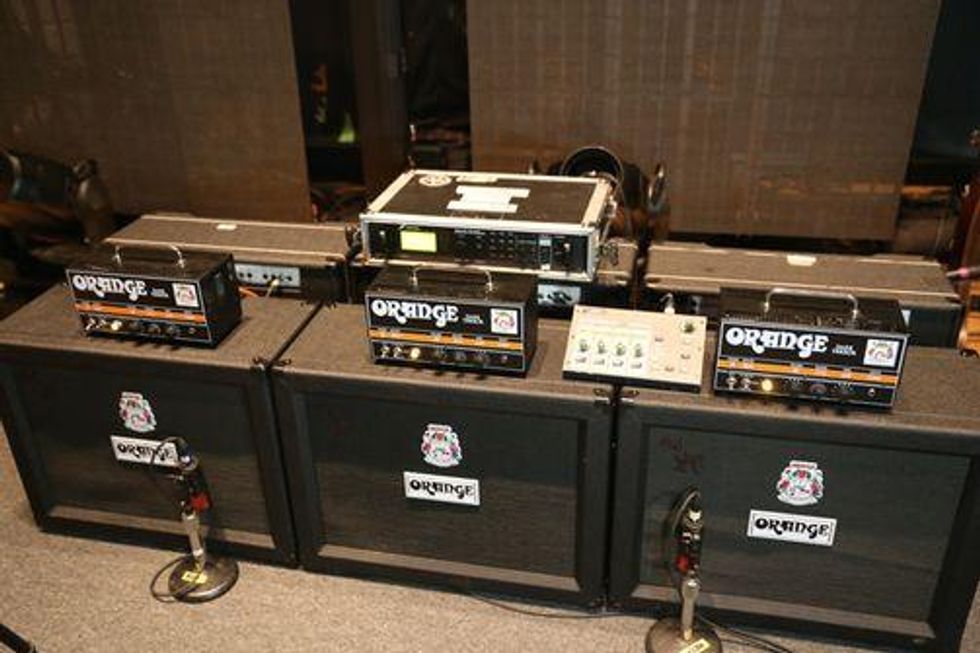
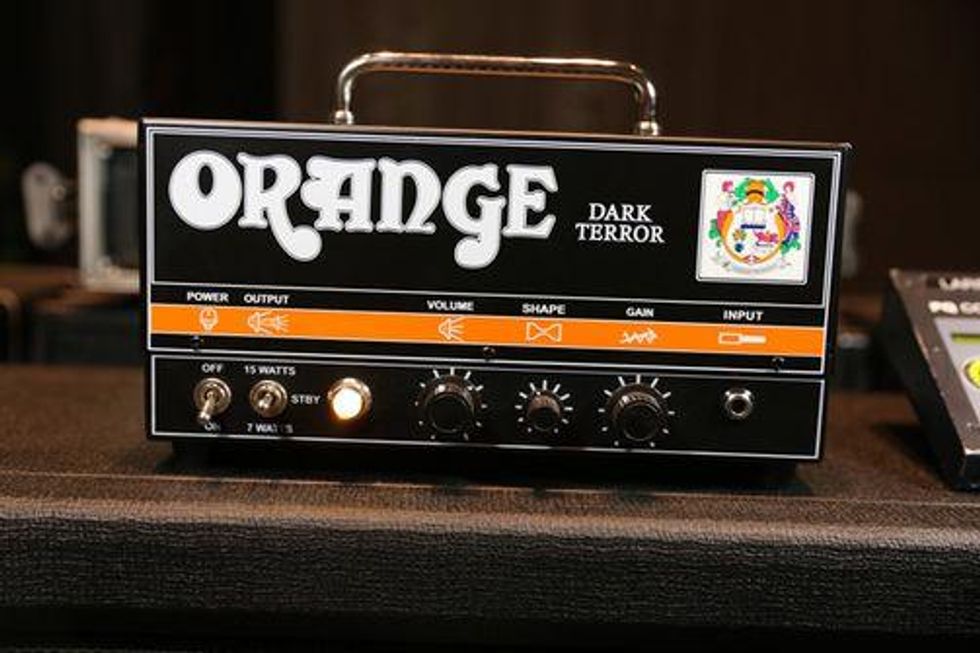
Check out Mark Hoppus’ rack! He rolls with this Neural DSP Quad Cortex unit. His main sound is based off of an Ampeg SVT, and other key modeled sounds include a Keeley Noble Screamer, an Orange Terror amp, and a JHS 424 Gain Stage.
Also in the rack are a Radial JX 44, Fretronics RSW switching system, and a Rupert Neve Designs 5211 preamp.