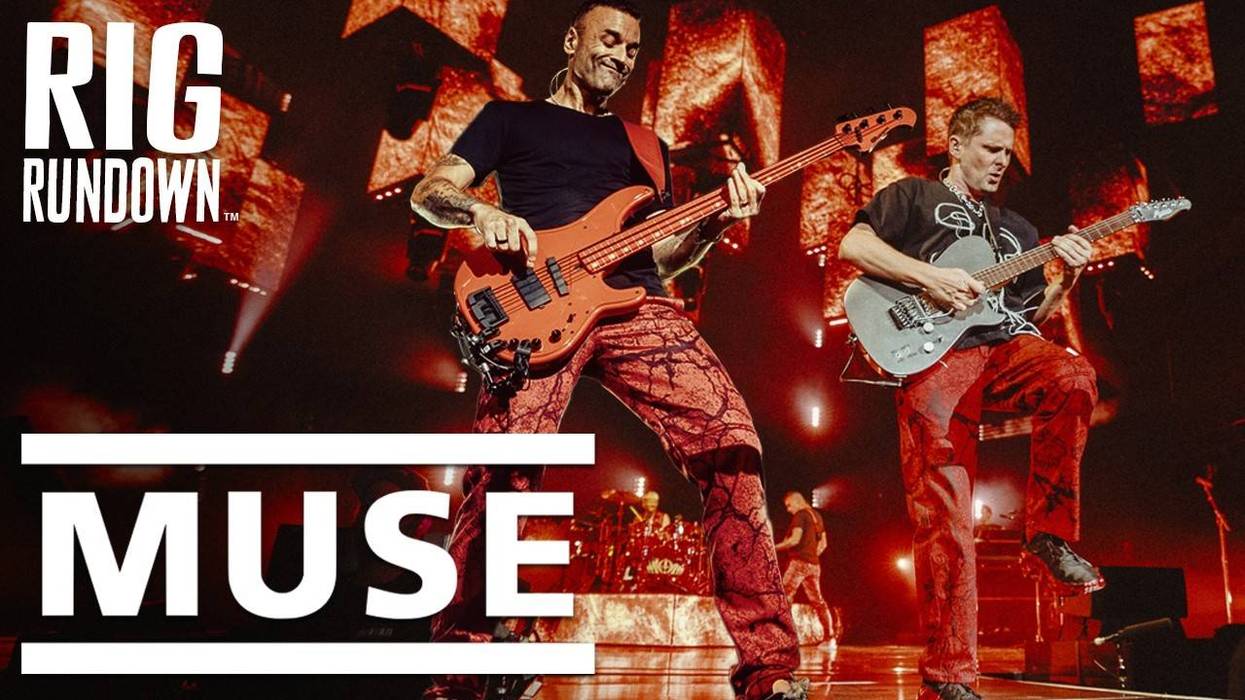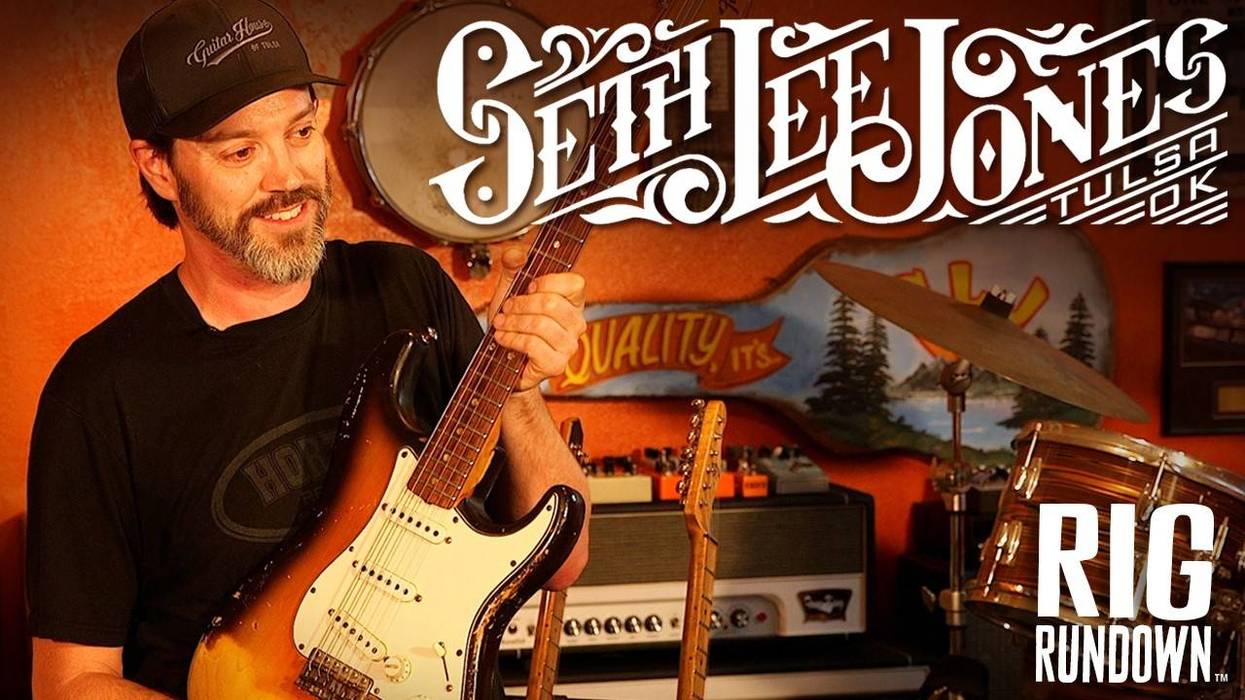

MGK—formerly known as Machine Gun Kelly—released his seventh studio record, Lost Americana, last August. When he took it out on tour, he hired two firebreathing fretboard masters, Justin Lyons and Sophie Lloyd, to knock his audiences dead. Ahead of their gig at Nashville’s Bridgestone Arena, PG’s Chris Kies met up with Lyons and Lloyd to get the lowdown on how they bring MGK’s music to life. Scope some of the highlights below.
This PRS Mark Tremonti is one of Lyons’ current favorites, despite the black finish—typically, he’d never take a black guitar, but this one’s so good that it gets a pass.
Bow Down
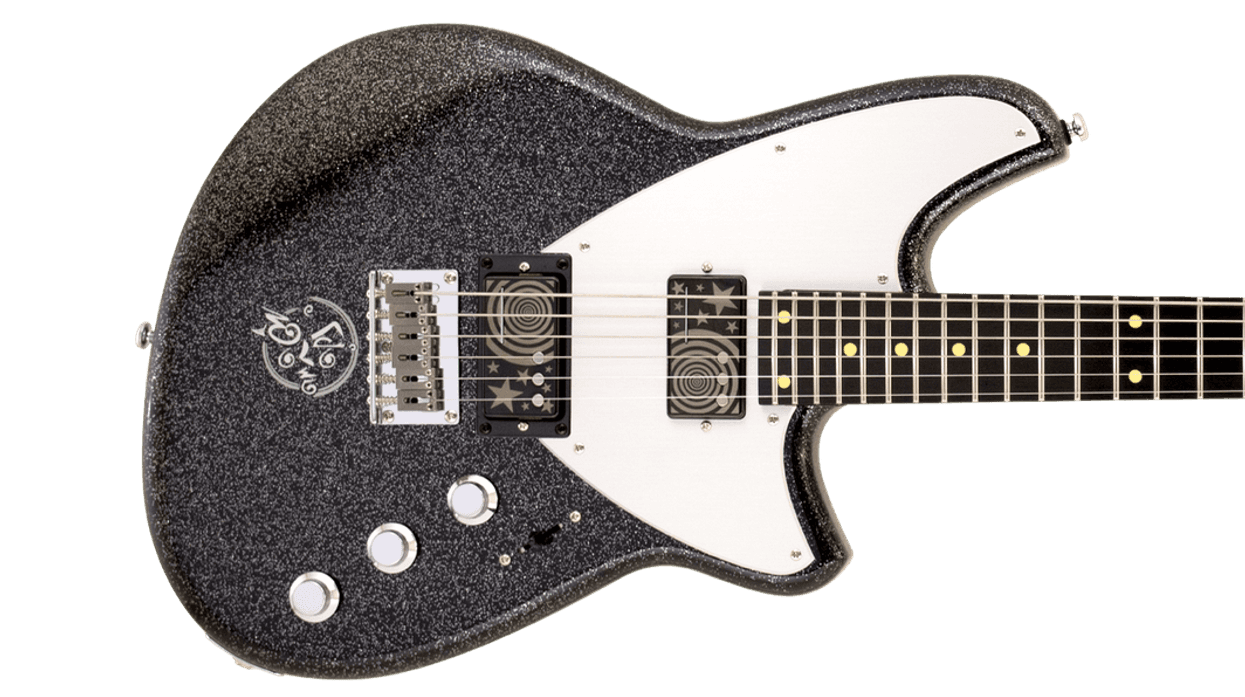
Just before Christmas, Reverend sent over this Sensei model, along with a Roundhouse. Lyons, who’s in talks with the company to build a signature model, can’t put the Sensei down.
Justin Lyons’ Tone Master Rig
For their amp-free, in-ear monitor stage setup, Lyons loves the Fender Tone Master Pro unit, which lets him emulate his treasured Mesa/Boogie amps. Tack a TS-style boost in front and he’s in tone heaven. He also digs Mark Lettieri’s patch pack.
Kiesel Engine
Lloyd was Kiesel’s first female signature artist, and she brought a stable of them out with MGK. Lloyd’s models feature black limba bodies and walnut necks, with Kiesel Lithium pickups in the bridge position. Her signatures are unique because they include a Sustaniac in the neck position, which makes the guitar “ring out forever” and offers different octave options. Lloyd uses the kill switch on her guitars during the show for “big ending” moments. She runs her Kiesels with Ernie Ball Paradigm strings (.010–.046).
Sophie Lloyd’s Kemper Rig
<p>Back home, Lloyd likes playing through a Neural Quad Cortex, but on this tour, she’s running a Kemper Profiler like the rest of the band. She was skeptical at first that it could replicate that magic of her favorite Diezel amp, but it does the job—and then some.</p><p>The rack backstage carries the Profiler brains, plus the Radial JX42 and Shure AD4Q units that handle Lloyd’s and Lyon’s signals.</p>
Ever wondered how Billy Corgan achieves that massive "chainsaw" fuzz tone that defined an era of alternative rock? In this edition of "Blueprints", PG contributor Tom Butwin dives deep into the gear that makes it possible, featuring the Reverend Billy Corgan Z-One with its unique Bass Contour control, the Electro-Harmonix Op-Amp Big Muff Pi for that essential seventies-style grind, and the Gosh Amplification Problem Solver to provide a classic Marshall-style foundation.
This is it — the granddaddy of Pedalboard series. The MONO Pedalboard Large is a pro-sized and -featured pedal solution that won't weigh you down in size or cost. The Pedalboard Large is cut from a single piece of anodized aluminum for superior strength, light weight, and an elegant textured surface. Cutouts along the surface hide pedal jumpers and power cables for a streamlined, professional look. Rubber feet on the bottom absorb shock and prevent the Pedalboard Large from sliding across hard surfaces as you stomp
Dave and Tom were so excited about this episode with Mr Big and Racer X guitarist Paul Gilbert that they almost fainted right before taping, leaving a very unamused Cindy to host it alone. It takes a lot to fluster an Axe Lord, but the prospect of talking to Paul Gilbert about designing his Fireman guitars, getting a guided tour through his collection of vintage Ibanez treasures, and finding out how to properly rig a power drill for speed picking is almost more than any fan of highly technical guitar wizardry could stand.
Gilbert, who is promoting his rifftastic new concept album WROC - based on the George Washington-penned tome Washington’s Rules of Civility, is also the first, but hopefully not the last, Axe Lords guest to introduce cosplay to the show. To whit, he appears sporting a revolutionary war-styled Tricorn hat, the perfect accessory for schooling us not just in arcane bits of American history but also in the finer points of high-stakes shred protocol.
Axe Lords is presented in partnership with Premier Guitar. Hosted by Dave Hill, Cindy Hulej and Tom Beaujour. Produced by Studio Kairos. Executive Producer is Kirsten Cluthe. Edited by Justin Thomas (Revoice Media). Engineered by Patrick Samaha. Recorded at Kensaltown East. Artwork by Mark Dowd. Theme music by Valley Lodge.
Follow @axelordspod for updates, news, and cool stuff.
When GWAR stomped through Nashville with the goriest gear of all, we had to take a look. PG’s Chris Kies caught up with the band at Marathon Music Works to hang with Grodius Maximus, Bälsäc the Jaws ’O Death, and Casey Orr (aka Beefcake the Mighty). The band rolls cab-free, armed with a stack of dangerously signature gear.
Grodius Maximus’ rig is all about spectacle, aggression, and controlled chaos—designed to sound less like a guitar and more like a “big crazy animal.” His primary instruments come from Radical Instrument Products in Salt Lake City. His go-to is pointy, pink, and equipped with a locking tremolo and a single humbucker. He also carries a gold neck-through model loaded with a pair of humbuckers and a coil tap.
Inspired by Buzz
Rounding out the guitar lineup is an Electrical Guitar Company instrument—something Grodius was turned onto by Buzz Osborne of the Melvins. That guitar features dual humbuckers and a Mastery bridge, adding a slightly more refined edge to an otherwise savage setup.
Dark Favorite
Grodius calls the Orange Dual Dark 100 his favorite amp of all time. While it’s not being used onstage for this show, its DNA is still present via a Kemper, which houses a model of the Dual Dark that anchors his core tone.
All Sorts of Nasty
Effects are where things get truly unhinged. On his rack, a Line 6 Filter Pro handles “all sorts of nasty tones,” while a lineup of Bananana Effects pedals sit in reserve, ready to be unleashed when needed. Switching duties are handled by a Voodoo Lab Guitar Audio switcher, and he also shows off a Death By Audio prototype, alongside trusted staples like the DBA Echo Dream 2 and DBA Robot.
His actual pedalboard is deceptively compact but vicious: a Boss Chromatic Tuner, a Line 6 FM4 pedal, a Hotone expression pedal, DOD Gonkulator, Bananana Mandala, and an MXR Carbon Copy Bright, all powered by a Voodoo Lab supply.
Bälsäc the Jaws ’O Death - Blue Beast
Bälsäc’s rig blends modern metal precision with an openness to conventional and unconventional tools. His signature Schecter Bälsäc Blue Jaw model—soon to be released at what he jokingly calls “an exorbitant price”—is constructed using material from his actual costume. Finished in Antarctic crackle, it’s loaded with a pair of blue Fishman Fluence pickups, delivering clarity and aggression in equal measure.
Non-Metal Vibes
He also relies heavily on a Schecter PT Custom with a purple finish—a T-style guitar that initially raised eyebrows. “It’s surprising how much I love the PTs,” he admits. “It’s such a non-metal shape.” The guitar is outfitted with Fishman Fluence pickups and an Amptone XY MIDIpad, which wirelessly controls his Fractal Axe-Fx III.
Modeling Rig
The Axe-Fx handles amp modeling duties, often dialed in to a Mesa/Boogie-style sound. He also rocks the familiar purple Line 6 Filter Pro. Because Gwar performs to click tracks, all patch and effect changes are automated through Ableton, keeping everything locked tight.
Chaos via Kaoss
Bälsäc’s pedalboard is deep and experimental: a Chase Bliss Onward, Death by Audio Robot and Disemboweller, and a Meris Ottobit and Hedra. In the rack, he keeps a Korg Kaoss Pad, EarthQuaker Devices Data Corrupter, and an EHX C9 organ emulator, allowing him to blur the line between guitar, synth, and noise weapon. He even uses a Moog Theremini as an expression controller, further expanding his sonic vocabulary.
Casey Orr/Beefcake the Mighty - Slim Nikki
Handling low-end duties behind the scenes is Casey Orr, who you might better as Beefcake the Mighty. His primary instrument is the Schecter Casey Orr Beefcake Bass, which shares its electronics with the Riot 4, but features a Nikki Sixx–style body, slimmed down for comfort. The bass also sports a thinner neck, along with 24 frets, a kill switch, and a pair of EMG pickups—a combination Orr describes simply as “super comfortable.”
Backpack Rig
On the amplification side, the cornerstone of Orr’s sound is the Darkglass Alpha·Omega Ultra, which he calls the “missing link” in achieving the bass tone he’d previously been chasing—aggressive, articulate, and perfectly suited to Gwar’s controlled mayhem.
John Bohlinger chats with Sacha Dunable about the new Minotaur DE, available in iterations with EMG 81/85 pickups and with passive Cthulhu pickups. Also showcased: the Will Putney signature Cyclops with built-in Electro-Harmonix Pitch Fork pedal and single EMG 81, plus new custom shop seven-string models across all Dunable platforms with in-house pickups and Hipshot hardware.
Dunable
Minotaur DE
SCALE LENGTH: 25.5"
NECK PROFILE: 1.65" nut width, .81" thick at 1st, .89" at 12th, Medium "C" profile